
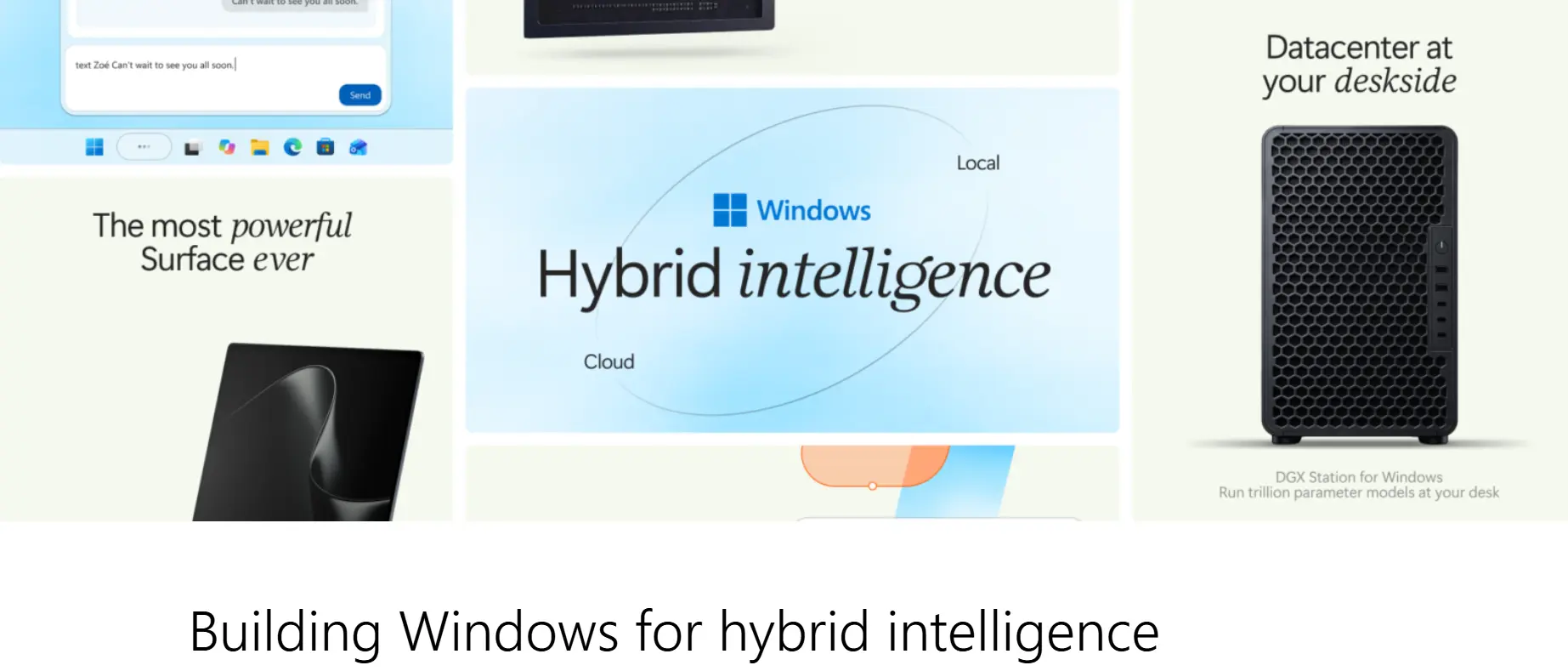
Microsoft is expanding Windows into a platform for hybrid intelligence, combining local AI models, cloud-based inference and AI agents that can perform actions directly on a PC. The company announced the new Windows strategy on October 7, positioning the operating system as a place where AI workloads can run locally when appropriate or move to the cloud when more computing power is needed.
The approach is designed to give users and organizations more control over where AI workloads run while potentially reducing cloud usage, improving responsiveness and keeping sensitive information closer to the device.
Quick Summary
- Microsoft is expanding Windows hybrid intelligence to combine local and cloud AI.
- AI agents will be able to perform more tasks directly on Windows PCs.
- MAI Code 1.1 Flash can run locally on compatible high-memory Windows hardware.
- GitHub Copilot is being extended to intelligently route workloads between local and cloud models.
- Microsoft Execution Containers (MXC) provide sandboxing and permission controls for AI agent execution.
- New hardware, including RTX-based systems, is being positioned for demanding local AI workloads.
- Several capabilities are rolling out gradually, so not every announced feature is immediately available.
What Is Windows Hybrid Intelligence?
Microsoft’s hybrid intelligence approach combines three elements: local models, local PC context and local actions, with cloud AI available when a task requires additional capability.
On compatible Copilot+ PCs, Microsoft’s Copilot will eventually be able to access relevant files and recent activity on the device, perform certain actions across Windows and use models running locally. Users will have permission controls over these capabilities.
This means an AI task does not necessarily have to send all of its processing to a remote cloud service. Windows can instead determine when local computing is suitable and when cloud intelligence is more appropriate.
Microsoft says hybrid intelligence is intended to make AI tokens go further while maintaining access to more capable cloud models when necessary.
MAI-Code-1.1-Flash Comes to Local PCs
One of the key developments is Microsoft’s move to bring MAI Code 1.1 Flash to local Windows hardware.
The coding model has 137 billion total parameters, with 6.8 billion active parameters. Microsoft says it can run locally using 3-bit precision, reducing the model’s size by nearly 80% while maintaining coding performance and supporting a 256K context window.
Microsoft is also bringing other large models to local hardware, including an upcoming NVIDIA Nemotron model with more than 70 billion parameters and DeepSeek V4 Flash, a 284-billion-parameter model.
The goal is to make increasingly capable AI models available directly on PCs without requiring every inference to be handled by cloud infrastructure.
Read More - MAI-Transcribe-2-Streaming: Microsoft Launches AI Voice Models
GitHub Copilot Gets Local Model Routing
Microsoft is also extending hybrid intelligence into developer workflows through GitHub Copilot.
GitHub’s HydraFusion system, which previously routed tasks between cloud models, is being extended to work with models running locally on Windows. This allows Copilot to determine whether a task should use on-device intelligence or cloud-scale computing.
Microsoft says the hybrid intelligence experience powered by HydraFusion is expected to enter experimental preview later in October for the GitHub Copilot app, GitHub Copilot CLI and Visual Studio Code.
For developers, this could make local models more practical for coding, experimentation and other workloads while reserving cloud inference for tasks that need it.
Microsoft Adds Security Controls for AI Agents
Running AI agents locally also introduces a security challenge because agents can potentially access files, execute code and interact with other systems.
Microsoft is addressing this through Microsoft Execution Containers (MXC), which are now generally available on Windows 11. MXC allows organizations to define which files and networks an agent can access, with those policies enforced during execution.
The system supports different isolation mechanisms, including process and session isolation, WSL, virtual machines and Windows 365 for Agents.
Microsoft says several AI tools already support MXC, including OpenAI Codex, GitHub Copilot, Replit, LM Studio and NVIDIA OpenShell.
This gives Windows a security layer specifically designed around the way modern AI agents operate rather than treating them simply as traditional applications.
New Windows PCs Are Built for Local AI
Microsoft is also introducing hardware aimed at running larger AI models locally.
The Surface Laptop Ultra, built around NVIDIA RTX Spark, offers up to 128GB of unified memory and is designed to run AI models exceeding 120 billion parameters locally. Microsoft opened pre-orders on October 7, with availability beginning October 16.
Microsoft is also working with ASUS, Dell, HP, Lenovo and MSI on Windows PCs powered by RTX Spark.
At the higher end, Microsoft says Windows systems based on NVIDIA DGX Station will be able to run models exceeding one trillion parameters locally, bringing significantly more AI computing capability to desktops and workstations.
What Windows Hybrid Intelligence Means?
Microsoft’s strategy represents a broader shift in how it sees the Windows PC. Instead of treating AI as something that primarily runs in the cloud, Windows is being developed as a platform where local and cloud intelligence work together.
For users, that could mean faster responses, greater control over sensitive data and more AI capabilities available without sending every task to a remote server. For developers, local models and agent security controls could make it easier to build and test AI-powered applications directly on Windows.
Microsoft says hybrid-intelligence features for Copilot+ PCs are expected to begin rolling out over the coming months.
Also Read –
Microsoft Copilot Cowork: AI Agent That Automates Work in Microsoft 365
Microsoft Copilot Checkout: In-App Payments with Stripe & PayPal
Microsoft Copilot: GPT-5.2, Smart Plus and AI Evolution
Source
Building Windows for hybrid intelligence
Bringing local models and sandboxed tools to Windows and GitHub Copilot