
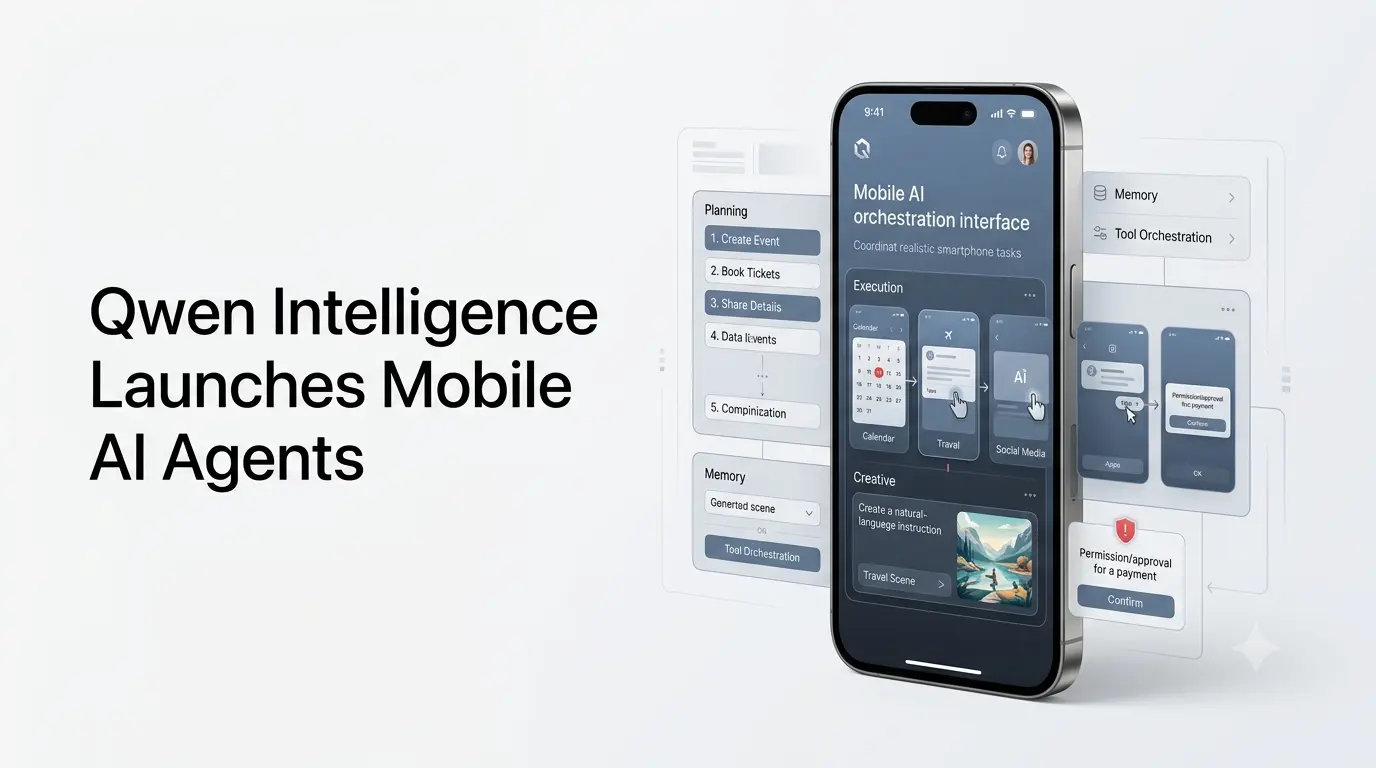
Alibaba’s Qwen team has introduced Qwen Intelligence, a mobile-focused AI platform designed to help smartphone manufacturers build agents that can plan complex tasks, operate apps and create content. The solution was unveiled on September 22, 2026, with three initial agent systems covering mobile planning, mobile use and creative generation.
Unlike a conventional smartphone chatbot, Qwen Intelligence is positioned as a full-stack mobile AI solution rather than a standalone assistant app. It combines Qwen models with agent infrastructure, mobile tools, memory, device-cloud coordination and safety controls, allowing manufacturers to integrate different components into their own products.
The launch also introduces a set of benchmarks intended to measure how well AI agents perform on complex smartphone tasks, including planning, cross-application execution, real-device operation and safety.
What Is Qwen Intelligence?
Qwen Intelligence is aimed primarily at smartphone manufacturers and ecosystem partners, rather than being another general-purpose Qwen model for consumers.
The platform provides modular components that manufacturers can adapt to their own devices and software environments. According to reporting around the launch, those components can include different model backends, agent harnesses, device-cloud coordination, platform operations and security capabilities. Manufacturers can also connect their own tools and skills.
That approach reflects a broader shift in mobile AI from answering questions toward executing multi-step tasks.
Alibaba has already been moving in this direction with the Qwen app, which gained agentic capabilities for tasks involving services such as shopping, travel and other real-world workflows earlier in 2026. Qwen Intelligence takes that concept closer to the operating-system and device layer by giving phone makers infrastructure for building their own mobile agents.
Quick Summary
- Qwen Intelligence is a new mobile-focused AI-agent platform from Qwen/Alibaba.
- It launches with three specialized agents: Mobile Planner, Mobile-Use and Mobile Creative.
- The Mobile Planner Agent handles complex task decomposition and orchestration.
- The Mobile-Use Agent can execute smartphone tasks using APIs with GUI interaction as a fallback.
- The Mobile Creative Agent focuses on AI-powered content creation.
- Qwen is also opening benchmarks covering planning, cross-app execution, real-device performance and safety.
- The development moves Qwen further toward agentic AI that can perform tasks on smartphones, rather than simply answering questions.
Three AI Agents Target Different Smartphone Tasks
Qwen Intelligence launches with three specialized systems.
1. Mobile Planner Agent
The Mobile Planner Agent is responsible for understanding a user’s goal, breaking it into smaller steps and coordinating the tools required to complete the task.
For a complex request, the planner can determine the sequence of actions rather than treating every interaction as an isolated command. Qwen’s MobilePA-Bench is specifically designed to test this type of capability across tool use, memory, skills and sub-agent collaboration.
Qwen says its Mobile Planner Agent ranks first on MobilePA-Bench as well as the benchmark’s Business and Memory variants. Those are company-reported benchmark results and should be understood within the specific evaluation methodology rather than as a universal ranking across all mobile agents.
The underlying challenge is significant because smartphone tasks are often stateful. App data changes after each action, permissions can interrupt a workflow, and users may leave important details unspecified. MobilePA-Bench was created specifically to evaluate these kinds of multi-step, real-world planning problems.
2. Mobile-Use Agent
The Mobile-Use Agent is responsible for actually performing actions on a phone.
Its architecture follows an API-first, GUI-fallback approach. When a suitable interface is available, the agent can use APIs, MCP or DeepLink-style mechanisms rather than simulating every tap on the screen. When an application does not expose an appropriate interface, the system can fall back to visual understanding and graphical-user-interface interaction.
Qwen reports scores of 82.1% on MobileWorld, 92.2% on MobileWorld-Real and 97.2% on AndroidDaily, alongside a reported 90% end-to-end success rate in its real-world testing. The official Qwen-UI-Agent materials independently document the 82.1% and 92.2% results, while the current project page reports 97.5% on AndroidDaily for Qwen-UI-Agent, so benchmark labels and versions should be checked carefully when comparing these figures.
MobileWorld itself evaluates 201 tasks across 20 applications, including long-horizon and cross-app workflows. Its tasks average 27.8 completion steps, and 62.2% involve multiple applications, making it substantially different from simple single-app GUI benchmarks.
Safety is also built into the mobile execution approach. Sensitive actions such as payments or deleting information can require user confirmation rather than allowing the agent to complete the operation autonomously.
3. Mobile Creative Agent
The third component, Mobile Creative Agent, targets smartphone-based content creation.
The system is designed to interpret a natural-language request and turn it into a structured creative workflow. Qwen says its image-generation process has been reduced from 100 steps to eight through model distillation and reinforcement learning, with first-image generation taking about three seconds in its reported testing. The company describes that as roughly twice as fast as leading competing approaches.
The technical work behind Qwen’s broader image-generation research includes experiments on pixel-space diffusion models. One Qwen-affiliated paper reports that a latent-to-pixel training strategy produced 3.18× to 4.75× end-to-end inference speedups in its experimental setup, although that research result should not be treated as a direct benchmark of every Qwen Intelligence creative workflow.
Qwen Opens a Mobile AI Benchmark Suite
One of the more significant parts of the announcement is the release of a broader evaluation framework.
Qwen is opening four benchmark projects:
| Benchmark | Primary focus |
|---|---|
| MobilePA-Bench | Complex task planning and orchestration |
| MobileWorld | Cross-application mobile-agent execution |
| MobileWorld-Real | Agent performance on physical Android devices |
| MobileWorld-Safety | Safety behavior during mobile-agent tasks |
MobileWorld already provides a public benchmark covering GUI-only, user-interaction and MCP-augmented tasks. The real-device work is intended to address the gap between simulated mobile environments and what happens on actual phones.
Qwen’s Qwen-UI-Agent project reports that its real-device evaluation uses more than 100 physical smartphones and more than 150 applications for task construction, trajectory collection, training and evaluation.
This matters because mobile agents face constraints that are difficult to reproduce in conventional benchmark environments: changing application states, permissions, network conditions, account information and unpredictable UI layouts.
Qwen Intelligence Is Already Moving Toward Phones
The platform is not being presented solely as a research project.
Alibaba has been working with HONOR on integrating Qwen Intelligence with MagicOS, and reports around the announcement identify the upcoming Magic9 series as an early commercial implementation. HONOR’s Robot Phone is also reported as supporting the solution.
Alibaba says the joint solution achieved 91.8% overall task accuracy, 3.6-second GUI operation speed and a 90% end-to-end service completion rate in its reported testing. It also says the system can handle complex workflows involving more than 100 operations. These figures are vendor-reported rather than independent industry measurements.
The broader direction is consistent with Alibaba’s existing AI strategy. The company has increasingly focused on agentic systems that connect models to real-world services and tools rather than limiting them to conversational responses.
Why Qwen Intelligence Matters for Mobile AI?
The main significance of Qwen Intelligence is its attempt to treat the smartphone as an agent execution environment, not simply as a screen for an AI chatbot.
A useful mobile agent needs to understand intent, create a plan, interact with multiple applications, deal with changing state and know when a user must approve an action. Qwen’s architecture separates several of those responsibilities across specialized agents and supporting infrastructure.
The benchmark strategy is equally important. Mobile agents can look impressive in demonstrations while struggling with long-running, cross-application tasks on real devices. Benchmarks such as MobileWorld and MobileWorld-Real provide more specific ways to measure those limitations.
Qwen Intelligence therefore represents both a product platform and an attempt to establish a broader evaluation layer for mobile AI agents.
For users, the eventual impact will depend on how smartphone manufacturers integrate these capabilities, how reliably agents operate across real applications, and how safety controls are implemented around sensitive actions. For developers and researchers, the newly expanded benchmark ecosystem provides another way to evaluate whether mobile agents can move beyond demonstrations toward dependable, multi-step execution.
Also Read –
Qwen 4 Enters Training as Alibaba Plans 5–10 Trillion Parameter Models
Qwen3-Coder-Next: Agent-Centric Coding Model for Developers
Source
Qwen Intelligence official website
Qwen-UI-Agent technical report
MobilePA-Bench official project
MobileWorld official benchmark
Qwen-UI-Agent GitHub repository
Alibaba Group – Qwen App agentic AI strategy
Qwen-affiliated image-generation research paper