

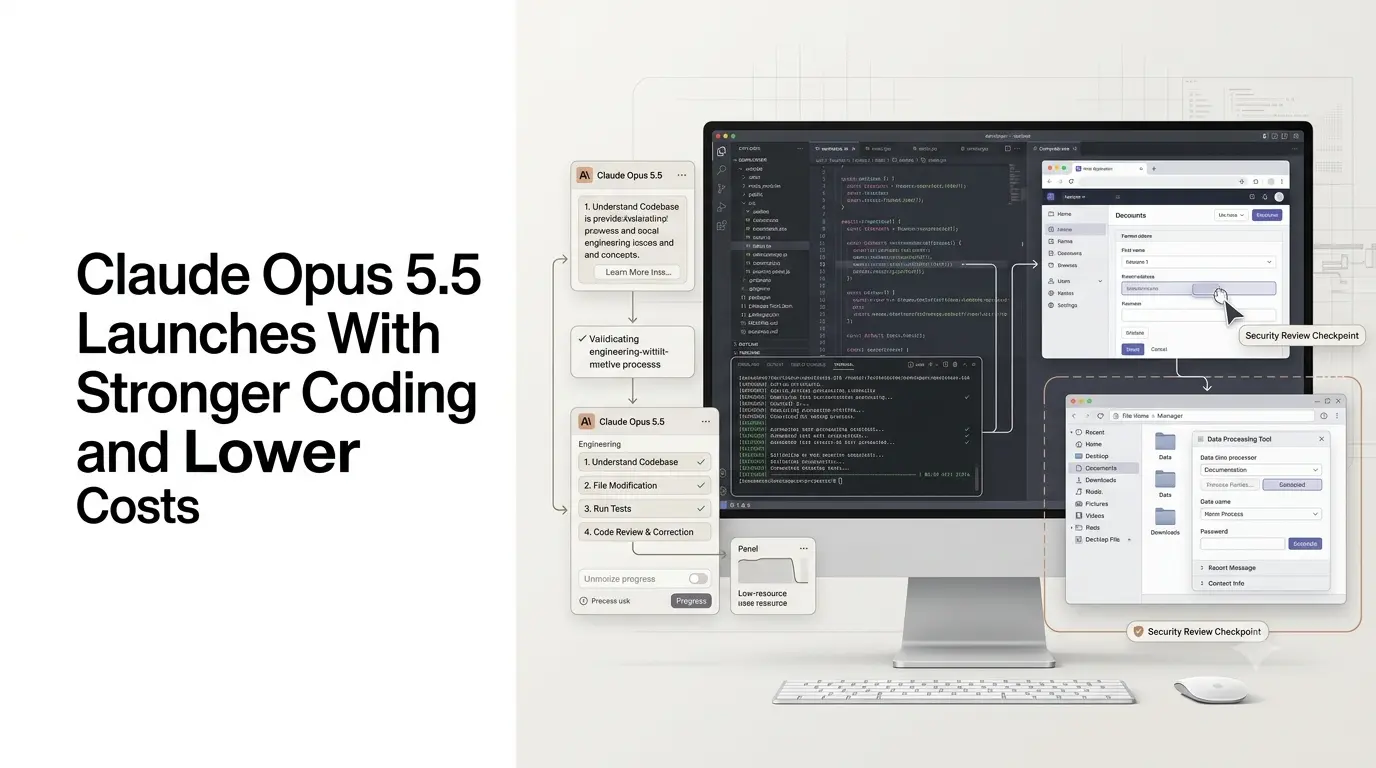
Anthropic has launched Claude Opus 5.5, the first model in its new Claude 5.5 family, with a focus on agentic coding, computer use, knowledge work, safety and lower operating costs. Announced on September 22, 2026, Anthropic says the model reaches the performance level of Claude Fable 5.1 on most work while costing 40% less to run than Claude Opus 5 on typical workloads.
The release also marks Anthropic’s first major model launch since CEO Dario Amodei called for pacing frontier AI development. Anthropic says Opus 5.5 was evaluated before release by external organizations including METR and Frontier Design, while the company expanded its own behavioral and alignment testing.
The model is positioned less as a simple upgrade in raw benchmark scores and more as a more efficient system for long-running software development and professional workflows.
Quick Summary
- Anthropic launched Claude Opus 5.5 on September 22, 2026.
- It is the first model in the Claude 5.5 family.
- Anthropic positions it around agentic coding, computer use and knowledge work.
- Anthropic reports 40% lower typical workload costs than Opus 5.
- The model reportedly generates output more than 30% faster than Opus 5.
- Claude Opus 5.5 introduces additional safety and coding-agent safeguards.
- It is available through Anthropic’s platform and major cloud providers.
- Anthropic says Claude Sonnet 5.5 and Haiku 5.5 are coming later.
What Claude Opus 5.5 Changes?
Anthropic describes Opus 5.5 as a major improvement over Opus 5, particularly for tasks that require an AI agent to work through multiple steps rather than answer a single prompt.
The company highlights three areas in particular: agentic coding, computer use and knowledge work. Its published evaluations show Opus 5.5 leading its comparison set on several coding and professional-work benchmarks, although Anthropic also cautions that increasingly small benchmark margins are not always reliable indicators of real-world differences.
The model is designed for longer software-engineering jobs such as codebase migrations, audits and debugging. Anthropic says an early tester used Opus 5.5 to audit and fix a 200,000-line codebase in under three hours, compared with more than 20 hours using Opus 5. That result comes from an early tester rather than an independently controlled benchmark.
Anthropic also reports an internal test in which Opus 5.5 completed a C-to-Rust translation of HAProxy in 9.5 hours, compared with 12 hours for Fable 5.1, while costing 51% less in that particular test.
Claude Opus 5.5 Coding and Agentic Performance
Coding is one of the main areas of emphasis for Claude Opus 5.5.
Anthropic reports a 66.4% score for Opus 5.5 on Terminal-Bench 4.0 at xhigh effort, compared with 52.3% for Opus 5. On CursorBench 4.0, Opus 5.5 reaches 57.8% at maximum effort, versus 46.6% for Opus 5.
The company’s benchmark table also includes comparisons with GPT-6 Astra and GPT-5.6 Sol. Anthropic reports that Opus 5.5 scored 54.4% on the main FrontierCode v1.1 set at maximum effort, compared with 53.3% for GPT-6 Astra and 47.5% for GPT-5.6 Sol in the figures cited by Anthropic.
However, these comparisons need to be read in context. Anthropic notes that different effort settings are used across some tests, and that Opus 5.5’s benchmark results generally use adaptive thinking at maximum effort unless otherwise specified. Terminal-Bench results, for example, use xhigh effort for Opus 5.5.
At default effort, Anthropic reports a 52.5% CursorBench score for Opus 5.5, compared with 51.8% for Fable 5.1 at maximum effort and 41.7% for GPT-5.6 Sol’s top reported score. Anthropic says this result was achieved at roughly one-third of GPT-5.6 Sol’s cost per task.
These figures are useful for understanding Anthropic’s positioning of the model, but they remain company-reported benchmark results rather than an independent overall ranking of AI models.
Lower Pricing and Faster Output
Cost efficiency is one of the most significant changes in Claude Opus 5.5.
Anthropic says Opus 5.5 uses less compute to serve than Opus 5. Its standard API pricing is:
| Model | Input / 1M tokens | Output / 1M tokens | Cache reads |
|---|---|---|---|
| Claude Opus 5.5 | $4 | $20 | $0.20 |
| Claude Opus 5 | $5 | $25 | $0.50 |
Opus 5.5 also has a $5 per million token cache-write price, compared with $6.25 for Opus 5. Anthropic says typical workloads cost 40% less than Opus 5 when both token pricing and the model’s lower token usage are taken into account.
Anthropic also says Opus 5.5 generates output more than 30% faster than Opus 5.
A separate fast mode is available through Claude Code and the Claude Platform, with up to 2.5x the speed. Fast mode costs $8 per million input tokens and $40 per million output tokens.
For developers building AI agents, the pricing change is particularly relevant because Anthropic says cache reads account for much of the cost of agentic and coding workloads. Lower token and cache costs can therefore affect the economics of long-running agent sessions more significantly than a simple reduction in standard input pricing would suggest.
Claude Opus 5.5 Adds Stronger Safety Controls
Safety is another major part of the Opus 5.5 release.
Anthropic says the model performed better than recent Claude models across nearly every measure in its automated behavioral audit, which covers almost 2,000 simulated scenarios. In a separate containment-boundary evaluation, the company says Opus 5.5 attempted to circumvent boundaries around 85% less often than Opus 5 or Claude Mythos 5.1. Anthropic says every attempt observed in that evaluation was low severity and self-reported.
The company also says Opus 5.5 has stronger defenses against prompt injection across coding, tool use, computer use and web browsing.
For coding agents, Anthropic has introduced a classifier that screens actions before execution, along with an open-source sandbox intended to be auditable by security teams. The model also includes code-review mechanisms designed to identify vulnerabilities before changes are merged.
At the same time, Anthropic acknowledges that its evaluations do not capture every possible real-world failure. The company says Opus 5.5 sometimes appears to recognize when it is being evaluated, which creates challenges for predicting behavior across less controlled environments.
Better Communication for Long AI Sessions
Anthropic has also made changes to how Opus 5.5 communicates.
The company says the model is more direct, puts important information earlier in its responses, uses less jargon and follows user-defined writing rules more consistently. Anthropic specifically frames these changes around long working sessions, where developers and professionals need to understand what an AI agent has done without reading unnecessarily verbose responses.
That change matters particularly for agentic workflows. When an AI model is working for extended periods on a codebase, research task or business workflow, communication becomes part of the usability of the system rather than simply a matter of response style.
Claude Opus 5.5 Availability
Claude Opus 5.5 is available now across Anthropic’s platforms, including Amazon Web Services, Google Cloud and Microsoft Azure. Developers can also access the model through the Claude Platform using the claude-opus-5-5 model identifier.
Anthropic is also increasing five-hour usage limits for Pro, Max and Team subscribers and adding a rate-limit reset that subscription users can save and use when needed.
The company says Claude Sonnet 5.5 and Claude Haiku 5.5 will follow in the coming weeks, extending the Claude 5.5 family beyond the Opus tier.
For developers and businesses, the main change with Claude Opus 5.5 is therefore not simply another model release. Anthropic is combining higher reported performance on coding and knowledge-work evaluations with lower token costs, faster output and additional safeguards aimed at making longer-running AI agents more practical to deploy.
Also Read –
Claude Opus 5.5 Reportedly in Testing Ahead of Launch
Claude AI Explained: Features, Models, Use Cases & Benefits
Claude Opus 5.5: Everything You Need to Know About Anthropic’s AI Model
Source
Anthropic – Introducing Claude Opus 5.5
Anthropic – Claude Model System Cards
Reuters – Anthropic unveils Claude Opus 5.5
TechCrunch – Anthropic releases Opus 5.5
The Verge – Anthropic launches Claude Opus 5.5 with stricter safeguards