

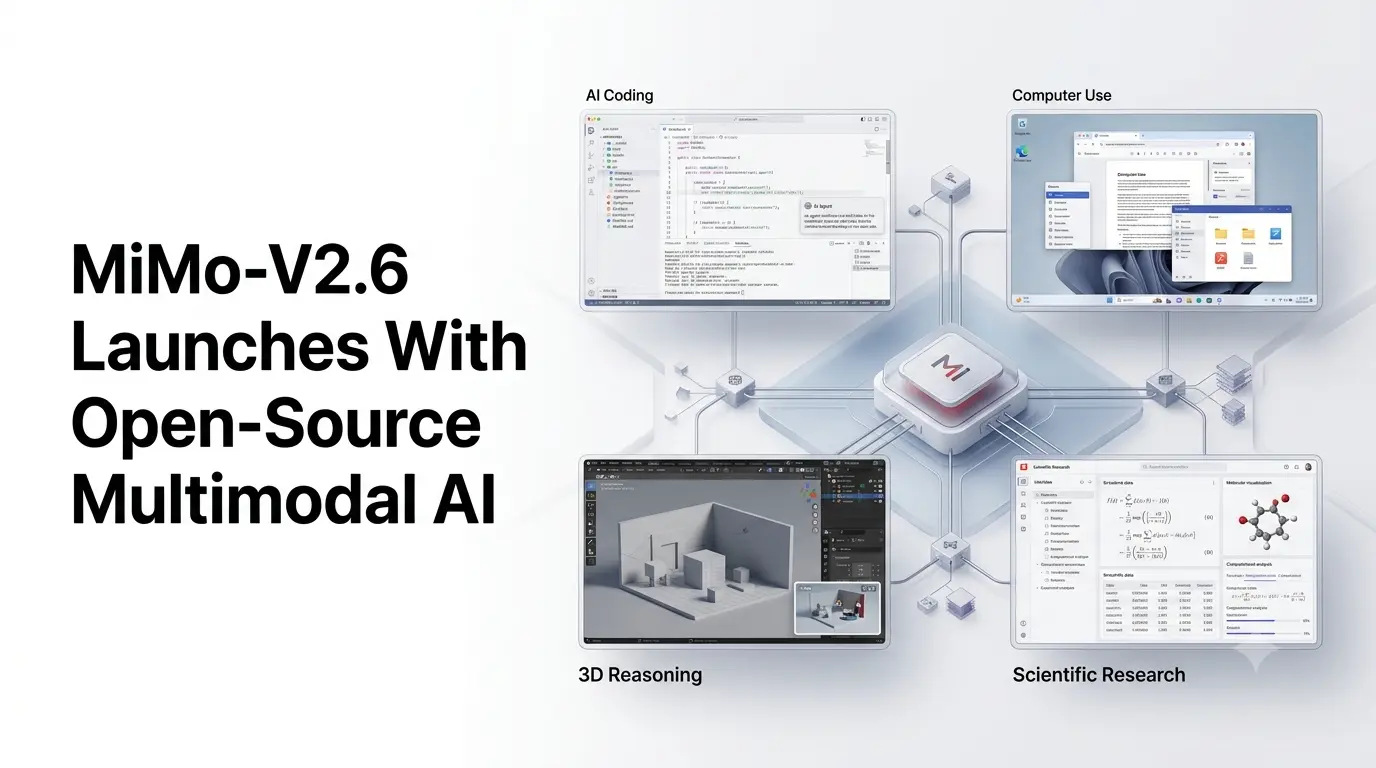
Xiaomi has released MiMo-V2.6, the next generation of open-source AI models built around multimodal reasoning, agentic workflows and large-scale reinforcement learning. The release includes MiMo-V2.6-Pro and MiMo-V2.6-Flash, alongside a faster MiMo-V2.6-Pro-UltraSpeed mode designed for latency-sensitive applications.
Xiaomi published the release on September 22, 2026, and makes the model, technical report, reinforcement-learning code and training environments available publicly. The company says MiMo-V2.6 represents its latest effort to scale reinforcement learning across complex, verifiable tasks rather than relying primarily on conventional supervised training.
The release also keeps API pricing at the same levels as the previous MiMo-V2.5 generation, while expanding the models’ capabilities across coding, computer use, visual reasoning, 3D creation, design and research workflows.
Quick Summary
- MiMo-V2.6 is Xiaomi’s new generation of open-source multimodal AI models.
- The release includes MiMo-V2.6-Pro and MiMo-V2.6-Flash.
- Xiaomi emphasizes large-scale reinforcement learning and agentic task execution.
- The models support coding, computer use, 3D reasoning, design and research workflows.
- Xiaomi is releasing model weights, technical materials and 7,000+ RL environments.
- API pricing remains unchanged from MiMo-V2.5.
- MiMo-V2.6-Pro UltraSpeed is offered for latency-sensitive workflows with Xiaomi claiming up to 20× faster generation.
- Xiaomi also launched MiMo Desktop alongside the new models.
What Is MiMo V2.6?
MiMo-V2.6 is a family of natively multimodal Xiaomi models. The Pro version is positioned for more demanding reasoning, coding and agentic workloads, while Flash is designed around a balance between intelligence, efficiency and cost.
The models can work across multiple input modes and are designed to interact with external tools and environments. Xiaomi’s demonstrations have extended beyond conventional chatbot use, showing the models performing software engineering, browser and computer interaction, 3D modeling, presentation creation and other multi-step tasks.
Xiaomi is also releasing a distilled MiMo-V2.6-Distill-Qwen-9B model. The company’s Hugging Face release lists the main Pro and Flash checkpoints alongside the distillated model. It provides the materials required for local experimentation and deployment.
MiMo-V2.6 Uses Large-Scale Reinforcement Learning
MiMo-V2.6 release is central to Xiaomi’s approach to scaling reinforcement learning.
Xiaomi says the Pro and Flash training runs each completed 30 reinforcement-learning steps in less than six days, processing approximately 750,000 trajectories. Xiaomi reports training costs of $2.62 million for the Pro and $850,000 for the Flash.
The company says the training process improved the average pass rate on its training tasks by 12% for Pro and 25% for Flash in relative terms. On the held-out DeepSWE v1.1 software-engineering benchmark, Xiaomi reports that the scores increased from 58.4 to 72.57 for Pro and from 48.8 to 65.68 for Flash during the RL runs.
Xiaomi also says it uses larger asynchronous batches, more diverse environments, and an additional grader computation. The training suite covers coding, general agents, visual tasks and cybersecurity-related environments.
An extremely significant part of the release is that Xiaomi publishes the infrastructure behind this work. The company says researchers can access its technical report, RL code and training environments to reproduce and examine the approach.
MiMo-V2.6-Pro Score: 46.32 on the Artificial Analyse Index
Xiaomi reports that MiMo-V2.6-Pro scored 46.32 on the Artificial Analysis Intelligence Index v4.3, which the company says makes it the highest-scoring open-source model in that September 2026 comparison.
That result places MiMo-V2.6-Pro ahead of Kimi K3 and Qwen3.8 Max in the open-model comparison cited by Xiaomi. The distinction is very significant: the 46.32 figure refers specifically to the Artificial Analysis Intelligence Index, rather than representing a universal measurement of AI capability.
Xiaomi also reports that MiMo-V2.6-Pro performs on par with Claude Opus 5 and GPT-5.6 Sol across most of the agent benchmarks it selected. The underlying benchmark table shows a more mixed picture, with MiMo-V2.6-Pro leading on some tests, trailing on others and matching competitors on some tasks.
For example, Xiaomi’s released results list MiMo-V2.6-Pro at 71.9 on DeepSWE v1.1, compared with 74.0 for Claude Opus 5 and 73.0 for GPT-5.6 Sol. On AutomationBench, however, Pro scored 53.1, compared with 50.3 for Claude Opus 5 and 45.8 for GPT-5.6 Sol.
That makes benchmark results more useful when treated as a collection of task-specific measurements rather than a single overall ranking.
From Coding to 3D Worlds and Computer Use
One of the more distinctive parts of MiMo-V2.6 is Xiaomi’s emphasis on “Vibe World.”
The model can take text, images or video and coordinate multiple agents to create 3D scenes. It can also implement interaction logic and visually inspect the generated results. Xiaomi says the system can then refine those environments based on what it observes.
The same approach can be applied to Blender. MiMo-V2.6 can generate 3D objects and scenes from textual descriptions or reference images, with Xiaomi demonstrating potential applications in animation, 3D printing and game development.
The company also demonstrated an embodiment simulation. MiMo-V2.6 can process multiple camera views and control a simulated Franka Panda robotic arm through visual feedback for tasks such as grasping, color matching and object placement.
These demonstrations show the model being used as an agent that combines perception, reasoning, coding and tool interaction. This is rather than simply generating text in response to a prompt.
MiMo-V2.6 Expands Into Design and Creative Work
Xiaomi also positions MiMo-V2.6 as a multimodal production system.
The company demonstrated the model by creating front-end interfaces and presentation decks from simple instructions. It can work with Figma and image- and video-generation tools while coordinating typography, layouts, components and visual assets.
Video production is another workflow shown in the demonstration. Xiaomi said MiMo-V2.6 can handle visual design, shot sequencing, motion, music composition and editing, with narration generated using MiMo-V2.5-TTS.
The model can also generate musical compositions. In one Xiaomi demonstration, the MiMo-V2.6-Pro created an orchestral score for approximately ten instruments and converted the result to MIDI.
These examples are company demonstrations rather than independent evaluations of professional creative quality. However, they illustrate the broader direction of the MiMo-V2.6 system: combining reasoning with external tools to complete multi-stage creative tasks.
MiMo V2.6 Is Being Tested As A Research Assistant
Xiaomi also presented two research-oriented demonstrations.
In materials research, MiMo-V2.6-Pro worked with Xiaomi researchers on metal-organic frameworks designed to absorb PFAS compounds. The model searched literature and patents, generated hypotheses, assessed candidate materials and used computational tools to screen proposed structures before potential wet-lab validation.
In mathematics, the model assisted researchers with a Lean 4 formalization of the main theorem from Li and Yorke’s “Period Three Implies Chaos.” Xiaomi says the resulting project contains more than 6,000 lines of Lean code and was verified by Lean’s kernel without unfinished proof placeholders.
These examples should be interpreted as research case studies rather than evidence that MiMo-V2.6 can independently conduct scientific research. They demonstrate how the model combines reasoning, coding, web research and specialized tools under human direction.
MiMo-V2.6 Pricing and Availability
MiMo-V2.6-Pro and MiMo-V2.6-Flash are available through Xiaomi’s AI Studio, MiMo Code, MiMo Desktop, the MiMo API Platform and OpenRouter.
Xiaomi says API API pricing remains unchanged from V2.5:
| Model | Cache-hit input | Cache-miss input | Output |
|---|---|---|---|
| MiMo-V2.6-Flash | $0.0028/M tokens | $0.14/M | $0.28/M |
| MiMo-V2.6-Pro | $0.0036/M tokens | $0.435/M | $0.87/M |
| MiMo-V2.6-Pro-UltraSpeed | $0.036/M tokens | $4.35/M | $8.70/M |
The UltraSpeed version is designed for applications where response latency matters. Xiaomi says it can deliver up to 20 times the output speed of the standard MiMo-V2.6-Pro while maintaining the same quality.
MiMo Desktop is also moving out of early access with the MiMo-V2.6 release. Xiaomi’s desktop product supports workflows involving documents, slides, spreadsheets, scheduling, files, browser interaction and computer control. It also integrates the updated MiMo models into the application.
MiMo-V2.6 includes much more than a conventional model refresh. Xiaomi combines open model weights with a publicly released reinforcement-learning stack, multimodal capabilities and agentic tools designed to operate across software, visual and physical simulation environments. The MiMo-V2.6 release gives developers and researchers access to the models themselves but also to parts of the infrastructure Xiaomi uses to train and evaluate them.
Also Read –
MiMo-V2-Flash VibeCoding Upgrade: Thinking Mode an Free API