

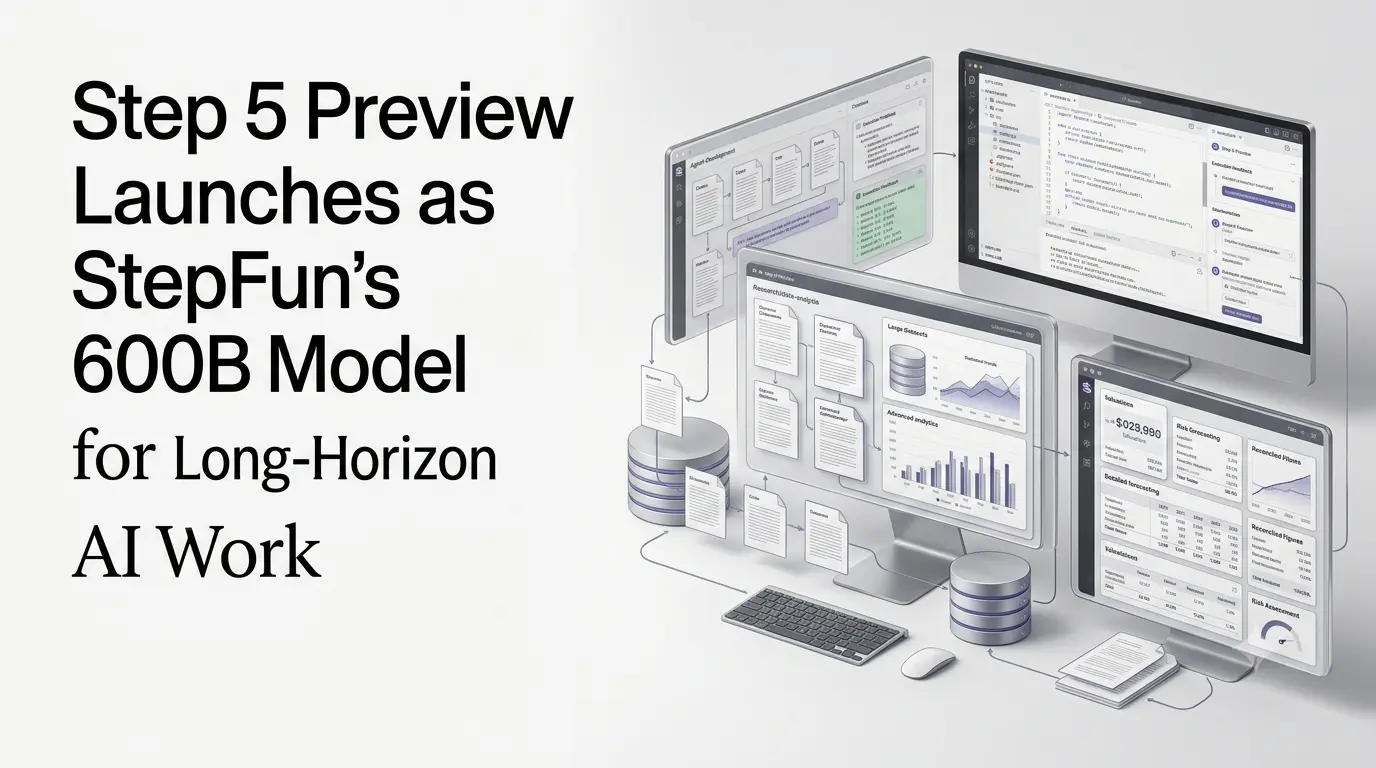
StepFun has introduced Step 5 Preview, a new flagship AI model designed for agentic software engineering, professional knowledge work and financial analysis. The model uses a sparse Mixture-of-Experts architecture with 600 billion total parameters and 27 billion active parameters per token, alongside a 1-million-token context window and support for text, image and video inputs.
StepFun is positioning the model around a cost-and-capability trade-off rather than simply claiming the highest benchmark scores. Its announcement describes Step 5 Preview as an attempt to advance the intelligence-versus-cost “Pareto frontier,” particularly for workflows that require repeated tool use, execution and refinement.
The model is available through StepFun’s products and API, according to the company. Its documentation lists the model ID as step-5-preview, with a maximum input context of 1 million tokens and maximum output of 64,000 tokens.
Quick Summary
- Step 5 Preview is StepFun’s new flagship AI model.
- It has 600B total parameters and 27B active parameters.
- Supports a 1M-token context window and multimodal inputs.
- Focuses on agentic coding, research, analysis and financial workflows.
- Designed for long-horizon execution and iterative tool use.
- StepFun also highlights applications involving 3D workflows and programmable hardware.
- Finance is a major focus, with dedicated evaluations including FinStepBench and FrontierFinance.
What Step 5 Preview Can Do?
StepFun designed the model for tasks that extend beyond single-turn question answering.
Its official documentation highlights four broad capability areas: long-context reasoning, software engineering, multi-step agent tasks and multimodal understanding. The model can process large collections of documents, work with programming tasks, use application-provided tools for multi-step workflows, and analyze images and videos.
The company also says Step 5 Preview supports tool calling, structured JSON output, prompt caching and adjustable reasoning effort. These capabilities are particularly relevant to applications where an AI model must repeatedly interact with external tools rather than simply generate a response.
StepFun’s examples extend into web development, 3D creation and programmable hardware. The company says the model can build web interfaces and data visualizations, use Blender to create and refine 3D assets, and integrate those assets into interactive applications using technologies such as Three.js.
Step 5 Preview Focuses on Long-Horizon Execution
One of the more notable aspects of Step 5 Preview is StepFun’s emphasis on extended autonomous execution.
The company describes tests in which the model maintains a running record of previous attempts, evaluates execution feedback and decides what to try next. One example involved giving the model 24 hours to optimize an inference kernel on an NVIDIA H100 GPU. StepFun reports that Step 5 Preview reached 508 TFLOPS after roughly 22 hours, compared with 493 TFLOPS for Claude Opus 5 in the company’s test.
Another experiment involved automated post-training. StepFun says Step 5 Preview worked on a Qwen3-30B-A3B model for 24 hours, modifying the post-training data process and ultimately raising AIME24 accuracy from 53.3% to 60%. The company says that result matched Claude Opus 5 while using fewer annotator tokens.
These are company-reported experiments rather than independent evaluations, so the results should be interpreted within StepFun’s stated testing setup.
Research and Professional Knowledge Work
Step 5 Preview is also aimed at research-heavy workflows in which an agent must gather information, reconcile sources and produce a finished deliverable.
In one example, StepFun says the model coordinated 950 web fetches in a single agent action for a climate study covering 1,000 locations over 25 years. It assembled 300,000 monthly records across 11 variables before analyzing regional differences in solar seasonality.
The company also reports that the model produced a 17-sheet analytical workbook for a diesel surcharge review, including source data, reconciliation, formulas, regional analysis and trend models.
These examples illustrate the type of workflow StepFun is targeting: not simply answering a research question, but coordinating multiple stages of information gathering, analysis and output generation.
Finance Is a Major Focus
Financial analysis is another central part of the Step 5 Preview launch.
StepFun says it developed three internal FinStepBench evaluations covering financial information retrieval, corporate valuation and deep research. The tests are intended to assess whether models can identify reliable information, reconcile differences between reports, make assumptions explicit and produce calculations that can be reproduced.
The company also reports a 66.4% score on FrontierFinance, compared with 69.7% for Claude Opus 5 and 55.0% for GPT-6 Astra in its published comparison. On its internal FinStepBench evaluations, Step 5 Preview scores 74.5% on LiveSearch, 60.6% on CorporateValuation and 55.8% on its finance deep-research evaluation.
Those numbers should not be interpreted as a universal ranking of financial AI models. They come from StepFun’s published evaluation setup, and benchmark methodology, model configurations and test conditions can materially affect results.
How the Model Performs on Coding Benchmarks?
StepFun reports strong results across several software-engineering evaluations, but the picture varies considerably by benchmark.
On StepCodeBench, Step 5 Preview scores 49.0%, compared with 63.9% for Claude Opus 5 and 61.0% for GPT-6 Astra in StepFun’s published table. On ProgramBench, it records 80.5%, while GPT-6 Astra scores 85.4% and Claude Opus 5 scores 82.3%.
The model performs differently on DeepSWE v1.1, where StepFun reports 67.7% for Step 5 Preview, compared with 74.1% for GPT-6 Astra and 74.0% for Claude Opus 5.
This makes the launch more nuanced than a simple claim that Step 5 Preview is the strongest coding model. Its published results show competitive performance on several tasks, while remaining behind established frontier models on others.
Availability
Step 5 Preview is currently available through StepFun’s products and API. Developers can access the model using the step-5-preview model ID, while StepFun’s documentation provides examples for text, image and video workflows.
The model supports image and video understanding in addition to text, with StepFun documenting image inputs through URL or Base64 and support for multiple images in a request.
StepFun is therefore positioning Step 5 Preview less as a conventional chatbot model and more as infrastructure for long-running AI agents, coding systems, research workflows and professional analysis.
The broader significance of Step 5 Preview is its attempt to combine a large sparse architecture, long context and multimodal input with extended tool-driven execution. Its published benchmarks do not show a universal lead over competing frontier models, but the model’s emphasis on sustained workflows and cost-efficient agentic execution makes it a notable new entry in the current AI model landscape.
Also Read –
Claude Opus 5.5 Reportedly in Testing Ahead of Launch
GPT-6 Astra: Features, Capabilities, Performance & What’s New?
StepFun AI Guide: Models, Products, Uses & API
Source
StepFun – Step 5 Preview official announcement
StepFun Documentation – Step 5 Preview
Vercel AI Gateway – Step 5 Preview model information