
Perplexity AI is an AI-powered answer engine that searches the web, synthesizes information, and provides answers with citations. Unlike a traditional search engine that mainly returns a list of links, Perplexity combines web search with large language models to produce a direct response and show the sources behind it.
The platform has expanded beyond basic AI search. Perplexity includes Pro Search, Research, advanced AI model access, file analysis, Projects, image and video generation, Perplexity Computer, the Comet AI browser, and an API platform.
This guide explains how Perplexity works, what its main features do, how its search modes differ, which plans are available, and where the platform’s limitations matter.
Quick Summary
- Perplexity AI is an AI-powered answer engine and research platform.
- It searches the web and combines information into AI-generated answers with citations.
- Key features include Pro Search, Deep Research, file analysis, Projects and multiple AI models.
- Comet provides an AI-powered browser, while Perplexity Computer focuses on agentic workflows.
- Perplexity can be used for research, writing, learning, analysis and information discovery.
- Users should still verify important information because AI-generated answers and sources can contain errors.
What Is Perplexity AI?
Perplexity AI is an AI search and research platform that combines web retrieval with AI-generated answers.
When you ask a question, Perplexity can search current web sources, analyze the information it finds, and produce a conversational answer with inline citations. Its current product description emphasizes three core ideas: real-time web research, multi-model orchestration, and web-first AI agents.
This makes Perplexity different from a conventional search engine in one important respect: the search results are not the final product. The platform attempts to turn those results into a synthesized answer.
For example, instead of searching separately for:
- the latest AI model releases,
- their specifications,
- pricing,
- official announcements,
- and comparisons,
You can ask Perplexity to research the topic and produce a cited summary.
The underlying system can route queries across multiple AI models rather than relying on one model for every task. Perplexity’s current product information lists models from providers including OpenAI, Anthropic, Google and its own Sonar family, with model availability depending on plan and feature.
How Does Perplexity AI Work?
Perplexity’s basic workflow can be simplified into four stages:
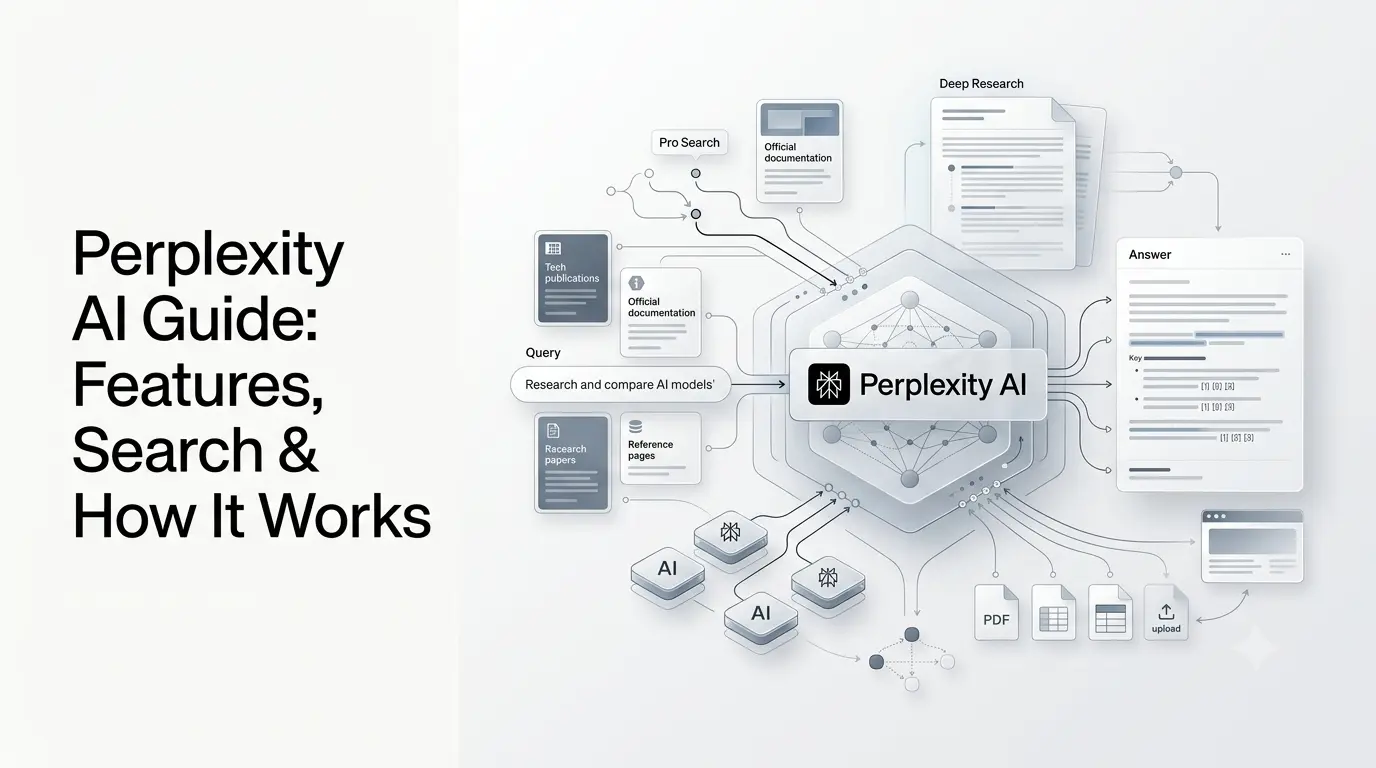
Question → Search → Synthesis → Cited answer
When a query requires web information, Perplexity interprets the question, searches relevant sources, processes the retrieved information with AI, and presents an answer with citations.
Its Pro Search documentation describes a more advanced workflow in which the system can select an appropriate model, perform multiple web searches, synthesize information from different sources, and provide direct links to the sources used.
1. Understanding the question
The system first interprets what the user is asking.
This matters because natural-language queries can contain multiple requirements.
For example:
Compare the latest AI video generators by pricing, maximum output length, commercial-use rights, and API availability.
That is not simply a keyword search. It requires identifying several separate information requirements.
2. Searching for information
Perplexity can search the web for relevant information instead of depending entirely on information stored in an AI model.
Its search system can work across different source categories and focuses, including the web, academic material, finance information, and user-provided files.
3. Synthesizing the results
The retrieved information is processed by an AI model and turned into a coherent response.
For complex queries, Perplexity may perform multiple searches rather than relying on a single search query.
4. Showing citations
Citations are a central part of Perplexity’s interface.
The platform places citations alongside claims so users can open the underlying sources and verify the information.
However, citations do not automatically make an answer correct. A source can be outdated, incomplete, or misinterpreted. Important claims should still be checked against the underlying source.
What Is Perplexity Search?
Perplexity Search is the platform’s core web-search experience.
The important distinction is that Perplexity combines retrieval and generation. Instead of simply returning a search-results page, it attempts to answer the question directly while retaining links to the supporting material.
Perplexity’s current product description calls this an Answer Engine and says it researches the open web in real time before returning cited answers.
This makes it particularly useful for questions where the user wants a synthesized answer rather than a list of websites.
Standard Search vs. Pro Search
Perplexity has different search experiences for different levels of complexity.
| Feature | Standard/Best Search | Pro Search |
|---|---|---|
| Main purpose | Quick answers | Deeper research |
| Web research | Yes | Yes, with more extensive search |
| AI model selection | System-managed | More advanced model options |
| Multiple searches | Task dependent | Designed for complex queries |
| Citations | Yes | Yes |
| Best suited for | Simple questions | Multi-step research |
| Research depth | Lower | Higher |
Perplexity describes Best Mode as a default experience that intelligently selects an appropriate model for a query, while Pro Search is designed for more complex research requiring deeper analysis.
What Is Pro Search?
Pro Search is Perplexity’s advanced research-oriented search mode for complex questions.
It can perform multiple web searches, synthesize information from numerous sources, and provide a more detailed answer with citations. Perplexity says Pro Search can use sources such as articles, academic papers, forums and videos depending on the selected search focus.
A useful way to think about it is:
- Standard search: Find and answer.
- Pro Search: Investigate, compare, synthesize and answer.
Pro Search is especially useful for:
- detailed product research,
- technical questions,
- market research,
- competitive analysis,
- academic research,
- complex comparisons,
- multi-source fact checking,
- long-form research.
What Is Perplexity Research?
Research is Perplexity’s deeper autonomous research workflow for complex questions.
Instead of asking the user to manually conduct dozens of searches, Research can perform multi-step investigation and produce a more comprehensive report.
Perplexity upgraded its Deep Research system in 2026 and connected it to its search infrastructure and advanced reasoning models. The company subsequently brought Deep Research into Perplexity Computer, where research findings can be turned into artifacts such as reports, spreadsheets, presentations, dashboards and websites.
A typical research workflow might look like:
Research question → multiple searches → source analysis → synthesis → report → follow-up work
This is more appropriate for questions such as:
Analyze the AI browser market in 2026, identify major competitors, compare their features, pricing and enterprise positioning, and summarize the major product developments.
That request requires substantially more work than a normal factual query.
What AI Models Does Perplexity Use?
Perplexity is not tied to a single AI model.
Its platform uses multi-model orchestration, meaning different models can be used for different tasks. Perplexity’s current documentation lists models including its own Sonar models as well as models from OpenAI, Anthropic and Google.
For example, Perplexity’s Pro documentation currently lists access to models including:
- Sonar
- GPT-5.2
- Claude Sonnet 4.6
- Gemini 3.1 Pro
- additional reasoning models depending on plan
Model availability and limits can change, so the model list should be treated as a current product snapshot rather than a permanent specification.
Why Does Multi-Model Access Matter?
Different AI models can have different strengths.
One may be particularly useful for:
- coding,
- reasoning,
- writing,
- summarization,
- research,
- or multimodal tasks.
Perplexity’s model-routing approach attempts to make model selection less important for users who simply want an effective answer.
Pro and Max users can also receive greater control over model selection.
What Are the Main Features of Perplexity AI?
Perplexity has evolved into a broader AI productivity platform. Its major features now include search, research, file analysis, projects, AI-generated assets, browser assistance and developer APIs.
1. Web Search With Citations
The core feature remains AI-powered web search.
Each answer can include citations linking back to the sources used. This makes it possible to move from a synthesized response to the underlying article, document or website.
2. Pro Search
Pro Search is designed for deeper questions that require multiple searches and more extensive source synthesis.
3. Deep Research
Deep Research performs more extensive, multi-step investigation and can generate detailed reports. It has also become part of Perplexity Computer workflows.
4. File Uploads and Analysis
Users can provide files as additional context.
Depending on the plan and workflow, Perplexity can analyze documents and other uploaded material alongside web information.
This is useful for:
- PDFs,
- reports,
- spreadsheets,
- presentations,
- research documents,
- business material,
- technical documentation.
Pro users receive higher file-upload and analysis limits than free users.
5. Projects
Perplexity’s Projects are persistent workspaces for longer-running research and tasks.
Projects can contain:
- conversations,
- files,
- instructions,
- connected tools,
- persistent context,
- artifacts,
- and collaborators.
In 2026, Projects replaced the previous Spaces concept as Perplexity expanded the platform toward persistent, collaborative workspaces.
This is useful when a project continues across multiple sessions instead of being a one-time search.
6. Image Generation
Paid Perplexity plans provide access to image-generation capabilities. The feature is integrated into the broader research and creation workflow rather than existing as a completely separate image-generation service.
7. Video Generation
Perplexity has also expanded into video generation, although access and limits depend on the subscription tier. Its current plan documentation lists video generation for paid tiers, with higher allowances available on Max and enterprise plans.
8. Create Files and Apps
Perplexity can move from answering a question to creating an output.
Its Create files and apps feature can be used for outputs such as:
- reports,
- spreadsheets,
- presentations,
- dashboards,
- simple web applications.
This changes the workflow from:
Search → Read
to:
Research → Analyze → Create
Perplexity’s current subscription documentation describes this as one of the major capabilities available to paid users.
What Is Perplexity Computer?
Perplexity Computer is an agentic environment designed to perform multi-step work rather than only answer questions.
It can combine research, files, tools, applications and web activity into longer workflows.
For example, a user could ask it to:
- Research a market.
- Collect relevant information.
- Analyze the findings.
- Create a spreadsheet.
- Build a presentation.
- Produce a report.
Perplexity has continued expanding Computer throughout 2026, including Windows support, Microsoft 365 integration, Deep Research, memory and project-based workflows.
This is a significant shift from Perplexity’s original identity as primarily an AI search engine.
What Is Comet?
Comet is Perplexity’s AI-powered browser.
Rather than treating AI as a separate chatbot window, Comet puts an AI assistant inside the browsing experience.
Perplexity describes Comet as capable of:
- answering questions about webpages,
- summarizing pages,
- navigating websites,
- comparing information across pages,
- interacting with web applications,
- helping with email and calendars,
- and using relevant personal context when authorized.
This makes Comet part of Perplexity’s broader move from answering questions to taking actions.
Comet and Privacy
Because an AI browser can potentially interact with browsing data, privacy becomes particularly important.
Perplexity says Comet stores certain browsing information locally and provides controls for deleting browsing history, cookies and cached data. Integrations such as Gmail and calendar access require user permission, and Perplexity says these integrations are opt-in.
Users should still review permissions carefully before allowing an AI browser to interact with sensitive accounts or perform actions on their behalf.
What Are Perplexity Projects Used For?
Projects are particularly useful for recurring research.
For example, a content team could create a project for:
“AI Industry Research”
And keep:
- research conversations,
- source documents,
- editorial instructions,
- competitor information,
- spreadsheets,
- connected tools,
- and previous findings
In the same workspace.
Perplexity says Projects support persistent files, instructions, connectors and collaboration.
This is more useful for ongoing work than repeatedly starting a new standalone search.
Is Perplexity Free?
Yes. Perplexity offers a Free/Standard plan, but paid subscriptions provide access to higher limits and additional capabilities.
Perplexity’s consumer plans include:
- Standard (Free)
- Pro
- Max
- Education Pro
It also offers Enterprise Pro, Enterprise Max and a separate API platform.
Perplexity Free
The free plan includes:
- basic web search,
- search history,
- limited Pro Searches,
- limited file uploads,
- system-selected models.
Perplexity’s current plan comparison lists 3 Pro Searches per day and 1 Research query per month for Free users.
Perplexity Pro
Perplexity Pro is currently listed at $20 per month or $200 per year on Perplexity’s pricing information. It adds broader access to Pro Search, advanced AI models, file analysis, image generation and other features.
Perplexity also says Pro provides significantly more citations per answer and increased file/photo upload capacity.
Perplexity Max
Perplexity Max is designed for users who need substantially higher access to advanced models and research/creation features.
It currently costs $200 per month or $2,000 per year when purchased through the web app.
Max includes additional access to:
- advanced models,
- Deep Research,
- Create files and apps,
- Comet’s Max Assistant,
- Computer,
- Brain in Research Preview,
- higher usage limits,
- early product access.
Education Pro
Education Pro is available to verified students and educators at a discounted price. Perplexity currently lists it at $10 per month with SheerID verification. The plan includes features such as Learn Mode, premium models, file and image uploads and additional search access.
Perplexity Pricing Comparison
| Plan | Current listed price | Main focus |
|---|---|---|
| Free | $0 | Basic AI search |
| Pro | $20/month or $200/year | Advanced search, models and creation |
| Education Pro | $10/month | Students and educators |
| Max | $200/month or $2,000/year | Heavy research and advanced AI access |
| Enterprise Pro | $40/user/month or $400/year | Business collaboration and security |
| Enterprise Max | $325/user/month or $3,250/year | Highest enterprise access |
| API | Usage-based | Developers and applications |
Enterprise pricing is based on active seats, while API usage is billed separately from consumer subscriptions.
Prices and feature limits can change, so users should verify the current plan before subscribing.
Perplexity vs Google Search
Perplexity and Google Search approach information discovery differently.
| Area | Perplexity | Traditional Search Engine |
|---|---|---|
| Primary output | AI-generated answer | Search-result pages |
| Citations | Integrated into answers | Links to sources |
| Conversational follow-up | Yes | Limited/varies |
| Web research | AI-assisted | Primarily retrieval and ranking |
| Multi-step research | Research modes available | Usually user-driven |
| Source verification | Direct citations | User opens results |
| AI synthesis | Central feature | Not necessarily central |
This does not mean Perplexity eliminates the need for traditional search.
Search engines remain useful when you want to browse many individual results, visit a particular website, find a specific page, or explore search results yourself.
Perplexity is more oriented toward answer synthesis and research.
Perplexity vs ChatGPT
Perplexity and ChatGPT increasingly overlap, but their product emphasis remains different.
| Area | Perplexity | ChatGPT |
|---|---|---|
| Core identity | AI answer engine/search platform | General-purpose AI assistant |
| Web research | Central feature | Available through web-enabled features |
| Citations | Core part of search answers | Depends on tool/workflow |
| Multi-model access | Strong focus | Primarily OpenAI model ecosystem |
| Deep research | Yes | Yes |
| AI agents/computer use | Computer and Comet ecosystem | Agentic capabilities vary by product |
| Projects/workspaces | Yes | Yes |
| File analysis | Yes | Yes |
| Image generation | Yes | Yes |
| Developer API | Yes | Yes |
The practical choice depends on the workflow rather than a simple feature checklist.
Someone researching a current topic with source citations may prefer Perplexity’s search-first workflow. Someone building a broader AI assistant workflow may use ChatGPT or another general-purpose assistant.
Perplexity vs Google Gemini
Gemini is Google’s AI ecosystem, while Perplexity is built around AI-powered search and research.
Gemini can connect deeply with Google’s broader ecosystem, while Perplexity emphasizes web research, source citations, multi-model access and its own agentic tools.
For research-heavy tasks, Perplexity’s distinction is its search-first answer engine architecture. For users already working heavily across Google’s services, Gemini’s ecosystem integration can be a different consideration.
What Are the Best Uses for Perplexity AI?
Perplexity is particularly useful when the answer depends on current or multiple sources.
Research
Ask Perplexity to investigate a topic and provide citations.
Example:
Research the latest developments in AI video generation and compare official announcements from the major companies.
Content research
Content creators can use it to:
- identify current developments,
- collect source material,
- compare competitors,
- verify dates,
- find primary sources,
- build research briefs.
It is still important to open the cited sources before publishing claims.
Product comparisons
Perplexity can research products across multiple sources and organize differences into a structured comparison.
Academic research
Academic and research-focused search can help locate papers and supporting information, although scholarly claims should be checked against the original papers.
Market research
Paid plans and premium data sources can support more advanced market and financial research. Perplexity’s current pricing information lists premium sources such as PitchBook, Statista and S&P Capital IQ for applicable paid offerings.
File analysis
Users can combine their own documents with web research, making Perplexity useful for workflows such as:
Upload report → ask questions → compare with current web information → create summary
Learning
Perplexity’s Learn step by step mode provides a more interactive learning experience. Perplexity introduced the feature broadly in 2026, allowing users to learn through guided questions and explanations rather than receiving only a direct answer.
What Are the Limitations of Perplexity?
Perplexity’s search-first architecture solves some problems but does not eliminate the fundamental limitations of generative AI.
Citations can still require verification
A citation shows where information came from, but it does not guarantee that the AI interpreted the source correctly.
For important claims, open the source.
Search results can contain low-quality information
The web contains:
- outdated pages,
- duplicate articles,
- SEO-generated content,
- incorrect claims,
- secondary reporting,
- and conflicting information.
Perplexity can retrieve information from these sources, so source quality remains important.
AI synthesis can introduce errors
Even when the underlying sources are correct, the generated summary can misunderstand context or combine information incorrectly.
Advanced features have usage limits
Free and paid plans have different quotas for Pro Search, Research, Computer, file uploads and creation tools. Heavy users may need a higher subscription.
Model access changes
Perplexity’s multi-model strategy means the available models can change as new models are released or older ones are retired.
Consequently, an article or tutorial describing a specific model as permanently available can become outdated.
Agentic features require caution
Features such as Computer and Comet can interact with websites, files and connected services.
That makes permissions and user oversight important, particularly for:
- email,
- calendars,
- financial services,
- business systems,
- account management,
- and other sensitive workflows.
How to Use Perplexity More Effectively
A good Perplexity query should explain what you want, what information matters, and how you want the result structured.
Instead of:
AI video generators
try:
Compare the major AI video generators available in 2026. Include official pricing, maximum video duration, image-to-video support, text-to-video support, API availability and commercial-use terms. Use official sources wherever possible and cite each claim.
This gives the system a clearer research objective.
Useful prompting practices
Specify the date
What changed in Perplexity during 2026?
Request primary sources
Prioritize official product documentation and company announcements.
Specify comparison criteria
Compare pricing, features, API access and usage limits.
Ask for citations
Cite the source for every important factual claim.
Separate confirmed facts from uncertainty
Identify claims that cannot be confirmed from official sources.
Ask for structured output
Create a table comparing the products by pricing, capabilities and availability.
These approaches reduce ambiguity and make the resulting research easier to verify.
Is Perplexity Accurate?
Perplexity can be highly useful for current research because it can retrieve information from the web and show citations, but accuracy still depends on the quality of retrieved sources and the model’s interpretation of them.
For high-stakes or publication-quality work, use Perplexity as a research assistant rather than an unquestioned authority.
A practical workflow is:
Perplexity research → open primary sources → verify claims → write or act
This is particularly important for:
- medical information,
- financial information,
- legal matters,
- product specifications,
- pricing,
- technical documentation,
- breaking news.
Is Perplexity an AI Search Engine or a Chatbot?
It is better described today as an AI answer engine and research platform than simply a chatbot.
Its core interaction is conversational, but its defining feature is the combination of:
- web search,
- AI synthesis,
- citations,
- multiple AI models,
- research,
- files,
- and increasingly agentic tools.
Perplexity itself describes its product as an answer engine and says it researches the open web in real time before generating cited answers.
What Is the Perplexity API?
Perplexity API Platform allows developers and businesses to integrate Perplexity-powered search and AI capabilities into their own applications.
Perplexity describes the API as a separate developer product with pay-as-you-go billing. It is not simply an extension of a consumer Pro subscription.
Developers can use Perplexity’s API ecosystem for applications that require:
- web-grounded answers,
- AI search,
- research,
- agents,
- structured workflows,
- and search-backed generation.
This is particularly relevant when a company wants to build its own interface instead of sending users directly to Perplexity.
Who Should Use Perplexity AI?
Perplexity is particularly useful for people who frequently need current, source-backed information.
That includes:
- Researchers
- Students
- Content creators
- Journalists
- Marketers
- Developers
- Analysts
- Business professionals
- Competitive-intelligence teams
- General users researching unfamiliar topics
The most important distinction is not whether someone is an AI expert. It is whether their work benefits from search, synthesis and source verification.
Conclusion
Perplexity AI has evolved from an AI search tool into a broader research and productivity platform.
Its core advantage remains the combination of web search, AI synthesis and citations, but the platform now extends into Pro Search, Deep Research, file analysis, Projects, AI-generated assets, Computer, Comet and developer APIs.
For everyday questions, the free experience can provide a useful starting point. More demanding research workflows can use Pro Search and Research, while power users can access higher limits through Pro or Max.
The most important habit when using Perplexity is simple: treat its citations as a path to verification, not as a substitute for verification. For important claims, open the original source, check its date and context, and distinguish primary documentation from secondary reporting.
Frequently Asked Questions (FAQs)
1. What is Perplexity AI?
Perplexity AI is an AI-powered answer engine that searches the web, synthesizes information using AI models, and provides answers with citations linking to supporting sources.
2. Is Perplexity AI free?
Yes. Perplexity has a Free/Standard plan with basic search and limited access to advanced features. Paid plans such as Pro and Max provide higher limits and additional capabilities.
3. How much does Perplexity Pro cost?
Perplexity Pro is currently listed at $20 per month or $200 per year. It includes expanded Pro Search, advanced models, file analysis, image generation and other features.
4. What is Perplexity Pro Search?
Pro Search is an advanced search mode designed for complex questions. It can perform multiple searches, analyze information from different sources, synthesize the findings and provide a cited response.
5. What is Perplexity Research?
Research is Perplexity’s deeper, multi-step research workflow. It can investigate complex topics autonomously and generate comprehensive reports, with Deep Research also available within Perplexity Computer workflows.
6. What is Perplexity Comet?
Comet is Perplexity’s AI-powered browser. It can help users research, summarize webpages, navigate websites, compare information and interact with web applications.
Also Read –
Perplexity Computer Effort Controls for AI Tasks
Perplexity Comet Enterprise AI Browser for Teams