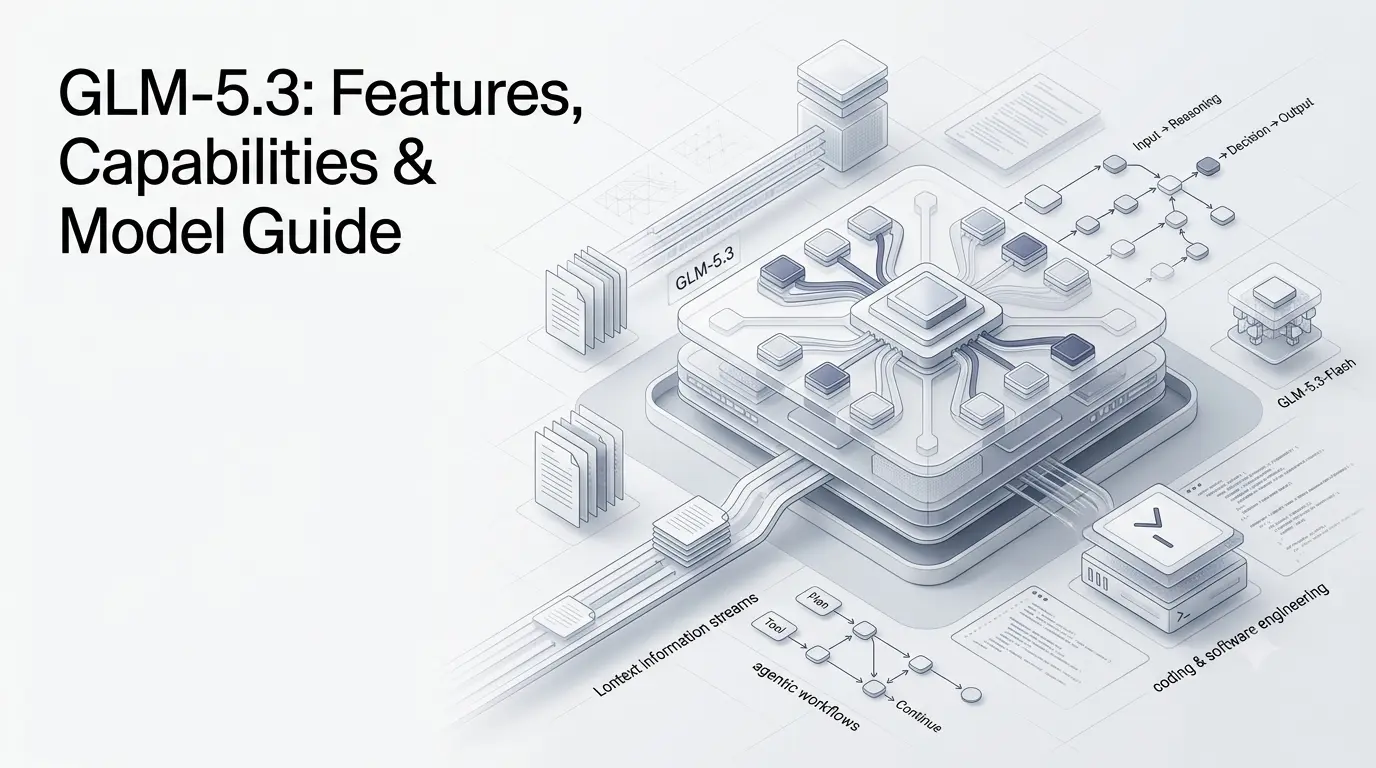
GLM-5.3 is Z.ai’s flagship reasoning model designed primarily for complex coding, long-horizon agentic tasks, and advanced software engineering. It uses the same base model as GLM-5.2, with Z.ai saying the improvements come from extensive post-training rather than a new pretraining run. The model has 753 billion total parameters, a 1-million-token context window, reasoning capabilities, function calling, structured outputs, and open-weight availability.
GLM-5.3 sits alongside the newer GLM-5.3-Flash, which takes a different approach: it is a smaller, efficiency-focused model with native multimodal capabilities for images, video, and files.
Quick Summary
- GLM-5.3 is Z.ai’s large reasoning model focused on coding, software engineering, and AI agents.
- It uses a 753B-parameter Mixture-of-Experts architecture with about 40B active parameters per token.
- It supports a 1-million-token context window for large codebases and documents.
- Key capabilities include reasoning, coding, tool calling, structured outputs, and long-horizon tasks.
- GLM-5.3 is available as open weights, with deployment subject to its specific license and hardware requirements.
- GLM-5.3-Flash is a separate, more efficient multimodal model supporting images, video, and files.
- API pricing varies by provider, so developers should check current pricing before deployment.
What Is GLM-5.3?
GLM-5.3 is a large-scale Mixture-of-Experts (MoE) language model from Z.ai, the company behind the GLM model family. It is optimized for tasks that require sustained reasoning, software development, tool use, and multiple steps rather than only short question-and-answer interactions.
The model uses a sparse architecture, meaning not all of its parameters are activated for every token. NVIDIA’s model card lists approximately 753 billion total parameters and around 40 billion activated parameters per token. It also uses DeepSeek Sparse Attention and supports a context length of up to 1,048,576 tokens.
One of the most unusual aspects of GLM-5.3 is its development path. Rather than creating an entirely new pretrained model, Z.ai says it retained the GLM-5.2 base and concentrated the improvements in post-training. The company reports that this approach produced substantial gains in coding and long-horizon tasks.
GLM-5.3 at a glance
| Specification | GLM-5.3 |
|---|---|
| Developer | Z.ai |
| Model family | GLM |
| Architecture | Sparse Mixture-of-Experts |
| Total parameters | 753B |
| Active parameters | ~40B per token |
| Context window | Up to 1,048,576 tokens |
| Input | Text |
| Output | Text |
| Reasoning | Yes |
| Function calling | Yes |
| Structured output | Yes |
| Context caching | Yes |
| Max output | Up to 131,072 tokens |
| Weight availability | Open weights |
| Primary focus | Coding, reasoning and long-horizon agentic work |
The exact capabilities available can vary by deployment or provider, so developers should check the relevant API or hosting documentation before building around a particular feature.
What Can GLM-5.3 Do?
GLM-5.3 is particularly focused on tasks where the model needs to reason through several steps and maintain context over an extended workflow.
Its major capabilities include:
- Complex software development
- Code generation and debugging
- Long-horizon agentic tasks
- Repository-level engineering
- Tool and function calling
- Structured output generation
- Large-context document and code analysis
- Reasoning-heavy problem solving
- Cybersecurity research and vulnerability discovery
- Automated workflows that require multiple steps
The model is therefore better understood as an engineering and reasoning model than as a general-purpose multimodal assistant.
Coding and software engineering
Coding is one of GLM-5.3’s central strengths.
Z.ai reports a 50% improvement over GLM-5.2 on its internal Z.ai Code Bench. On public evaluations cited by the company, GLM-5.3 also showed large gains on Terminal-Bench 3.0 and other software-engineering evaluations.
The model can be used for workflows such as:
- Understanding an existing codebase.
- Identifying a bug or implementation requirement.
- Planning a change.
- Generating or modifying code.
- Running tools or tests through an agent framework.
- Reviewing the resulting output.
- Iterating when the first attempt fails.
That workflow is important because long software tasks often require much more than generating a single function.
Long-horizon agentic tasks
GLM-5.3 is designed for tasks that can continue through many intermediate steps.
For example, an agent built around the model could potentially:
- inspect a large repository,
- determine which files need modification,
- create a plan,
- edit several files,
- run tests,
- interpret failures,
- revise the implementation,
- and continue until the task reaches an acceptable state.
Z.ai’s published evaluations show significant improvements over GLM-5.2 on long-horizon agent benchmarks. The company’s model card highlights this as one of the major areas where post-training improved the model.
Reasoning
GLM-5.3 supports configurable reasoning effort. NVIDIA’s model documentation lists low, high, and max reasoning settings, with the default configured as max in that deployment.
This gives developers a way to trade reasoning depth against the amount of computation and output involved in a task.
For simple requests, lower reasoning effort may be sufficient. More complicated coding, mathematical, research, or agentic tasks can benefit from deeper reasoning.
Tool and function calling
GLM-5.3 supports function calling, allowing applications to connect the model with external tools and software functions. It also supports structured outputs.
This is particularly useful for agentic applications because the model does not have to stop at producing text. It can be integrated into workflows where software executes specific actions based on the model’s decisions.
For example, a developer could connect a model-powered application to:
- databases,
- code execution environments,
- internal APIs,
- search systems,
- file-processing tools,
- business applications,
- testing environments.
The model itself does not automatically gain access to these systems; the application developer must provide the tools and permissions.
How Does the 1 Million Token Context Window Matter?
One of GLM-5.3’s most important specifications is its 1-million-token context window.
A context window determines how much information a model can consider within a single interaction or processing session.
For developers, a 1M-token context can be useful when working with:
- large software repositories,
- lengthy technical documentation,
- extensive research material,
- multiple files,
- long conversations,
- large specifications,
- complex agent workflows.
The practical benefit is not simply being able to paste a huge amount of text into a prompt. The model also needs to retrieve and reason over the relevant information effectively.
Z.ai describes GLM-5.3 as particularly suited to long-horizon work, while Alibaba Cloud’s model documentation confirms a maximum input/context length of 1,048,576 tokens.
What Changed From GLM-5.2 to GLM-5.3?
The most important difference is not a completely new base architecture.
Z.ai says GLM-5.3 uses the same base model as GLM-5.2 and that its gains came from post-training. This makes GLM-5.3 an interesting example of how additional reinforcement and post-training work can improve an existing large model without simply increasing its parameter count.
| Area | GLM-5.2 | GLM-5.3 |
|---|---|---|
| Base model | Previous GLM-5 generation | Same base as GLM-5.2 |
| Post-training | Earlier training recipe | Expanded post-training |
| Coding | Strong | Improved |
| Long-horizon agents | Supported | Major improvement |
| Context | Around 1M tokens | Up to 1M tokens |
| Focus | General reasoning and coding | Coding, agents and long-running engineering |
| Weight availability | Open weights | Open weights with model-specific license |
The improvement therefore comes primarily from training and post-training methodology, rather than simply making the underlying model larger.
GLM-5.3 vs GLM-5.3-Flash: What’s the Difference?
This is an important distinction because the two names are easy to confuse.
GLM-5.3 is the large reasoning model focused on coding and long-horizon agentic work.
GLM-5.3-Flash is designed around efficiency and native multimodal capabilities. Z.ai describes Flash as its first natively multimodal model in the GLM-5 family, with support for text, images, video, and files.
| Feature | GLM-5.3 | GLM-5.3-Flash |
|---|---|---|
| Primary focus | Coding and long-horizon reasoning | Efficient multimodal and agentic work |
| Architecture | Sparse MoE + sparse attention | Hybrid sparse and linear attention |
| Total parameters | 753B | 320B |
| Active parameters | ~40B/token | 18B |
| Context | 1M tokens | Up to 1M tokens |
| Multimodal | No | Yes |
| Images/video/files | Not native | Native |
| Coding | Strong | Strong |
| Agent workflows | Strong | Strong |
| Open weights | Yes | Yes |
| License | Model-specific GLM-5.3 license | MIT, according to Z.ai’s release |
GLM-5.3-Flash is therefore not simply a smaller version of the same model. Z.ai says it was built from a new base model and uses a different architecture and multimodal training approach.
What is GLM-5.3-Flash Used For?
The Flash model broadens the GLM-5 family beyond text-only engineering.
Z.ai says GLM-5.3-Flash can work with documents, spreadsheets, presentations, screenshots, charts, interfaces, images and video. It can also use visual information as feedback during multi-step workflows.
Potential applications include:
- Visual document analysis
- Spreadsheet and data analysis
- Presentation generation and review
- Screenshot understanding
- UI and website analysis
- Content production
- Browser and computer-use workflows
- Faster coding assistance
- Agent automation
Z.ai also says GLM-5.3-Flash has been integrated into AutoClaw for real-world work and is available through supported inference frameworks.
What Are the Main Use Cases for GLM-5.3?
1. Software development
Developers can use GLM-5.3 for code generation, debugging, refactoring, repository analysis, testing workflows, and software-engineering agents.
Its large context is particularly relevant to projects where understanding relationships between many files is important.
2. Coding agents
GLM-5.3 is designed for agents that can continue working through a task instead of returning one isolated answer.
This can include coding agents that:
- inspect repositories,
- modify files,
- run tests,
- interpret errors,
- and iterate.
Z.ai’s ZCode ecosystem specifically integrates GLM models into agentic coding workflows, including long-running tasks and remote control features.
3. Research and technical analysis
The large context window can make the model useful for analyzing extensive technical material, provided the application supplies the relevant information.
Possible workflows include comparing documentation, analyzing code, summarizing large collections of material, and extracting structured information.
4. Cybersecurity research
GLM-5.3 has also attracted attention for cybersecurity capabilities.
Z.ai reports strong performance on CyberGym, including vulnerability-discovery tasks, and says its post-training produced an unexpected increase in cybersecurity capability.
This capability has legitimate defensive applications, such as vulnerability research and code auditing, but it also means deployment should include appropriate security controls and access policies.
5. Enterprise automation
When connected to tools, GLM-5.3 can serve as the reasoning layer of a larger automation system.
For example:
User request → model reasoning → tool call → result → model evaluation → next action
That architecture can support internal engineering systems, data workflows, research assistants, and other multi-step applications.
Is GLM-5.3 Open Source?
GLM-5.3 is available as open weights, but it is important not to automatically equate open weights with an unrestricted open-source software license.
Z.ai publishes the model through its zai-org/GLM-5.3 Hugging Face repository, including model files and deployment instructions. The repository uses a model-specific GLM-5.3 license, so organizations should review the actual license before commercial deployment or redistribution.
This distinction matters for businesses considering self-hosting
How Can Developers Run GLM-5.3?
Developers can access GLM-5.3 through APIs and supported inference infrastructure.
The model repository provides examples for:
- Transformers
- vLLM
- Docker Model Runner
- hosted inference providers
The Hugging Face model card also provides an OpenAI-compatible vLLM serving example.
For developers who do not want to manage the hardware required for a 753B-parameter model, hosted inference is generally the more practical route.
The model is also available through third-party infrastructure, including NVIDIA’s platform and other inference providers.
How Much Does GLM-5.3 Cost?
Pricing depends on where the model is accessed.
For example, Alibaba Cloud’s Model Studio currently lists the international/Singapore API price at:
- $1.40 per 1 million input tokens
- $4.40 per 1 million output tokens
- $0.26 per 1 million cached input tokens
The same documentation lists a 200 RPM and 3-million-TPM rate limit for that service. Pricing can differ by region, provider, plan, or promotional offer.
| API usage | Listed price |
|---|---|
| Input | $1.40 / 1M tokens |
| Cached input | $0.26 / 1M tokens |
| Output | $4.40 / 1M tokens |
These figures should be treated as a current reference rather than a permanent global price. Developers should verify the provider’s live pricing before estimating production costs.
What Are the Limitations of GLM-5.3?
GLM-5.3’s specifications are strong, but there are practical limitations.
Hardware requirements
A 753B-parameter model is extremely large. Even though MoE architecture reduces the number of parameters activated for each token, storing and serving the full model remains a significant infrastructure challenge.
For many individual developers, hosted inference will be substantially easier than self-hosting.
Text-only design
The standard GLM-5.3 model is primarily a text-in/text-out reasoning model. Developers looking for native image, video, or visual-document understanding should examine GLM-5.3-Flash or another multimodal model instead.
Reasoning can increase cost and latency
Deeper reasoning can require more computation and generated tokens. A task that does not need extensive reasoning may therefore be less efficient when using maximum reasoning effort.
Benchmark results are not universal
Z.ai’s benchmark results provide useful evidence about particular capabilities, but benchmark performance does not guarantee identical results in every application.
Actual performance depends on:
- prompt design,
- reasoning settings,
- tools,
- agent framework,
- hardware,
- inference provider,
- task complexity,
- and evaluation methodology.
Security considerations
The model’s cybersecurity capabilities make access controls particularly important in production environments. Organizations should restrict tool permissions and test agent workflows before allowing automated actions against real systems.
Who Should Use GLM-5.3?
GLM-5.3 is particularly relevant to:
- Software developers
- AI application developers
- Coding-agent builders
- Researchers
- Technical teams
- Organizations experimenting with open-weight models
- Developers building long-context applications
- Teams requiring tool-using reasoning systems
For users primarily interested in image understanding, document vision, screenshots, or video, GLM-5.3-Flash is the more relevant member of the family because it was designed with native multimodal capabilities.
Conclusion
GLM-5.3 represents a different path to improving large language models: instead of replacing the GLM-5.2 base model with a new pretrained model, Z.ai concentrated on post-training to improve coding, reasoning, and long-running agentic behavior.
Its combination of a 753B MoE architecture, 1M-token context window, reasoning, tool use, and open-weight availability makes it particularly relevant to developers building coding agents and other complex AI systems.
The wider GLM-5 family is also expanding in a different direction through GLM-5.3-Flash, which brings native multimodal capabilities and a more efficiency-oriented architecture. That distinction is important when choosing between the models for real-world applications.
Frequently Asked Questions (FAQs)
1. What is GLM-5.3?
GLM-5.3 is a large reasoning language model developed by Z.ai. It is designed primarily for complex coding, software engineering, long-horizon agentic tasks, and other reasoning-intensive workloads.
2. Is GLM-5.3 free?
The model weights are publicly available, but running GLM-5.3 yourself requires substantial computing infrastructure. Hosted API access is generally usage-based, with prices varying by provider.
3. How large is GLM-5.3?
GLM-5.3 has approximately 753 billion total parameters in its Mixture-of-Experts architecture, with around 40 billion parameters activated per token according to NVIDIA’s model documentation.
4. Does GLM-5.3 support images?
The standard GLM-5.3 model is text-focused. Z.ai’s GLM-5.3-Flash is the multimodal member of the family and supports images, video, and files.
5. What is the context window of GLM-5.3?
GLM-5.3 supports up to 1,048,576 tokens, or approximately 1 million tokens, depending on the deployment.
6. Is GLM-5.3 good for coding?
Coding is one of its primary design targets. Z.ai reports substantial improvements over GLM-5.2 on its internal coding evaluation and on several public software-engineering benchmarks. Actual results can vary by task, tools, prompting, and deployment.
Also Read –
GLM-5.3 Inference Infrastructure: Z.ai’s AI Agent Approach