
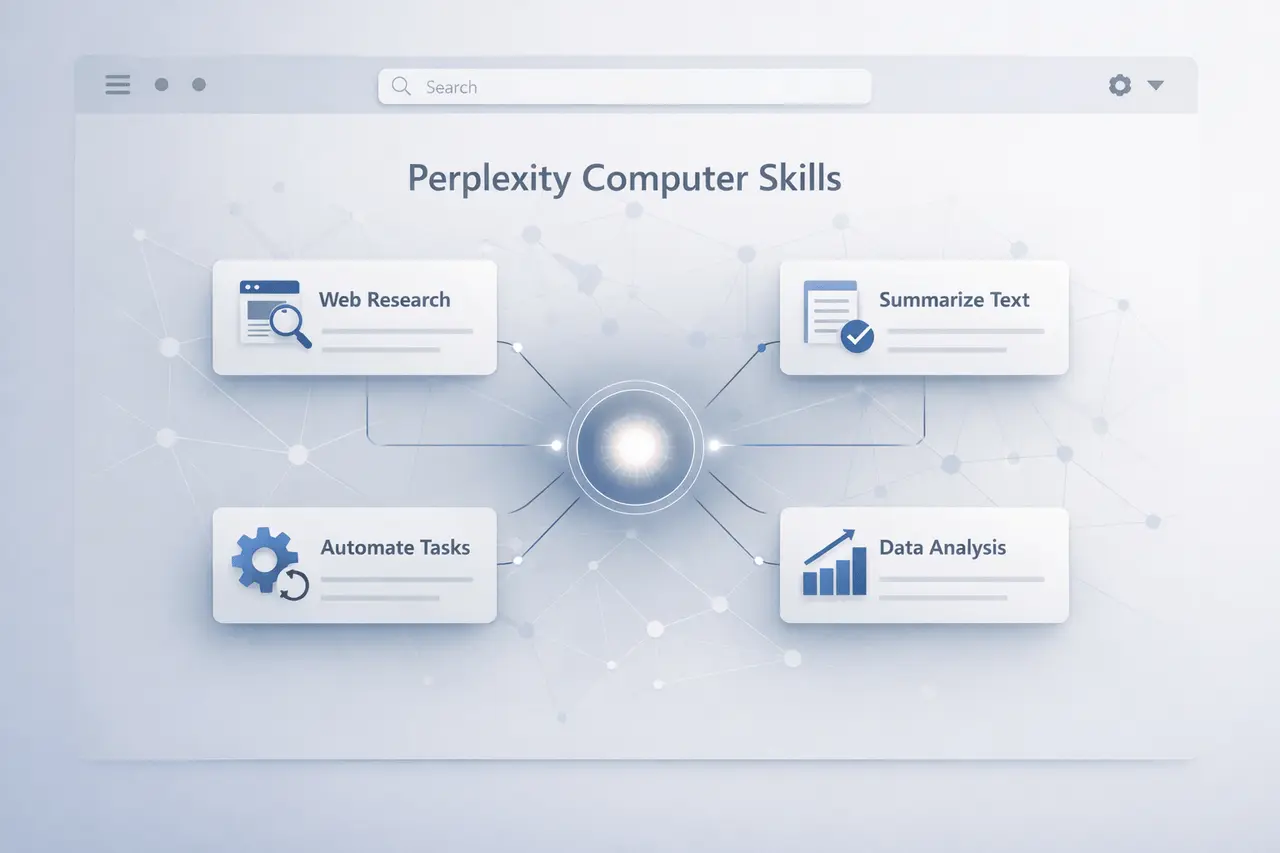
Perplexity has launched Skills for Perplexity Computer, the latest feature designed to automate repetitive workflows by enabling users to create repeatable tasks that the computer will automate when required. This feature allows users to instruct an AI to complete multiple tasks at once and retain those instructions for future use.
The introduction of Perplexity Computer Skills is a move towards more personalised and autonomous AI assistants. It allows the system to store users’ workflows and apply them across different sessions. This update will significantly reduce repetitive tasks and improve the user experience with AI-powered productivity tools.
What are Complex computer Skills?
Computer skills are reusable instructions or abilities that users can build to automate specific tasks. Once they are defined, these capabilities remain accessible to the system and are automatically activated when the AI detects a suitable situation.
Instead of directing the AI whenever an action needs to be completed, Users can design an ability that teaches the AI how to manage it.
The key characteristics of this feature are:
- Memory that Persists across Tasks – Skills are saved even after they are created.
- Automation Reusable – AI can use the ability when similar situations arise.
- Customised user Workflows – Users can define actions based on their own personal work
- Automated Execution – The system can activate skills without prompting repeatedly
The objective is to reduce friction during repetitive AI interactions and move towards an environment where AI assistants actively manage workflows rather than respond to individual requests.
What is the Skills System Works?
The Skills feature provides an automation layer that can be taught in Perplexity Computer. Users can provide instructions for a repeated task, and the system stores them as a reusable capability.
Step-by-step workflow
- A user can identify an activity they frequently perform.
- They build a skill and describe the steps required to finish it.
- Perplexity Computer saves the skills as a reusable ability.
- When the system encounters a relevant event, it will automatically apply the capability.
This layout lets the AI slowly build an automation library with a variety of custom actions.
Over time, users will develop a variety of capabilities that enable the system to act more like an actual personalised AI agent rather than a traditional chatbot.
Examples of Skills That Could Be Developed
While the feature is flexible, typical applications may include tasks like:
- Automatically formatting notes from research
- Forming structured summaries using documents
- Running recurring data analysis queries
- Preparing standardized reports
- Automating email or documentation workflows
- Performing structured research queries
Because users define skills, the system can adapt to a variety of professional workflows.
This is a similar approach to that observed in AI robots and automated systems, where AI systems can perform a series of actions rather than producing text responses.
Why Perplexity is Growing into AI Automation?
Perplexity is well-known for its artificial intelligence-powered web search, which integrates large language models and real-time web crawling to provide responses that are frequently cited.
The launch of Skills suggests that the company is advancing towards a larger idea: Artificial Intelligence-assisted Computing, which is an ever-present assistant capable of performing tasks across different workflows.
Many business trends are driving this change:
- The demand is growing for automated AI tools
- More interest is shown in Personal AI Agents
- It is the rise of persistent AI systems for memory
- The competition between AI platforms to extend beyond chat applications
By enabling users to design reusable capabilities, Perplexity is making its platform more compatible with AI systems based on agents that complete multi-step tasks in a controlled manner.
How do Perplexity Computer Skills Compare to Other AI Automation Approaches?
Numerous AI tools are currently experimenting with similar automation concepts. However, their implementation strategies differ.
| Platform | Automation Method | Persistence | Customization |
|---|---|---|---|
| Perplexity Computer | Skills system | Persistent | User-defined |
| OpenAI GPTs | Custom GPT workflows | Persistent | Prompt-based |
| AI agent frameworks | Autonomous task execution | Variable | Developer-focused |
| Automation tools | Rule-based workflows | Persistent | Structured rules |
Perplexity’s Skills seem to focus on ease of use and personalisation, allowing non-technical users to design automated systems that can be reused without creating complicated workflows.
The Potential Benefits for Users
If widely accepted, Perplexity Computer Skills could offer several advantages.
1. Reduced repetition prompting
Users do not have to repeat the same set of instructions.
2. Personalised AI workflows
The system slowly adapts to the individual’s work patterns.
3. Productivity increases
The automation of routine tasks could free up time to do more complicated tasks.
4. Improvements in AI usability
Skills make it easier to interact with AI systems by decreasing manual configuration.
Potential Limitations and Proposed Challenges
While it is possible to gain benefits from the feature, several questions remain about the long-term capabilities of this technology.
Limited automation scope
The initial versions of Skills could focus on task instructions in the context of Perplexity rather than a broader automated system.
Reliability of triggers that are automatically generated
To ensure skills work efficiently, the system must be able to recognise when it is appropriate to use them.
Management of complexity
As users gain more expertise, managing them can be difficult without dedicated organisational tools.
Future updates could resolve these limitations by introducing libraries of skills and editing tools, or by integrating with other services.
What does this mean for the future of AI assistants?
The introduction of Perplexity Computer Skills is a sign of an overall shift in AI advancement.
Traditional AI chatbots respond when asked; however, newer systems are developing to become perpetual virtual chatbots equipped to store workflows and automate tasks.
It is evident in a myriad of sectors that are involved in AI creation:
- AI agents capable of multi-step reasoning
- Automation-focused AI assistants
- Persistent memory features in large language models
- custom AI workflows
By allowing users to instruct the system on how to perform reusable actions, Perplexity is moving closer to a future in which AI systems will function like individuals as collaborators in productivity, rather than simply tools to talk to.
My Final Thoughts
The release of Perplexity Computer Skills signals an important step towards autonomous AI assistants. By allowing users to create reusable abilities, Perplexity Computer Skills can recall workflows and apply them as needed.
While AI platforms battle to create better tools for productivity, features such as Skills emphasise the growing importance of persistent memory, automation, and AI agents in today’s technology landscape.
If it is further expanded, Perplexity Computer Skills could transform the system from a simple AI search engine into a more comprehensive artificial intelligence-powered assistant capable of handling complex tasks and workflow processes.
FAQs
1. What are computer Perplexity Skills?
Perplexity Computer Skills are task-specific instructions that can be reused, which allow users to automate routine workflows. Once they are created, the system will remember them and apply them automatically whenever they are required.
2. How can Perplexity Skills increase productivity?
Skills can reduce the need to initiate AI to complete the same tasks constantly. Users can create workflows once and let the system complete these tasks on its own.
3. Can users build custom automation using Perplexity Skills?
Yes. Users can design their own Skills based on routine tasks, allowing the AI to build a customised workflow.
4. Are Perplexity Skills like AI agents?
Skills have a lot in common with AI agent capabilities, as they enable the AI agent to run stored instructions autonomously. But they were created primarily for tasks that require automation.
5. Do Perplexity Skills need Coding understanding?
The feature was designed for general users, so it is possible to create skills without programming experience.
6. Are Perplexity Skills useful in different situations?
Yes. Skills are capabilities that can be reused when the system recognises an appropriate situation.
Also Read –
Perplexity Computer: The Future of Unified AI Systems