
stereOS is an operating system based on Linux, specifically designed for AI agents. In contrast to lightweight “agent runtimes” often labeled as operating systems, stereOS provides a hardened, full-stack environment designed to handle autonomous AI workloads at the scale needed safely.
As AI agents improve their capabilities to perform code, manage infrastructure, and interact with other systems, the need for an OS layer becomes apparent. stereOS solves this issue by combining NixOS, gVisor-based sandboxing, and
namespace isolation to provide an architecture that protects against the execution of agents.
Why AI Agents Need a Real Operating System?
AI agents aren’t just API wrappers. Modern agents can:
- Use a shell command to execute
- Deploy infrastructure
- Interface with Hardware
- Orchestrate sub-agents
- Perform autonomous workflows
The use of these agents in traditional sandboxes creates structural constraints.
Limitations of Existing AI Sandbox Approaches
ApproachCore Limitation: Why It Breaks at Scale
Consumer hardware (e.g., Mac mini) is expensive, lacks an isolation model, and is not vertically scalable.
Docker containers, Restricted Virtualization, and No Sub-Virtualization are proper; Docker-in-Docker is unstable.
Firecracker MicroVMs: Hardware abstraction stripped; GPU PCIe passthrough; restricted access to hardware.
Native VMs: High resource cost. Using a single agent in a VM will not be efficient.
These methods may compromise the scalability of hardware access, as well as security.
stereOS presents a new architecture designed especially for untrusted, autonomous agents.
What is stereOS?
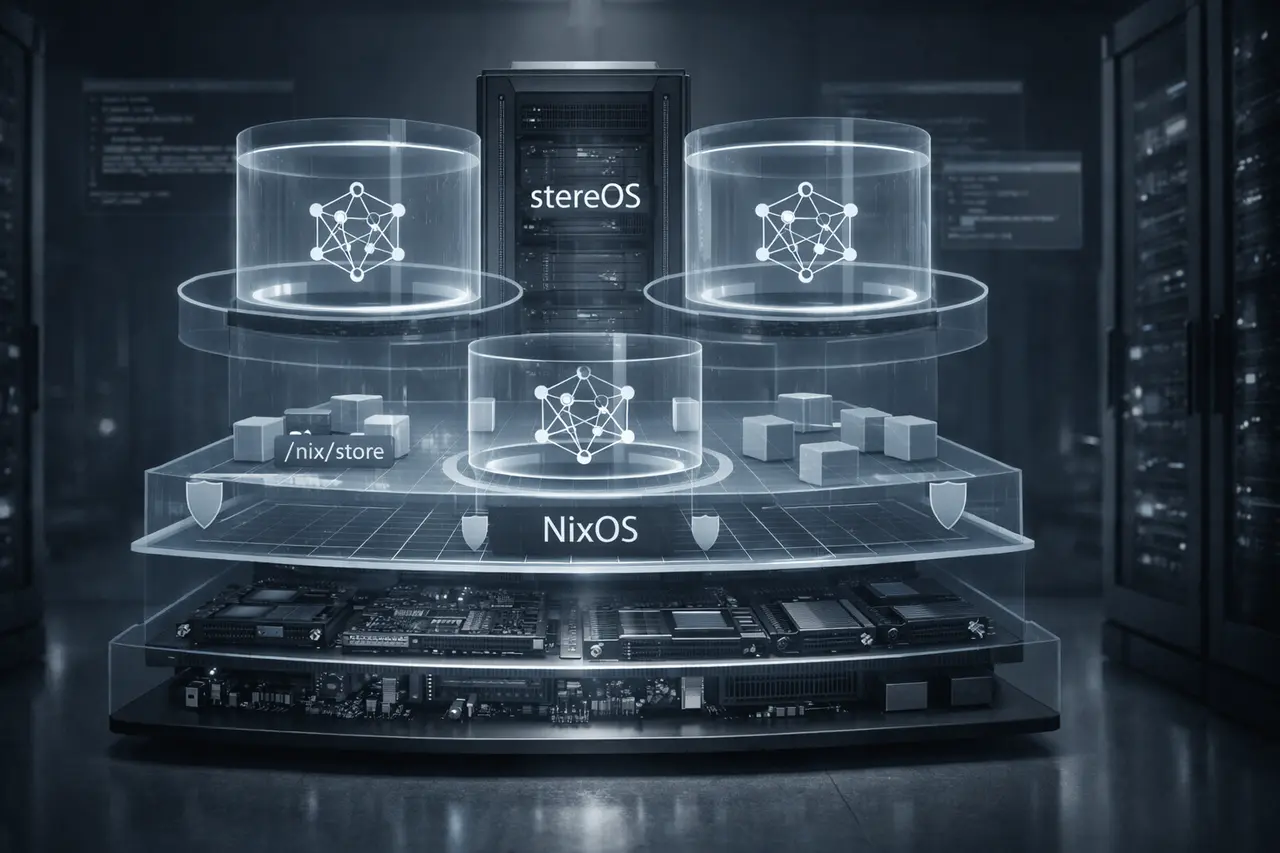
stereOS is an enhanced Linux operating system based on NixOS, designed to provide security-conscious, scalable execution of AI agents.
It combines:
- Full Linux environment
- Immutable /nix/store architecture
- gVisor-based sandboxing
- Kernel isolation per agent
- Defense-in-depth privilege separation
In contrast to container-only systems, stereOS provides a real operating system layer, giving agents the freedom they need while ensuring strong containment boundaries.
How does stereOS Work?
1. Built on NixOS
stereOS utilizes NixOS as its basis. NixOS is a platform that provides:
- Reproducible builds
- Declarative system configuration
- Immutable package storage (/nix/store)
- Strong dependency isolation
The store is designed to be read-only. This greatly reduces the risk of a persistent system failure.
2. Agent Sandboxes using GVisor
In stereOS, agents’ sandboxes run using gVisor, the user-space kernel that blocks and separates system calls.
Each agent receives:
- Its own kernel’s virtual boundary
- Namespaced access to file systems
- Interaction is controlled by the resources of the system
If an agent does not pass through the gVisor layer, it does not appear on host hardware. It will be a limited “agent” user within the NixOS system – thereby establishing a further isolation barrier.
3. Defense-in-Depth Architecture
StereOS utilizes the layered containment method:
- gVisor virtual kernel isolation
- Namespace mounting of /nix/store
- Restricted system-level permissions
- Optional system-level agent execution via agentd
This design is layered to reduce the risk of blast radius from untrusted or autonomous agents.
Native Agents and Agentd
Alongside sandboxed agents, stereOS also supports “native” agents.
They are launched using the agentd utility and are run on the system level with restricted rights.
Native agents can:
- Orchestrate sub-agents
- Manage sandbox lifecycles
- Coordinate workflows
- Trigger nested isolation mechanisms
It lets you use structured multi-agent systems while maintaining internal sandboxing limits.
StereOS vs Traditional Virtualization
| Feature | Docker | Firecracker | Native VM | stereOS |
|---|---|---|---|---|
| Full Linux OS | No | Partial | Yes | Yes |
| Lightweight Isolation | Yes | Yes | No | Yes |
| Hardware Access Flexibility | Limited | Restricted | Yes | Supported |
| Sub-Virtualization | Broken (Docker-in-Docker) | Limited | Heavy | Supported |
| Immutable Base System | No | No | No | Yes (NixOS) |
| Agent-Centric Design | No | No | No | Yes |
stereOS uniquely offers OS-level functionality and sandbox-level confinement.
Why is stereOS important in AI Infrastructure?
As AI agents evolve into autonomous, the risk to infrastructure increases. A poorly sandboxed AI agent could:
- Exfiltrate data
- Deploy malicious infrastructure
- Modify system state
- Abuse hardware resources
The traditional containerization system was designed for use with adversarial, self-directed, autonomous AI systems.
stereOS responds to this by:
- Enforcing immutable system state
- Reducing privilege escalation vectors
- Enabling secure hardware access
- Supporting nested sandboxing
It is an evolution of the infrastructure away from “container-first AI” to “OS-first AI.”
Application Real-World of StereOS
is especially relevant to:
AI Research Environments
Tests that are secure of autonomous agents that are experimental without putting host systems at risk.
Multi-Agent Orchestration
Hierarchical agent systems in which parent agents create agents and oversee sub-agents.
AI DevOps Automation
Agents that provision infrastructure and services, or deploy them, or manage pipelines for CI/CD.
GPU-Dependent AI Workloads
scenarios that require hardware passthrough, which microVMs with lightweight capabilities cannot support.
Autonomous Code Execution Platforms
Platforms on which AI writes, compiles, and dynamically executes code.
The advantages of the stereOS
- Purpose-built for AI agents
- True operating system foundation
- Immutable base system via NixOS
- gVisor-backed sandboxing
- Defense-in-depth security model
- Support for multi-agent architectures that can be scaled
- More efficient than full VMs
Limitations and Considerations
In the meantime, stereOS introduces a new architecture that businesses should take into consideration:
- Operational difficulty of managing a custom OS layer
- Compatible with orchestration stacks that are already in use
- Learn curve in NixOS environments
- Resource planning for large-scale agent deployment
It isn’t a drop-in replacement for container platforms. It is a distinct architecture.
Practical Considerations for Deployment
Organizations that evaluate stereOS must:
- Define trust boundaries for agent workloads
- Different orchestration and execution agents
- Make use of defense-in-depth Sandbox layers
- Monitor resource consumption across sub-agents
- Integrate audit and logging trails
If used with care, the stereOS platform can dramatically lower the risk of infrastructure in autonomous AI systems.
The Future of AI Agent Operating Systems
AI agents are quickly developing towards greater autonomy. As their capabilities increase, the infrastructure needs to evolve accordingly.
The future could include:
- Dedicated AI-native operating systems
- Hardware-aware sandboxing
- Frameworks for multi-layered isolation
- Agent lifecycle orchestration at the OS level
stereOS is a very early custom-built implementation of this model.
My Final Thoughts
stereOS redefines what infrastructure must be, as it is designed to support autonomous AI agents. Instead of relying on microVMs, containers, or ad hoc Sandboxes, it offers an enhanced Linux operating system specifically designed for agent execution.
By combining NixOS’s ability to change its properties, GVisor separation, and layered privilege limits, stereOS mitigates the risks posed by untrusted or autonomous actors while providing advanced capabilities for agents.
In the future, as AI technology continues to increase in both complexity and autonomy, operating systems like stereOS could become the foundational technology for ensuring secure, scalable agent deployment.
FAQs
1. What is
stereOS is an operating system based on Linux, designed specifically to run AI agents securely with NixOS and gVisor-based Sandboxing.
2. How is stereOS different than Docker?
Docker offers container isolation that is not fully OS-level and is not sub-virtualization. stereOS provides a complete OS with layers of isolation designed specifically for autonomous agents.
3. Does stereOS support GPU workloads?
Yes. Unlike microVMs with lightweight capabilities that limit hardware access, stereOS was designed to ensure compatibility with hardware when needed.
4. What’s the purpose of NixOS in StereOS?
NixOS provides an unchangeable, repeatable system base by using a read-only /nix/store, reducing the risk of persistent attacks.
5. Are there ways to let stereOS be able to run several AI agents at the same time?
Yes. stereOS allows multiple sandboxed agents. Additionally, native agents can manage sub-agents by using the internal mechanisms for sandboxing.
6. Are stereOS’s capabilities suitable for use in production AI infrastructure?
It was designed to support security and scalability. automated agent implementation. It is recommended that organizations evaluate the compatibility of HTML0 with their orchestration stacks and security requirements before deployment.
Also Read –
T54Ai and the Future of Trusted AI Agents