
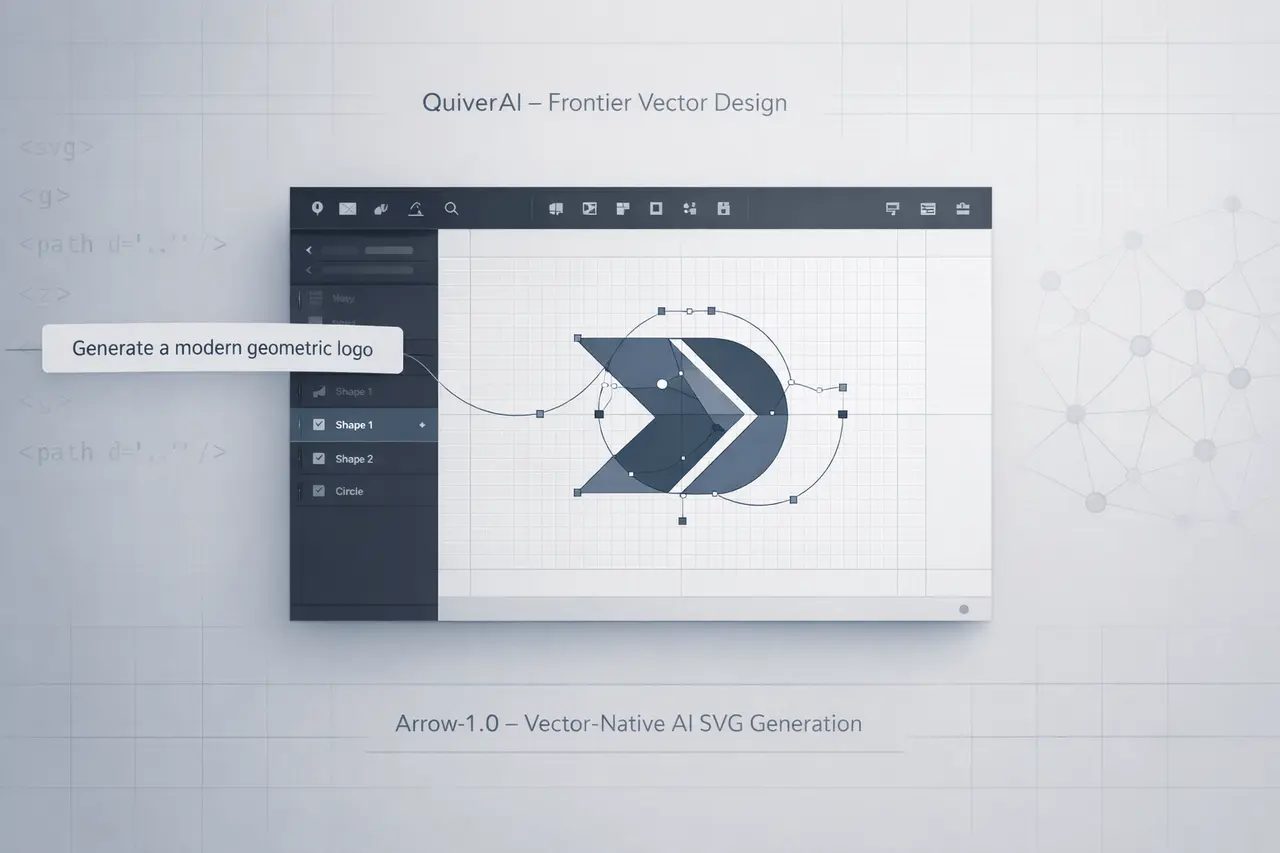
QuiverAI is an AI laboratory and product company focused on the design of vectors at the frontier. In early 2026, QuiverAI announced the close of an $8.3 million seed funding round led by Andreessen Horowitz (a16z), with participation from angels and early-stage investors.
The first product that it has released, Arrow-1.0, is an AI model that creates SVG (Scalable Vector Graphics) files from images and text prompts. Arrow-1.0 is currently in public beta through QuiverAI’s web application.
This announcement marks an important shift in how AI considers graphic design and treats visuals not just as pixels but as written software.
What Is QuiverAI?
QuiverAI is advertised as a combination of:
- An AI research lab focused on vector-native model development
- A product company building tools for real-world design workflows
The company’s direction is based on previous research in SVG generation, with a focus on vector graphics rather than rasterised images.
Frontier Vector Design Explained
Classic generative AI models generate raster outputs (PNG, JPEG), which are images composed of fixed-pixel grids.
The QuiverAI approach is based on vector-based AI generation, and outputs include:
- Editable
- Composable
- Resolution-independent
- Codified as a code
This allows greater control and integration with designing tools.
What Is Arrow-1.0?
Arrow-1.0 is the first production model specifically designed for use in AI-generated SVGs.
Core Capability
Arrow-1.0 creates an SVG file directly out of:
- Text prompts
- Input images
- Multimodal inputs merged
In contrast to raster diffusion models, Arrow-1.0 outputs structured vector code which can be viewed and edited by traditional vector design tools.
How Arrow-1.0 Works: Visual Code Generation?
QuiverAI’s approach is built on a paradigm called visual code generation.
Instead of forecasting pixels, produce:
- SVG paths
- Shapes
- Layers
- Gradients
- Transform attributes
At its core, it generates vectors structured with XML rather than bitmap approximations.
Why This Matters?
Treating visuals as code enables:
- Direct editability
- Component reuse
- Parameter-level refinement
- seamless integration into the design process of products
This is a method that aligns with how professionals and developers utilise vector-based assets.
Feature Comparison: Raster AI vs Arrow-1.0
| Feature | Traditional Raster AI Models | Arrow-1.0 (Vector-Native AI) |
|---|---|---|
| Output Format | PNG / JPEG | SVG |
| Editability | Limited | Fully editable |
| Scalability | Fixed resolution | Infinite scaling |
| Layer Structure | Flattened | Structured paths & layers |
| Integration in Design Tools | Requires tracing | Native compatibility |
This distinction makes Arrow-1.0 particularly relevant to UI designers, product teams, and branding processes.
Real-World Applications of AI Vector Generation
1. UI and Product Design
- Icon generation
- Component Illustrations
- Design system assets
- Scalable interface graphics
Vector-native output decreases the manual redrawing and tracing process.
2. Branding and Marketing
- Logo concepts
- Infographics
- Social media assets
- Presentation visuals
SVG output enables rapid iteration and resizing without sacrificing quality.
3. Developer Workflows
Since SVG is a code-based asset, it may include:
- Incorporated directly into web-based applications
- Modified programmatically
- Optimised for performance
This combines AI design tools and front-end design workflows for engineers.
Seed Funding and Strategic Backing
The QuiverAI’s $8.3M Seed round was directed by Andreessen Horowitz (a16z), one of Silicon Valley’s most well-known venture firms.
Seed financing at this point usually provides:
- Research and development of models, as well as training
- Infrastructure scaling
- Team expansion
- Product refinement
The backing indicates an investor’s confidence in Vector-Native AI Systems as a new category of generative AI.
Use Cases by Industry
| Industry | Use Case | Business Benefit |
|---|---|---|
| SaaS | UI icons & illustrations | Faster design cycles |
| E-commerce | Product graphics | Scalable marketing assets |
| Media | Infographics | Rapid content production |
| Education | Visual explainers | Editable teaching materials |
| Startups | Branding kits | Cost-efficient asset generation |
Benefits of QuiverAI’s Approach
Precision and Control
Structured SVG output allows designers to modify specific paths, anchor points, and layers.
Workflow Integration
Assets created in Arrow-1.0 can be utilised directly to:
- Design software
- Web applications
- Developer environments
Iterative Design
Since images are generated from code, iteration can be more controlled and systematic than in pixel-basedAI outputs.
Limitations and Practical Considerations
In the public beta software, Arrow-1.0 may face:
- Complex prompt sensitivity
- The structure of the accessibility is not always clean.
- Learning curve for optimal output control
Vector generation is more structured than raster generation, which makes certain art styles more difficult to convey than in diffusion-based systems.
Companies evaluating Arrow-1.0 should take into consideration:
- Compatible with existing design stacks
- Refinement needed for post-generation
- Team familiarity with SVG workflows
Broader Shift Toward Structured AI Outputs
QuiverAI is a reflection of a larger trend in AI towards more structured Generation :
- Code generation models
- Structured document generation
- API-aware AI systems
Vector graphics are a natural fit for this trend, as they are programmable and definable.
With its focus on vector-native generation rather than pixel imitation, QuiverAI is positioning itself within a technologically distinct, potentially high-leverage class of generative AI tools. AI software.
My Final Thoughts
QuiverAI is a major advancement in the development of AI-powered design software. By focusing on vector-native creation, QuiverAI shifts AI image creation away from predicting pixels to an organisedan organised visual code.
With $8.3 million in initial capital backed by Andreessen Horowitz, and the debut of Arrow-1.0 in beta, public QuiverAI has positioned its company at the intersection between AI research and workflows for professional designers.
As the field of generative AI develops, the use of structured outputs, such as SVG, could become increasingly important for teams that require accuracy, editability, and seamless interoperability. QuiverAI’s pioneering vector design approach suggests that the next phase of AI innovation may not only produce images but also visual systems driven by code.
Frequently Asked Questions (FAQs)
1. What is QuiverAI?
QuiverAI is an AI lab and product company focused on designing vectors at the frontier, creating models that generate SVG graphics from images and text.
2. What exactly does Arrow-1.0 accomplish?
Arrow-1.0 is an AI model that produces editable SVG files using text prompts and images. It is now available as a public beta via QuiverAI’s web application.
3. What makes Arrow-1.0 different from other image generators?
In contrast to Renderer-based AI models that produce PNG and JPEG files, Arrow-1.0 produces structured SVG code that supports full editing and scaling.
4. Who was the QuiverAI seeder who won?
$8.3 million initial round managed by Andreessen Horowitz (a16z) together with additional early-stage and angel investors.
5. What is the significance of vector-native AI?
Vector-native AI creates graphic structures that can be modified, enlarged, and integrated directly into professional workflows for design and development.
6. Is Arrow-1.0 production-ready?
Arrow-1.0 has entered public beta. Teams are encouraged to test it in their workflows to determine whether it is suitable for use in production.
Also Read –
T54Ai and the Future of Trusted AI Agents