

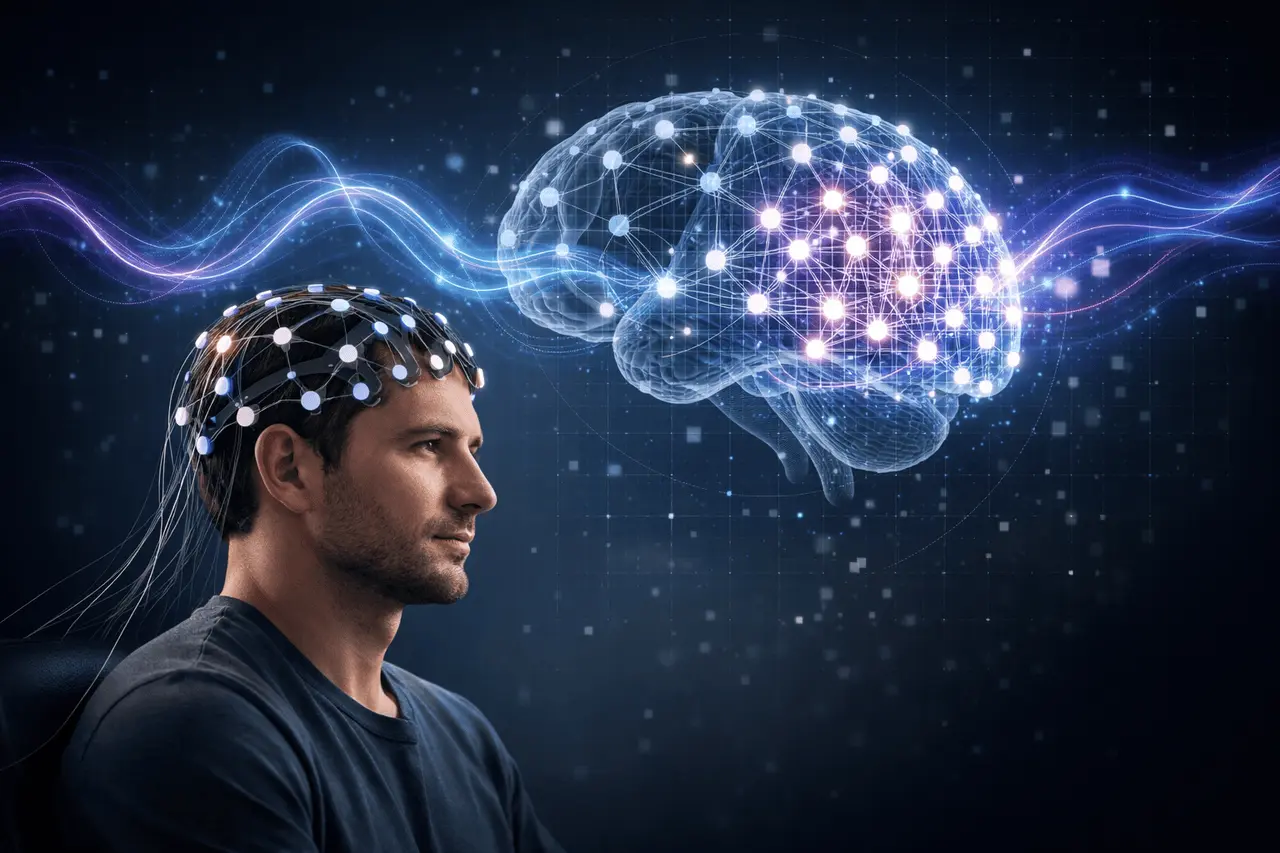
ZUNA EEG reconstruction is an advanced approach to rebuilding high-fidelity brain signals from sparse or noisy electroencephalography (EEG) data. The goal is to improve diagnostics, neuroscience research, and brain-computer interface (BCI) systems. ZUNA addresses long-standing limitations in non-invasive EEG processing.
EEG is used extensively because it is accessible, informative and useful for real-world applications. But EEG signals are often imperfect, messy, or degraded by artefacts. ZUNA offers a scalable method for restoring low-quality or missing channels without additional equipment or retraining.
This article will explain what ZUNA means, how it functions, and why it is important for BCI systems, and how it compares to conventional EEG interpolation techniques.
What is ZUNA?
ZUNA is a machine-learning-based EEG reconstruction model trained to extract high-quality brain signals from weak or insufficient EEG recordings.
It was taught on:
- Two million hours of channel time
- 208 EEG datasets
- Multiple electrode layouts and electrode configurations
The key innovation lies in the use of masked diffusion training coupled with 4D spatial embeddings, which allows the system to generalise across different datasets and electrode systems.
Unlike classical interpolation techniques, ZUNA:
- Predicts channels that are missing due to a lack of data
- uses electrode coordinates for reconstruction
- scales range from headsets for consumers to research systems with 256 electrodes
- Requires no training when electrode layouts alter
Why EEG Reconstruction Matters?
Role of EEG in BCI as well as Diagnostics
EEG tracks electrical activity in the scalp by using electrodes. It is typically used for:
- Diagnose neurological disorders
- Monitor brain states
- Support research in cognitive neuroscience
- Allow thought-to-text BCI applications
Since EEG is inexpensive and noninvasive, it can be a key component of scalable brain-computer interface systems.
Issue: Noisey and Incomplete Signals
Despite having a wealth of information, EEG data is frequently damaged through:
- Channel dropouts
- Motion artifacts
- Electrical noise
- Sparse electrode coverage
These issues can affect signal quality, diminish clinical efficacy, and restrict the development of advanced BCI software.
Traditional interpolation techniques attempt to identify channels that are not available; however, they decrease significantly when:
- Electrode density is very low.
- Upsampling can be aggressive (e.g. 4x)
- Electrode layouts vary across datasets
ZUNA was developed to break through these limitations.
How ZUNA EEG Reconstruction Works?
1. Masked Diffusion Training
ZUNA can be trained with a method of masked diffusion in which:
- Random EEG channels are hidden during training.
- The model is trained to identify absent signals.
- Noise modelling enables robust signal recovery.
This technique helps the system learn spatial and temporal relationships across electrode arrays.
2. 4D Spatial Embeddings with Spatial Embeddings
ZUNA incorporates electrode coordinate information into its model architecture.
This allows it:
- Understand geometric relationships between electrodes
- adapt to any layout
- Generalise across research-grade and consumer devices
Since spatial awareness is built into ZUNA’s system, it doesn’t require retraining electrodes for new configurations.
ZUNA vs Traditional EEG Interpolation
The most well-known method of EEG channel reconstruction uses spherical spline interpolation, implemented in tools like MNE.
Below is an analysis of ZUNA compared to traditional interpolation techniques.
Feature Comparison Table
| Feature | ZUNA | Spherical Spline Interpolation |
|---|---|---|
| Learns from large datasets | Yes (2M channel-hours) | No |
| Uses spatial embeddings | Yes | Limited geometric assumptions |
| Handles arbitrary electrode layouts | Yes | Performance varies |
| Scales to 256 electrodes | Yes | Performance degrades |
| Requires retraining for new layouts | No | Not applicable |
| Performance at 4× upsampling | Strong | Often breaks down |
ZUNA has shown increasing benefits as upsampling speeds increase, especially when 4x reconstruction is used, where traditional approaches struggle.
Application Real-World of ZUNA
1. Brain-Computer Interfaces for Thought-to-Text
High-resolution signal reconstruction improves:
- Decoding accuracy
- Temporal precision
- Veracity in actual-world conditions
It is crucial to scale a noninvasive BCI system.
2. Clinical Diagnostics
Better signal fidelity support:
- More accurate assessments of the neurological
- More effective in detecting subtle anomalies
- Reduction of dependence on electrodes with dense setups
3. Consumer EEG Devices
ZUNA is a great way to enhance low-channel headsets by anticipating missing data, effectively reducing the gap between research and consumer systems.
Use Cases for Industry
| Industry | Application | Benefit |
|---|---|---|
| Healthcare | Neurological diagnostics | Improved signal clarity |
| Neuroscience Research | High-density signal modeling | Cross-dataset generalization |
| BCI Development | Thought decoding systems | Higher reconstruction fidelity |
| Consumer Neurotech | Wearable EEG headsets | Enhanced data quality without hardware upgrades |
Benefits of ZUNA EEG Reconstruction
- Generalises across 208 datasets
- Training based on massive-scale EEG data
- It is compatible with sparse and dense systems.
- No retraining needed to learn new layouts
- Excellent performance with high upsampling
Its capacity to scale without any architectural modifications makes it suitable for both research labs and commercial applications.
Limits and the Practical Aspects
While ZUNA shows strong reconstruction performance, practical deployment depends on:
- Integration into existing EEG processing pipelines
- Computational resource requirements
- Validation in particular clinical settings
As with any AI-driven signal reconstruction system, external validation and benchmarking are essential before clinical deployment.
Why is ZUNA a breakthrough in BCI that can be scaled?
Brain-computer interface systems require:
- High signal high-quality
- Robustness across environments
- Flexibility to different hardware
Traditional EEG reconstruction techniques rely on geometric interpolation assumptions that do not hold when coverage is absent or when oversampling is insufficient.
ZUNA’s masked diffusion-based learning and spatial embeddings enable robust generalisation across datasets and electrode layouts. This is a significant technological advancement in non-invasive BCI infrastructure.
By improving signal reconstruction without requiring new equipment, ZUNA reduces barriers to widespread EEG use.
My Final Thoughts
ZUNA EEG reconstruction represents a significant improvement in high-quality, non-invasive neural signal processing. Using masked diffusion training and 4D spatial embeddings, ZUNA reconstructs high-quality EEG signals across dense and sparse electrode systems without retraining.
Its outstanding performance at high-speed upsampling, its ability to generalise across different datasets, and its compatibility with research- and consumer-grade systems make it the foundational technology for the next generation of interfacing with brain computers.
While EEG continues to be the foundation for neuroscience research and diagnostics, and even thought-to-text BCI applications, strong reconstruction models such as ZUNA will play a major part in advancing possibilities of noninvasive neurotechnology.
Frequently Asked Questions
1. What is it that makes ZUNA different from conventional EEG interpolation?
ZUNA utilises machine learning trained on massive EEG datasets, whereas conventional methods rely on mathematical interpolation assumptions without data-driven learning.
2. Can ZUNA be used alongside consumer EEG headsets?
Yes. ZUNA can recreate missing channels from sparse systems. It doesn’t require retraining to accommodate various electrode configurations.
3. Does ZUNA require an additional piece of hardware?
No. It enhances signal quality using existing EEG recordings without the need for electrodes or hardware modifications.
4. Why is it important to upsample 4x?
Higher upsampling can improve the spatial resolution. Traditional methods tend to degrade with 4x reconstruction, whereas ZUNA retains its high performance.
5. Is ZUNA appropriate for use in clinical settings?
It is a promising technology clinically, but its implementation depends on validation in specific medical settings.
6. How big was the training data?
ZUNA is trained on 2 million channel-hours across 208 EEG databases.
Also Read –
Tiny Aya Multilingual Model: 3.35B AI for 70+ Languages