

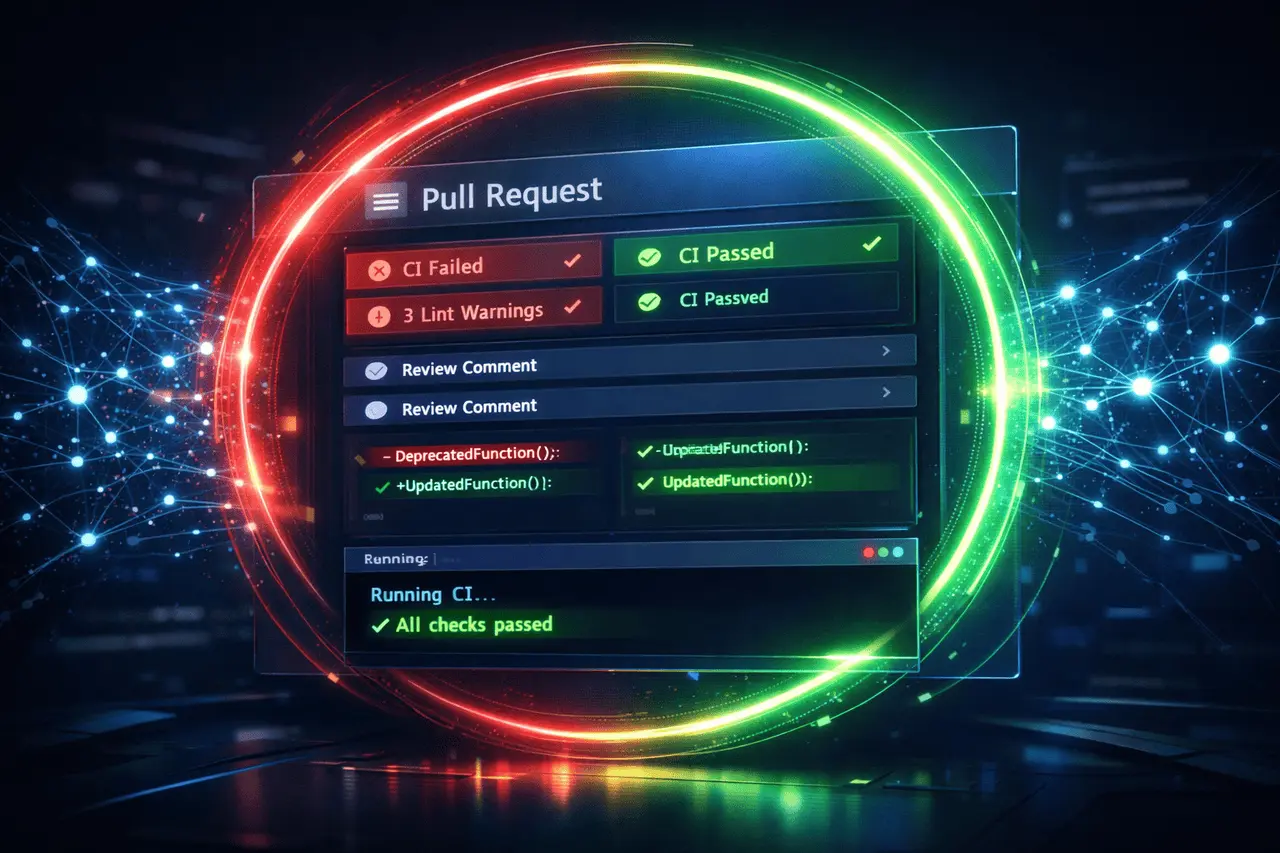
Software teams often review Pull Requests (PRs), fix lint issues, resolve CI problems, and respond to automatically generated review feedback. Devin Autofix changes that workflow by providing an AI agent for coding that automatically fixes problems through its own requests, thus closing the loop with no constant human intervention.
This feature extends pipeline automation for development in the present. Instead of halting at the code generation stage, the agent repeats the process until the checks pass, review comments are addressed, and the PR meets high-quality standards.
What is Devin Autofix?
Devin Autofix is a function developed by Cognition’s AI software engineer, Devin. It allows Devin to address issues discovered during the pull request review process automatically.
If a PR designed by Devin receives:
- Commentary on review by Devin Review
- Bot feedback from an automated system
- CI pipeline failures
- Errors in formatting or linting
Devin responds by making changes to the PR and, without prompting, the manual.
It is the end of what’s commonly called, within AI development processes, the “agent loop”: the process of creating, evaluating the results, fixing it, re-evaluating, and repeating until the process is completed.
Reasons Why Closing the Agent Loop Matters?
AI-assisted coding tools often end up generating code. Developers should still:
- Interpret review comments
- Diagnose CI failures
- Fixes to be applied
- Re-run pipelines
The manual loop is limiting productivity increases.
However, Devin Autofix permits an agent:
- Detect issues that are flagged
- Apply specific corrections
- Re-run checks
- Continue to repeat until all checks are passed
This results in a more autonomous development process aligned with the latest DevOps automation techniques.
How Devin Autofix Works?
On a more fundamental level, Devin Autofix integrates with pull request workflows and auto-feedback systems.
Step 1: PR Creation
A pull request contains code that has been modified or created.
Step 2: Automated Review & CI Feedback
Feedback could originate from:
- Devin Review
- GitHub bots
- CI pipelines
- Linting tools
Step 3: Automated Iteration
If there are issues:
- Devin examines the feedback
- Changes the codes
- Updates are pushed in the same way to the PR
- Re-triggers CI checks
It will continue until the checks have passed or Autofix is turned off.
Workflow Comparison Table
| Workflow Stage | Traditional AI Coding | With Devin Autofix |
|---|---|---|
| Code generation | AI writes code | AI writes code |
| Review feedback | Developer reads comments | AI reads comments |
| CI failure fixes | Manual debugging | AI fixes automatically |
| Lint resolution | Developer updates formatting | AI resolves lint issues |
| Iteration loop | Human-driven | Agent-driven |
| Final merge readiness | Slower, manual iteration | Faster, automated completion |
This technology significantly reduces the developer’s burden, especially in repositories that have strict CCI enforcers.
Configuring Devin Autofix
Administrators can enable Autofix under the heading Customization in Settings.
Autofix can be scoped to:
- All bot comments
- Only specific bots
- Disabled entirely
This flexibility lets teams maintain control over the level of freedom Devin is allowed within the review loop.
For teams worried about excessive automation, scoping Autofix to reliable review sources is a sensible method.
Devin Review Integration
Autofix collaborates closely with Devin Review, the review system available at devinreview.com.
Notably:
- Devin Review works on both private and public PRs
- A GitHub account connection isn’t required for use
If Devin Review reports issues, Autofix can automatically address them, reducing the back-and-forth between automated reviewers and developers.
Principal Benefits of Devin Autofix
1. Reduction of Developer Overhead
Engineers are less involved in working on mechanical issues, such as:
- Formatting problems
- Minor test failures
- Warnings about static analysis
2. Faster CI Cycles
Continuous integration systems typically fail builds due to minor issues. Autofix speeds up cycle times by resolving issues without manual intervention.
3. Better Quality PR
Because Devin can iterate until checks pass, the more likely PRs are to:
- Meet lint standards
- Pass tests
- Automated codes review regulations
4. Stronger DevOps Alignment
Modern software delivery is based on automation. Autofix matches AI Agents with
- CI/CD pipelines
- Automated code quality tools
- Policy-driven development environments
Use Cases for Team Type
| Team Type | How Devin Autofix Helps |
|---|---|
| Startups | Speeds iteration with small teams |
| Enterprise engineering | Reduces review overhead in large repos |
| Open-source maintainers | Improves contributor PR quality |
| Platform teams | Enforces CI/lint compliance automatically |
In highly compliant or regulated situations, Autofix can be scoped to ensure compliance with governance standards.
Practical Perspectives
While extremely powerful, Autofix operates within defined limits.
Configuration Control
Admins determine:
- What bots trigger Autofix?
- The Autofix global application is not a problem.
- When should you turn it off?
The assurance that automation cannot override deliberate human-based review decisions.
Depends upon Clear Feedback
Autofix is most effective when feedback is well-structured and machine-readable. For instance:
- CI error logs
- Lint output
- Review comments generated by bots
Human comments with ambiguous human voices might need an explanation by hand.
Codebase Complexity
In huge or extremely interconnected codebases, autofixes may require several iterations before CI succeeds. The automated fix is built to keep running checks until they succeed.
Devin Autofix in the context of AI Software Engineering
AI Coding tools have advanced from autocomplete systems and have evolved into agent-based software engineers who can:
- Planning tasks
- Writing multi-file changes
- The management of the state of sessions
Devin Autofix represents another improvement: autonomy in quality control.
Instead of using reviews and CI as validations for external sources, Autofix incorporates them into an agent’s workflow. The result is that pull requests are transformed from static artifacts to self-improved submissions.
Rules and Limitations and Governance Aspects
While Autofix enhances autonomy, teams must consider:
- Review the accountability policies
- Merge approval requirements
- Compliance logging
- Configurations for access control
Automation should supplement, not replace, human supervision, particularly in production systems that have high-risk workloads.
Impact on the Productivity of Developers
By 2026, AI coders will begin to be incorporated into full DevOps processes.
The old model:
- The developer writes code
- Reviewer comments
- Developer fixes
- CI runs again
Using Devin Autofix, steps 2-4 may run automatically when issues arise from the tool or mechanical components.
This shifts the developer’s time to:
- Architectural decisions
- Complex debugging
- Product logic refinement
Instead of fixing lint issues or formatting issues.
My Final Thoughts
Devin Autofix represents a significant advancement in AI-driven software engineering. By automatically resolving review comments, CI failures, and lint issues, it can close the loop between generation and validation, reducing friction in pull request workflows.
The system’s scope is adjustable, allowing teams to maintain control over governance while reaping the benefits of automation. In today’s DevOps environments, where CI/CD pipelines have strict quality controls, closing the loop on agents is not only convenient but strategically important.
Over time, as AI agents are embedded in development pipelines, capabilities such as Devin Autofix signal a shift from assistive coding tools to self-contained engineering systems that can be integrated directly into production workflows.
FAQs
1. How do I find Devin Autofix?
Devin Autofix will be an option that allows Devin, the AI Software Engineer, to automatically correct issues identified in its own pull requests, such as CI bot comments and bot failures.
2. What is the procedure to help Devin Autofix close the agent loop?
It reviews automated feedback, makes corrections and updates to the PR, and runs checks again until all issues are resolved.
3. Can administrators manage Devin Autofix behavior?
Yes. Administrators can enable Autofix on the Settings tab and select whether it applies to all bots, a specific bot, or is deactivated completely.
4. Does Devin Review require a GitHub account connection?
No. Devin Review can be used to pull private or public requests, without requiring a GitHub account.
5. What kinds of problems can Devin Autofix resolve?
It is a way to address CI problems, lint mistakes, formatting issues, and automated review comments from bots.
6. Are you sure that Devin Autofix is fully autonomous?
It is a way to automate the resolution of feedback generated by tools and mechanical mechanisms. However, the human oversight and approval workflows remain vital.
Also Read –
Codemaps in Windsurf: Revolutionizing Code Understanding with AI