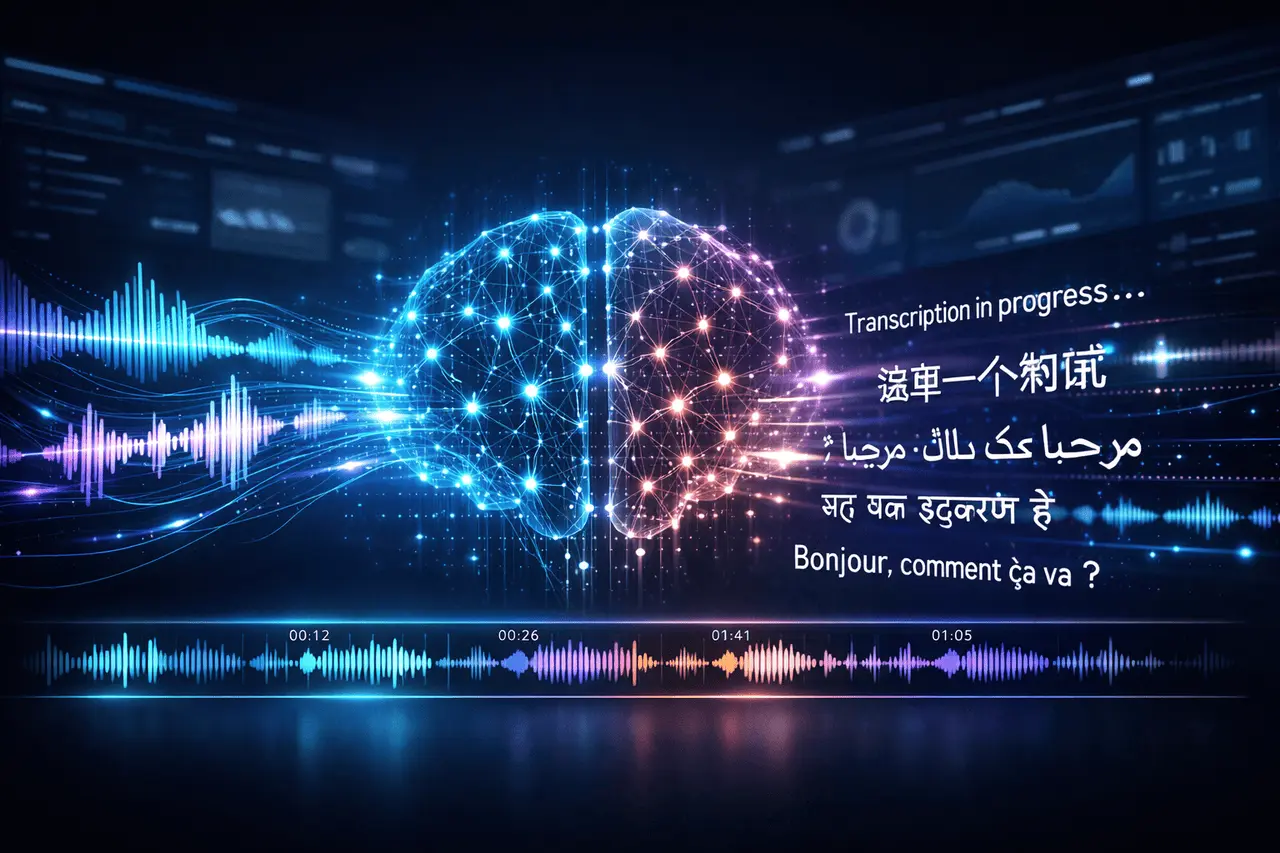
Qwen3 ASR represents a significant leap forward for open-source speech recognition, offering production-ready capabilities for real-world audio. It was released alongside Qwen3 ForcedAligner. The model family is focused on robustness, multilingual coverage, and precise alignment, areas that have traditionally impeded free speech technologies.
It is designed to handle messy inputs, such as noisy environments, mixed speakers, or even singing. The Qwen3 ASR aims to bridge the gap between research-quality and deployed speech-based AI models.
What is Qwen3 ASR?
Qwen3 ASR is free and open-source automatic speech recognition software designed to process complex, real-world audio at scale. It can handle a wide range of dialects and languages. It includes automatic language identification and processes large audio files with ease.
The software also includes Qwen3-ForcedAligner, an additional tool for creating accurate word- and phrase-level time stamps. Together, they form an end-to-end speech-to-text alignment stack suitable for both production and research.
Why Qwen3 ASR Matters?
Speech recognition systems usually do well when benchmarks are controlled; however, they fail when faced with noisy or different situations. Qwen3 ASR fills this gap by focusing on robustness and practicality.
The main reasons why it is essential are:
- Reliable transcription in noisy, complex audio environments
- Multilingual and broad dialectal coverage
- Audio processing in long-form, without chunking that is aggressive
- Open-source licensing is suitable for modification and deployment
This makes Qwen3-ASR useful for research, enterprises, and developers who are developing
applications that use speech.
Qwen3 ASR’s Core Capabilities
Dual Language, Dialect, and Multilingual Support
Qwen3 supports the following dialects and languages:
- 30 different languages that use automatic identification of languages
- 22 accents and dialects to improve accuracy in regional settings
Automated language identification enables the model to recognize spoken language without manual configuration, thereby simplifying Multilingual Pipelines.
The Robustness of Real World Audio
The model was designed to be stable in:
- Background noises and sounds that overlap
- Informal speech patterns
- Music, singing, and other song-like audio
This robustness makes Qwen3 perfect for recordings made outside studio conditions, such as live events or user-generated content.
Long Audio Processing
Qwen3-ASR can handle up to 20 minutes of sound in a single session, thus reducing the need for fine-grained segmentation. This is especially useful for:
- Interviews and meetings
- Podcasts and lectures
- Long-form media transcription
Qwen3 ForcedAligner: High-Precision Speech Alignment
Qwen3 ForcedAligner goes beyond transcription by providing accurate time alignment between text and audio.
Alignment Accuracy
The aligner can provide phrase- and word-level timestamps across 11 languages, enabling synchronization of text and speech.
Its alignment accuracy is described as superior to traditional methods in light of:
- MFA-style aligners
- Alignment based on CTC
- CIF-style alignment
The format is ideal for speech analytics, subtitle generation, and linguistic research.
Feature Comparison Table
| Feature | Qwen3-ASR | Traditional ASR Systems |
|---|---|---|
| Language Coverage | 52 languages & dialects | Often limited or manual |
| Noise Robustness | High, real-world focused | Degrades in noisy audio |
| Long Audio Support | Up to 20 minutes per pass | Requires heavy chunking |
| Auto Language ID | Yes | Often unavailable |
| Forced Alignment | Word/phrase-level precision | Sentence-level or coarse |
The Inference process and fine-tuning of the Stack
Qwen3 ASR provides a complete open-source inference system and fine-tuning tool that reduces the effort required to experiment before deployment.
Supported Serving Modes
The stack can support:
- Batch inference for large-scale processing
- Streaming inference for real-time transcription
- Asynchronous serving for scalable applications
Integration with workflows based on vLLM enables the most efficient use of current hardware.
Fine-Tuning Flexibility
Developers can modify Qwen3-ASR for domain- or vocabulary-specific accents using the tuning pipeline. This is essential for companies with unique speech patterns.
Real-World Applications
Media and Entertainment
- Subtitling for long-form videos
- Transcription of songs as well as musical performances
- Content indexing for audio archives
Business and Productivity
- Call transcription and meeting
- Multilingual customer support analysis
- Voice-driven documentation systems
Research and Linguistics
- Word alignment
- Speech analysis in multilingual languages
- Annotation of a dataset at a scale
Advantages as well as Limitations
Advantages
- Production-ready and open-source
- High performance for noisy settings
- Multilingual and broad support
- Correct forced alignment for a select set of languages
Practical Limitations
- The high-precision force alignment is currently restricted to up to eleven languages
- The deployment process still requires compute resources
- Fine-tuning demands curated audio data for best results
Practical Options for Adoption
Before deploying Qwen3 ASR, organizations must evaluate:
- Language of target and coverage requirements for dialects
- Infrastructure requirements for long audio processing
- If forced alignment is needed for the particular case
Teams that work with similar AI model or comparable speech technologies could easily integrate due to the modular nature of their stack.
My Final Thoughts
Qwen3-ASR is a mature open-source speech recognition system that offers robustness, multilingual support, and long-audio handling in a single system. The addition of Qwen3 ForcedAligner enhances its utility in applications that require precise timing and alignment. Speech interfaces are continuing to expand across all industries. Qwen3-ASR is a versatile, future-proof platform for building robust, real-world speech AI systems.
FAQs
1. What are the uses of Qwen3ASR?
Qwen3-ASR can be used to perform multilingual speech-to-text transcription, particularly in real-world or noisy conditions.
2. How many languages can Qwen3 ASR support?
This supports 52 dialects and languages, including 30 with automatic language identification.
3. Does Qwen3ASR support long audio files?
True, it can process up to 20 minutes of audio in a single run without ad hoc segmentation.
4. What is Qwen3 ForcedAligner?
Qwen3-ForcedAligner provides high-precision phrase- and word-level timestamps, enabling precise alignment of audio and text.
5. Does Qwen3 ASR meet the requirements for production?
Yes, it’s intended to be production-ready and has a complete inference and fine-tuning of the stack.
Also Read –
Qwen3-TTS: Open-Source Multilingual Text-to-Speech