
Modern AI agents can sound extremely competent but are unable to perform real-world tasks. Things like fixing bugs, running terminal commands, or managing messy repositories require perseverance, resilience in the face of errors, and awareness of tools.
In these areas, most models fail because they stop too soon, just before they are ready, or break when they are in uncertainty. ROME’s research addresses this issue by proposing a novel method for training agents that focuses on ROME AI agent, genuine tools, long-horizon execution, and outcomes-driven learning, rather than superficial text fluency.
Why are reliable agents who use tools still a challenge?
Large models of language can reason quickly, but their real-world work doesn’t stop at the text. Practical tasks, such as debugging software, repairing repositories, and operating systems, require users to work with tools, monitor progress, rectify errors, and remain until the task is completed. A lot of systems fail not because they are inexperienced; instead, they fail because they stop before they are ready or break when tools perform unexpectedly.
The research paper mentioned above directly addresses this gap. It presents ROME, an open agent-based model trained not just on text but also on full run-throughs of interactions with the tool. The premise is straightforward yet powerful: when you train agents in real sandboxes and reward complete outcomes and actions rather than tokens per se, small open models could outdo much more powerful models on real-world tasks.
Starting with tokens and predicting the completeness of actions
Most language models are designed to predict the next word. This is a good goal in conversation; however, it is not well coordinated with multi-step tasks involving tools. If rewards are linked to token-level accuracy, agents can write plausible texts, but fail to complete the objective effectively.
It proposes a novel training framework based on the degree to which agents’ actions are successful. Instead of rewarding texts, it assesses whole chunks of interaction, including plans, tools, calls to the tool, observations, and retries. This is essential for tasks with a long horizon where success depends on perseverance and recovery rather than eloquence.
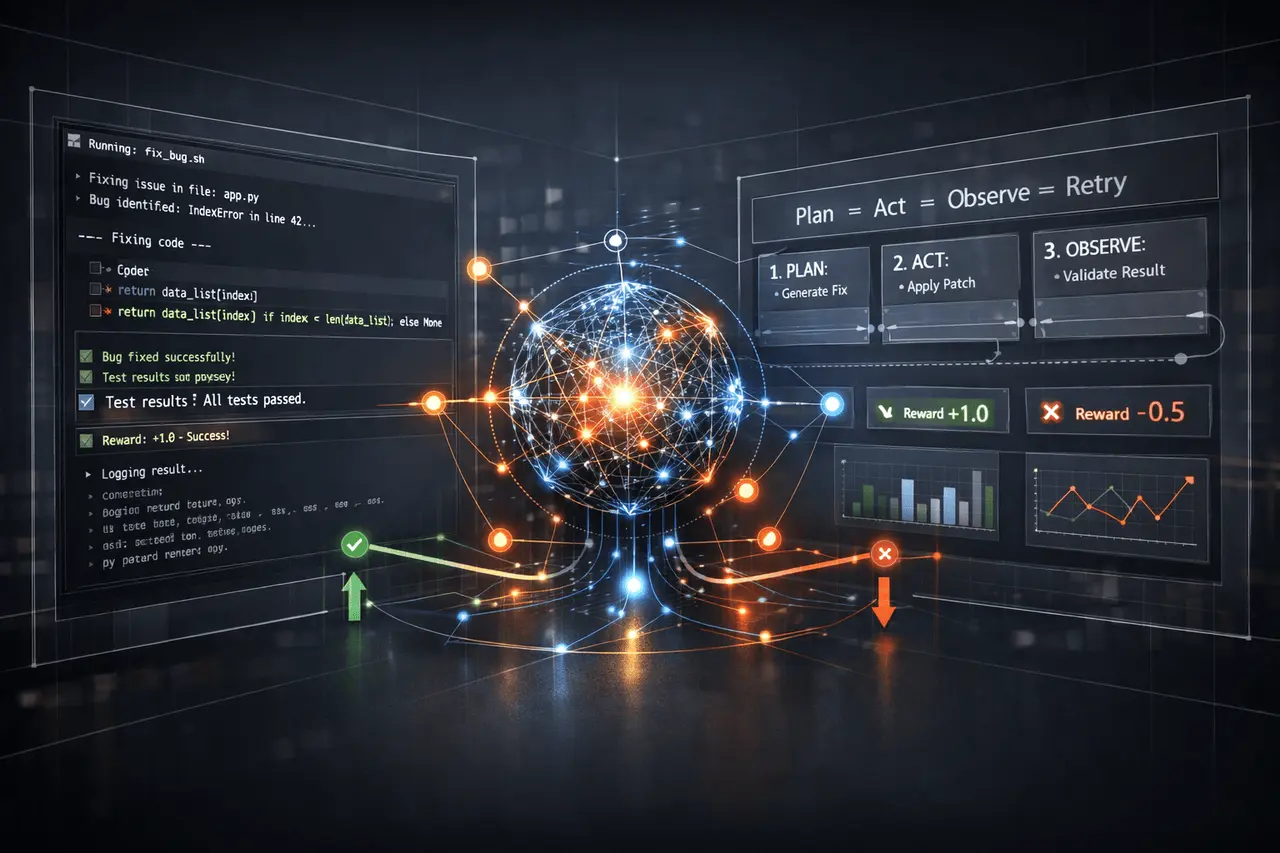
ROME is educated to plan, perform, act, review results, and then retry if needed. When things go wrong, the system doesn’t stop or lose hope of success. It continues to work within the tool’s environment until the problem is fixed or is proven to be impossible.
The Agentic Learning Ecosystem (ALE)
At the heart of the strategy is a well-structured training stack known as”the Agentic Learning Ecosystem (ALE). ALE was designed to create an authentic, high-quality experience for people learning to use tools.
It is composed of three parts:
1. Sandboxes for execution that are locked down
Agents operate in safe, reproducible environments where commands can have real consequences; however, they cannot escape their limits. This configuration ensures security and the authenticity of the environment. The paper defines this element as a hardened Sandbox layer that replicates the behavior of a real-world terminal or repository.
2. Large-scale rollouts and training infrastructure
ALE is software that allows performing millions of agent attempts, both successful and unsuccessful, across a variety of tasks. These rollouts provide complete tracks that include every action, every observation reported, and every decision taken during the course.
3. Step management tools and context-packing
Long-running tasks can consume context windows. ALE uses a command-line workflow that packs the most pertinent information into each stage, allowing the agent to stay focused and avoid losing important details.
In combination, the components let agents learn from actual interactions rather than rely on artificial shortcuts.
ROME AI agent: More than one million real-time routes
The most important contribution of the study is its size. The authors generate more than a million complete Trajectories, each containing specific logs of actions taken and observations. These trajectories depict how agents respond when tools perform poorly, commands fail, or intermediate states are unclear.
The training on this data shows ROME something most models do not: the ability to keep going even when tasks don’t progress smoothly. The model learns that retries are normal, mistakes are instructive, and that partial progress is essential.
This data set isn’t just huge; it’s highly enriched with behavioral information. This is why it’s so rich: the ability to learn with a high degree of.
ROME AI agent: IAP is reinforcement learning to complete long tasks
To learn ROME, the authors propose the interaction-level policy Alignment (IPA) approach. IPA is a reinforcement-learning technique designed explicitly for agent-based systems.
Instead of assessing isolated tokens, IPA evaluates complete interaction segments. The reward will be based on whether the sequence of events moved the agent closer to completing the task. This helps prevent abrupt stopping and brittle behaviour, two of the most common failure modes in long-running agents.
By aligning rewards with outcomes rather than just the surface quality of text, IPA stabilizes training on long-term tasks where mistakes are exacerbated over time.
ROME AI agent: Benchmarking on real developer workflows
The paper reviews ROME across several complex, heavy, tool-based benchmarks rather than synthetic reasoning tests.
A significant test involves fixing bugs in a repository, where agents need to read code, execute commands, detect errors, and apply patches. On the verified portion of the well-known software engineering benchmark, ROME achieves a 57.40 percent success rate. This shows that open-source models can compete with larger proprietary systems when properly trained.
To enhance the generalizability of stress tests, the authors present Terminal Bench Pro, an improved command-line benchmark designed to limit the leakage of answers and memorization. Tests require genuine thinking and adaptation, not just memorization of patterns.
With those settings, ROME consistently shows improvements in persistence, accuracy, and recovery behavior.
What makes smaller models more open to making a difference?
The most significant result is that it’s not just a single score, but rather a paradigm shift. The results indicate that how you instruct agents is as important as their size.
Through a grounded learning approach based on real-world tool usage, completing actions, and large-scale routes, ROME demonstrates that open models don’t require significant parameter counts to be successful. If they are trained with the appropriate signals, they can match and even exceed systems many times their size on real tasks.
This is a significant development in open research, enterprise deployments, and cost-effective agent design.
What does this signify in the near future for an AI agent?
ROME suggests a future in which AI agents are rated less by the quality of their speech and more by the reliability of their work. Being able to finish tasks, avoiding errors, and persevering in the face of complexity are the characteristics that matter in manufacturing environments.
The research also demonstrates the significance of infrastructure. The process of training agentic systems isn’t only about algorithms. It needs sandboxes, log assessment, rewards, and designs that reflect actual use.
As more organizations adopt agent-based techniques, such as ALE and IPA, this will likely impact how future generations of autonomous technology are developed.
My Final Thoughts
ROME’s results suggest an essential shift in how we evaluate and teach AI agents. Scale alone isn’t the determining factor. The alignment between the training goals and actual-world behaviour is more important. Through a foundational approach to learning based on full action trajectories, rewarding complete interactions, and exposing agents to real-world environments, this method shows that open models can provide solid, reliable performance on real-world tasks. As agents are increasingly used in production frameworks like this, the distinction between assistants that speak and those that actually perform can blur.
Frequently Asked Questions
1. What exactly is ROME in a simple sense?
ROME is one of the most accessible AI agent models trained on actual user interactions. It’s designed to complete lengthy, complicated tasks with minimal effort by planning, acting, reviewing results, and then retrying if required.
2. What is the reason why training in real sandboxes is so essential?
Sandboxes in real life expose agents to authentic tool behavior, which includes mistakes and edge cases. The sandboxes teach agents how to recover and remain in a way that synthetic environments usually do not capture.
3. How does IPA differ from standard reinforcement learning?
IPA rewards complete interactions, not individual tokens, and aligns learning with completed tasks rather than high-quality text that is merely surface-level.
4. What makes Terminal Bench Pro different from other benchmarks?
It focuses on real commands and is designed to reduce leaks or re-used responses, requiring agents to make sense of the tool’s real-time use.
5. Can smaller open models really compete with large proprietary ones?
The results indicate that, when trained on real trajectories with outcome-based rewards and proper infrastructure, even smaller models can perform as well.
6. Who benefits most from this research?
Developers developing autonomous coding robots, automated systems for enterprises, and researchers focused on long-term, reliable AI-related behaviors will find these knowledge points particularly beneficial.
Also Read –
IQuest-Coder-V1: LoopCoder Architecture Explained
DeepSeek mHC: A Fundamental Shift in Transformer Architecture