
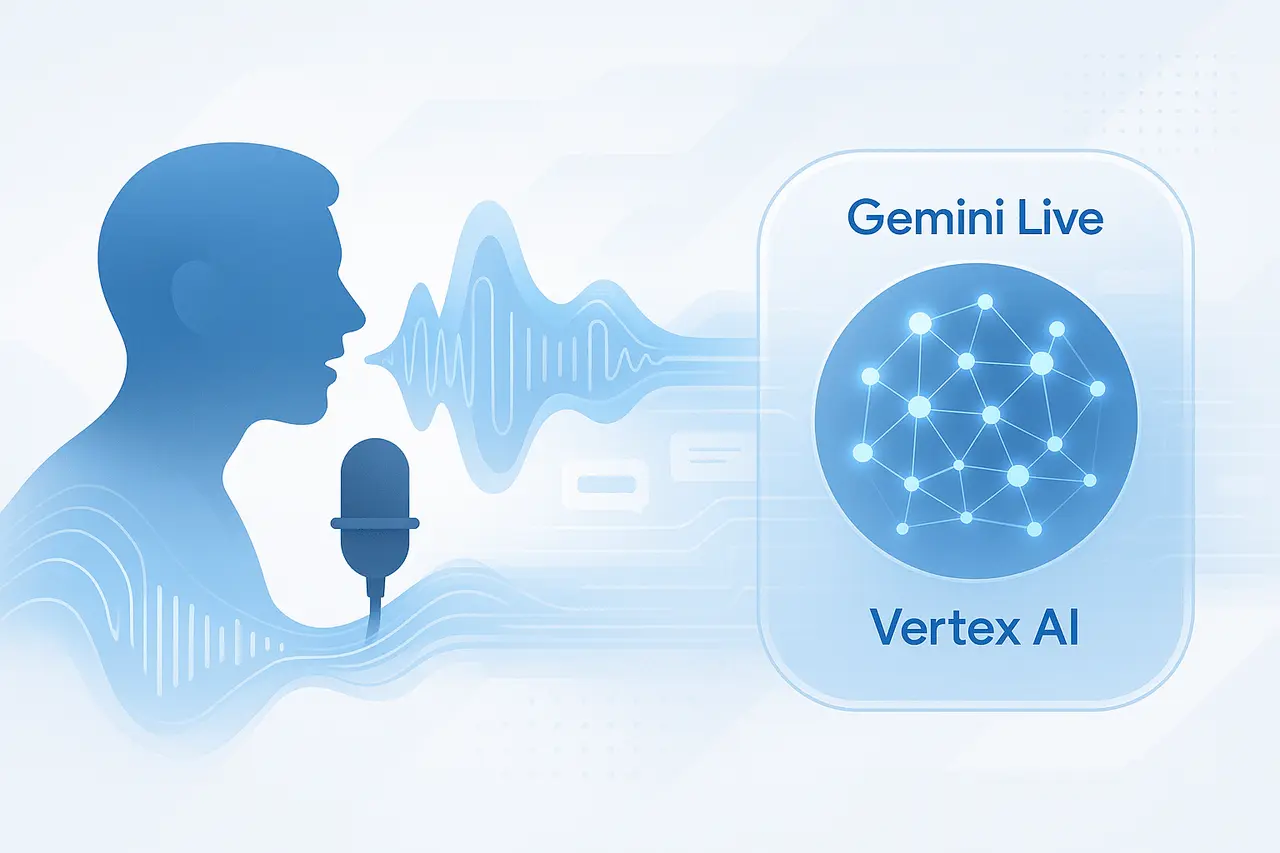
Real-time, voice-driven interaction is increasingly common across modern digital products, including automated customer service systems, intelligent assistants, and multimodal applications. However, traditional voice AI models have struggled for years with latency, fragmented pipelines, and limited emotional awareness due to their reliance on distinct speech recognition, language processing, and text-to-speech components.
The Gemini Live API on Vertex AI represents a significant shift in the current landscape, offering a unifying, native audio model designed to enable continuous, low-latency, and emotionally sensitive conversations. By allowing real-time multimodal interaction in a single conversation, the Gemini Live API sets a new standard for creating authentic, high-quality voice experiences at scale.
What Is Gemini Live API on Vertex AI?
Gemini Live API is a revolutionary advancement in conversational AI from Google Cloud that enables low-latency, real-time audio and multimodal conversations powered by Vertex AI. Historically, creating voice-driven AI required chaining separate speech-to-text and language-understanding systems, which often led to noticeable delays and a lack of flow in interactions. Gemini Live API breaks this pattern by bringing all these functions into a single continuous session that can handle text, audio, and even visual inputs seamlessly.
In December 2025, Google made public the initial release (GA) of its Gemini Live API on Vertex AI, indicating its readiness for deployment in production-grade enterprise applications. The basis of this version is the Gemini 2.5 Flash Native Audio model, which brings the most natural and emotionally responsive conversational intelligence to real-time experience.
Why Native Audio Matters?
The heart of the Gemini Live API’s features is the native audio processing. Instead of converting speech to text before generating responses, the API processes raw audio streams directly within a single model. This reduces latency dramatically and allows the agent to respond in a fluid, lifelike manner.
This audio format native to the human body provides several advantages:
- Low-Latency: Reliable in real time, it can bridge the gap between voice and agent responses by eliminating the traditional delay that is associated with speech pipelines that are batch-based.
- Expressive Interaction: By studying acoustic characteristics such as tone, pitch, and speed, the system can discern emotional context, enabling emotional dialogue in which the agent can adjust its responses based on the sentiment it has detected.
- Simple Creation: Developers do not need to manage different services that deal with speech recognition as well as synthesis. This reduces architectural complexity and operating costs.
Gemini Live API on Vertex AI: Key Features and Capabilities?
The Gemini Live API offers a collection of advanced features to help next-generation chat agents:
Real-Time Multimodal Interaction
In contrast to APIs that focus solely on audio or text, the Gemini Live API natively handles audio, text, and visual data streams. This multimodal feature allows agents to recognise spoken input alongside images (such as pictures or screenshots), enabling richer interactions across different devices.
Affective Dialog
By analysing audio in raw form, the Gemini Live API can identify emotional signals and adjust its behaviour to make interactions more sympathetic or assertive, based on a person’s personality, voice, and mood. This feature significantly improves customer satisfaction, specifically for customer support and personal assistant apps.
Proactive Audio and Barge-In Control
Traditional voice AI typically relies on simple activity detection to decide whether to listen. Gemini Live API’s proactive audio feature smartly determines when to respond or not, allowing natural interruptions while reducing awkward conversations.
Tool Integration and Real-World Knowledge
Agents that use the Gemini Live API can invoke functions of other tools and gain access to up-to-date data via an integrated search grounding. A voice assistant can retrieve the latest information, take action, and provide precise answers without interrupting the conversation.
Continuous Memory
Long conversations can maintain context, allowing agents to recall the user’s preferences or previous discussion topics. This constant memory can lead to personal experiences during lengthy conversations.
Enterprise-Grade Reliability
In addition, with GA Status for Vertex AI, the Live API provides robust infrastructure support, including multiple-region availability and compliance features designed for enterprise workloads. This provides stability and scalability for production deployments.
How does the Gemini Live API work?
Instead of using REST, which is independent, Gemini Live API uses an ongoing WebSocket connection to enable bidirectional, stateful communication. This design allows instant transfer of text, audio, or video from an app on the client to the model, and then back. The result is a conversations that feel natural for users.
The typical setup for production consists of:
- Media Capture: This front-end program can capture audio (and sometimes video) from the user.
- Backend Proxy: The secure server functions as a proxy between the client application and the Gemini Live API, handling authentication and business logic.
- WebSocket Session: This backend manages the WebSocket session that includes Vertex AI, stream input data, and receiving model responses in real-time.
- Response Handling: Client app processes incoming text or audio responses and displays them to the user.
Developers can build prototypes directly in platforms such as Google AI Studio or Vertex AI Studio, where quickstarts and reference demos are available to support development.
Gemini Live API on Vertex AI: Use Cases in the Real World
Several organisations have embraced this Gemini Live API to transform the user experience:
- eCommerce Support: Platforms such as Shopify have utilised their Live API to create intelligent assistants that assist merchants in real time, making customer interactions feel natural and personal.
- Services for Financial Institutions: Mortgage and lending companies are utilising voice agents to assist customers and brokers in nuanced financial conversations and are integrating the Gemini Live API to provide emotional intelligence during crucial calls.
- Support for Field and Health Care: Companies in the field of healthcare are using real-time voice assistants to improve patient engagement, which combines effective dialogue and reliability to enhance the quality of care.
- Interactive Partners: Consumer applications, like AI companions that incorporate audio and visual inputs, leverage Gemini Live API’s multimodal capabilities to dynamically create and guide users.
Getting Started Gemini Live API on Vertex AI: Best Practices
To build using the Gemini Live API: Gemini Live API effectively:
- Create a plan for Streaming in Real-time: Design your application around the concept of a continuous session instead of API calls with no state.
- Security Credentials: Utilise servers on the backend to control authentication and secure API keys.
- Use Demos Templates and Demos: Google provides quickstart demos and templates that illustrate fundamental patterns for WebSocket handling and audio processing.
- Multimodal Testing: Take advantage of both audio and visual inputs to give you more immersive customer experiences.
Final Thoughts
The release of the Gemini Live API on Vertex AI signifies a significant shift in how conversational AI systems are created and implemented. By removing rigid multi-stage voice pipes and adopting native audio processing for continuous, real-time conversation, this platform enables quicker responses, deeper emotional understanding, and more authentic human-AI interaction.
Both for enterprises and developers, the approach helps reduce system complexity while allowing advanced capabilities such as affective dialogue, multimodal contextual awareness, and seamless tool integration. As real-time conversations become the foundation of digital engagement, the Gemini Live API provides an enterprise-ready, scalable path to create multimodal and voice applications that feel incredibly real and responsive. It also feels human.
Frequently Asked Questions
1. What distinguishes Gemini Live API from traditional voice AI frameworks?
The Gemini Live API uses a single native audio model that processes raw audio, text, and visual information in real time, eliminating multiple-stage pipelines and reducing response time.
2. Is the Gemini Live API suitable for production purposes?
Yes. With its widespread accessibility through Vertex AI, it supports the highest level of stability and reliability, as well as multi-region deployment and the ability to use compliance features.
3. Which modalities does the Gemini Live API support?
The API manages continuous streams of text, audio, and visual inputs that allow natural conversations in multimodal environments.
4. Do developers need a backend to use the Gemini Live API?
While direct client connections are possible via a proxy server, it is recommended to manage sessions, credentials, and business rules securely.
5. Does Gemini Live API adapt to the users’ emotional tones?
Yes. Affective dialogue capabilities allow the API to recognise the emotional meaning of speech and modify responses accordingly.
6. What can I do to begin developing using the Gemini Live API?
You can start your journey with Vertex AI Studio using demos and templates that illustrate session configuration, WebSocket streaming, and multimodal input integration.
Also Read –
Live API Voice Agents: Building Smarter Real-Time AI
Google Gemini Audio Updates: Live Translation and TTS Upgrades
DeepMind UK AI Partnership: Science, Education and Safety