

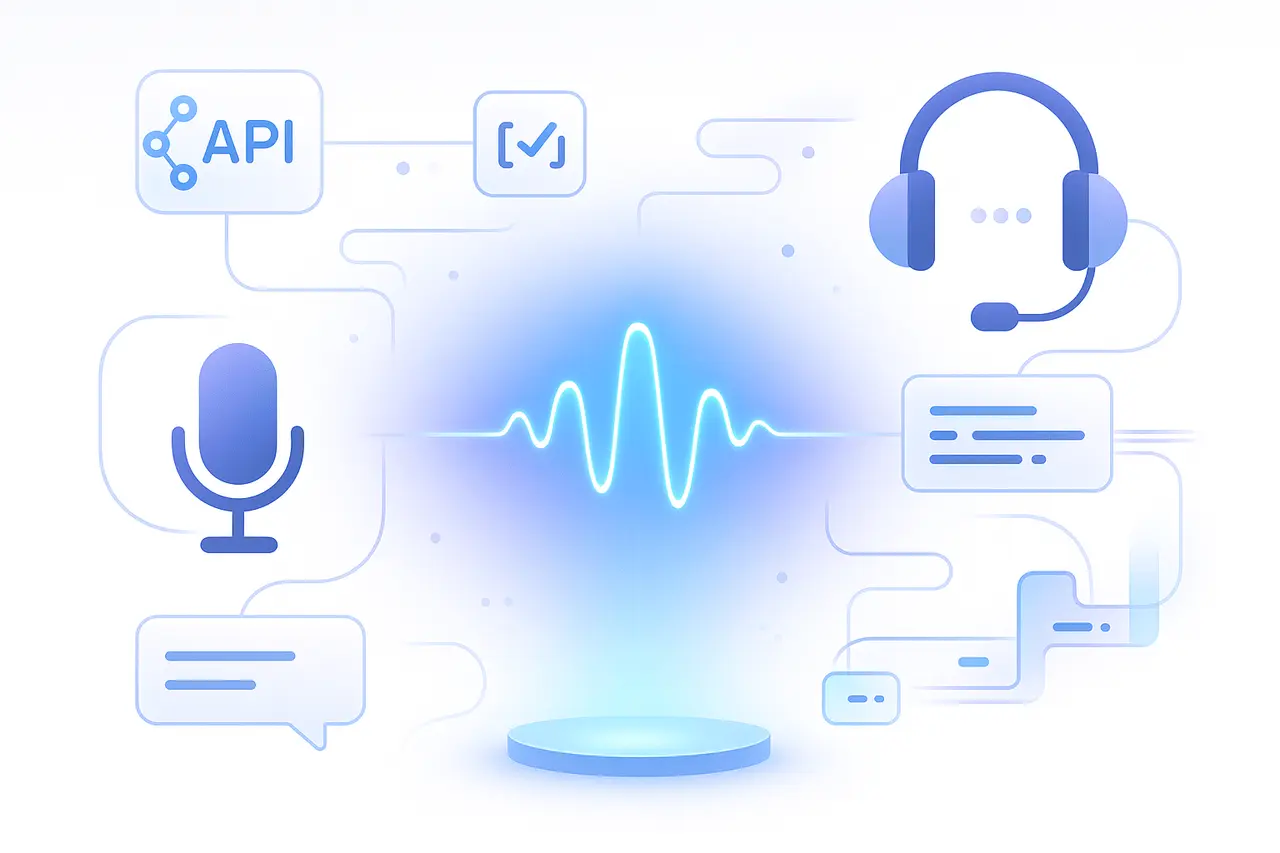
Voice agents, software capable of comprehending and responding to human speech in real time, are changing the way we interact with tech, from chatbots for customer support to hands-free virtual assistants powered by advanced artificial intelligence that can recognise natural language, connect with other services, and have conversations that feel natural.
Recent advancements in Live API models have. This article explains Live API voice agents and the implications of these changes for businesses, developers, and users.
What Is a Live API for Voice Agents?
The Live API (or voice agent) is an interface for programming applications that allows developers to create applications in which speech input (speech) processing occurs in real-time, while speech output (spoken responses) is immediately generated as a result. These APIs manage the essential tasks of speech recognition and language understanding, as well as contextual management and speech synthesis – often in a single, low-latency pipeline.
Contrary to the traditional system that chains distinct components (speech-to-text text processing, speech-to-text text-to-speech), Modern Live APIs handle audio seamlessly, reducing latency while preserving the nuances of conversation. This shift in architecture significantly improves the quality of conversations across devices and platforms.
Voice agents for Live API: Important Improvements in the Latest Live API Models
Recent announcements from the top AI platforms point to a brand new phase of voice agent capabilities. The new Live API models showcase enhancements in three areas:
1. Sharper Function Calling
Function calling enables AI voice agents to call backend or external processes via spoken commands. Modern models are more accurate at determining the best time and method to connect to external APIs to retrieve data, request information, or trigger tools to meet user requirements.
In the past, systems could misidentify triggers or mishandle arguments in complex multi-step processes. Modern Live API models deliver sharper detection and the execution of function calls, even when in the middle of fluid conversations. This is vital for real-time applications, such as booking systems or real-time data search, as well as procedural automation.
2. Robust Instruction Following
The ability of an AI to follow instructions from developers or users, even if instructions are multi-layered or complicated. Advancements in model training and assessment have increased adherence rates, ensuring that voice assistants complete tasks exactly as instructed.
This robustness is essential in cases such as guided troubleshooting and contextual prompts in enterprise workflows, as well as in custom-scripted behaviours where ambiguous or incomplete compliance could undermine the user’s confidence. Recent upgrades have significantly improved instruction quality, allowing developers to insert more detailed, deliberate instructions without resorting to weak prompt hacks.
3. Smoother Conversations
Natural conversation isn’t just about comprehending the following sentence; it’s about maintaining context across several exchanges, handling interruptions, and adapting to shifts in tone or subject. The latest Live API models are significantly better at maintaining conversational context, making responses feel more unified and natural.
This smoother, more conversational quality results from improvements in session memory, better turn management, and more efficient processing of multi-turn conversation histories. All of these make voice agents more responsive and intuitive for users.
How Live API Voice Agents Work?
On a more fundamental level, voice agents developed using Live APIs can follow a life cycle:
- Audio Capture: This system monitors spoken words in real-time.
- Understanding: It uses audio directly (or through integrated speech-to-text) to determine the meaning, intention and context.
- Decision making: Based on the interpretation of intent, the agent decides on the proper actions, like getting information, performing the function, or producing an answer to a spoken word.
- Action/Response: This agent performs all required function calls and produces natural spoken output, which continues conversations.
This type of pipeline is typically enabled via WebRTC and WebSocket connections, which provide low-latency audio streaming between the client and the model infrastructure.
Specific platforms go even further, supporting modalities such as video and image inputs, as well as session context data, enabling agents to respond more efficiently to complex multimodal cues.
Live API voice agents: Real-World Use Cases
The advancements introduced by the modern Live API models expand the possibilities of voice-agent applications:
Live API Voice agents, Enterprise, and Customer Service
Voice agents can handle inbound inquiries, automate service tasks, and even escalate complex situations, while also integrating with backend systems to retrieve real-time data or perform transactions. More precise function calls and higher quality make these experiences more affordable and efficient when compared with older IVR systems.
Industrial and Field Applications
In industries such as manufacturing and logistics, voice assistants can help workers navigate procedures or diagnose problems via spoken commands or visual cues. They can also incorporate real-time sensor information. Multimodal Live APIs enable these types of experiences at low latency.
Smart Devices and Consumer Assistants
Voice agents embedded in smart speakers, wearables, and mobile applications benefit from smooth conversational interactions and instantaneous responsiveness. Conversational understanding of natural language and contextual retention make user interactions effortless and enjoyable.
Live API Voice agents: Challenges as well as considerations
As Live API Voice agents rapidly advance, however, developers should be aware of the following aspects:
- Safety and Privacy: Processing audio in real time demands careful management of personal data and consent, particularly in sensitive scenarios.
- Latency Constraints: Network conditions and model response time can affect perceptions of responsiveness.
- Edge Cases: The misinterpretation of unclear background noise or speech could result in errors in function invocation as well as output.
To overcome these issues, you need to conduct thorough testing across diverse input conditions and an elaborate architectural design.
Final Thoughts
The most recent Live API voice models reflect a noticeable shift towards production-ready AI for conversational applications. By improving the accuracy of function calls, enhancing instruction follow-up, and making it easier to conduct conversations more fluidly, they address the old-fashioned limitations that had previously prevented the development of complex voice-based apps. Developers will benefit from reduced workarounds and increased assurance when creating real-time voice applications that communicate directly with data and live systems. For consumers and businesses, it means quicker, more natural and reliable voice interactions. As Live APIs mature, they are expected to become the basis for next-generation voice interfaces across the enterprise, customer service, and consumer tech.
Frequently Asked Questions
1. What makes a Live API voice agent different from a traditional voice assistant?
Live API voice assistants use real-time processing and unified speech-to-speech models that allow conversation to flow seamlessly, rather than combining distinct speech-to-text and text-to-speech components, resulting in lower latency and more natural conversations.
2. How can sharper function calls increase user interaction?
A more precise function call means your voice assistant is better at determining when to call a backend function and then doing so promptly. This can yield accurate results for tasks such as bookings, data retrieval, and database queries.
3. Why is a thorough instruction follow-up vital for developers?
Robust instruction following ensures that the agent can perform complex or nested tasks precisely, as per the developer’s behaviour, eliminating the need for workarounds and increasing predictability.
4. Do the Live API voice agents maintain lengthy conversations?
Yes. Improved retention of context and memory during sessions can lead to more fluid, multi-turn conversations, making interactions more coherent and consistent.
5. Are Live API voice agents suitable for enterprise use?
Absolutely, Numerous companies use the latest Live APIs to provide customer service, operational assistants, and industry-specific tools that require real-time accuracy and integration with backend systems.
6. What future advancements can developers expect?
Developers can expect to see ongoing improvements in multimodal comprehension, adaptive thinking, and greater integration with real-world data sources, enabling more sophisticated voice agents.