
The development of AI assistants has been rapid. However, data substantiating how people actually use them was scarce up to this point. A new, large-scale investigation of all-purpose AI agents provides the first systematic evidence on their use, acceptance, and contexts of use. By studying the hundreds of millions of anonymous interactions using an AI-powered browser and its companion, researchers have shed some light on who uses these tools, how often, and for what purpose. These findings offer crucial insights into the future of collaboration between humans and AI in digital work and education.
In this article, we explore AI agent usage, uncovering how people rely on intelligent assistants for productivity, learning, and everyday decision-making.
Study Overview: What, Who and How Much
The study focused on Comet, a browser with an integrated universal-purpose AI assistant. The dataset comprised billions of “agentic” interactions. These are not just chats; they are requests in which the assistant performs autonomous actions, such as navigating the web via external APIs or filling out forms, acting as a digital proxy.
To better understand user behaviour, researchers also created a hierarchical “agentic taxonomy” that categorises user instances by topic, subtopic, and job, allowing for precise classification of what users ask their agents to accomplish.
AI Agents Uses: Demographics & Sectors
The use of AI agents varies across populations. The data show that the adoption rate of AI agents is strongly linked to socioeconomic and educational factors. Countries with higher GDP per capita and more years of schooling are much more likely to use these agents extensively.
Furthermore, professionals in fields that require knowledge or technology, such as academia, digital technology marketing, finance, and entrepreneurship, make up the majority of active users.
In contrast, industries that depend on physical interactions (e.g., energy, agriculture) exhibit lower levels of acceptance, suggesting a gap between knowledge-based and manual-labour sectors in AI agents’ uptake.
What People Use AI Agents For?
One of the more striking findings is that a large portion of agents’ use is devoted to cognitive tasks, rather than to basic automation or convenience. In particular, the two most important categories that are Productivity & Workflow and Learning & Research together make up 57% of all agent-related requests.
- Productivity and Workflow (36%). This covers tasks like document editing or creation, and email filtering, composing reports and managing calendars, basically taking care of the repetitive cognitive burden of work.
- Learn & Research (21%) Users often request assistance from the agent in the process of synthesising information, such as writing articles, collating data, or studying documents.
In addition, other activities such as online shopping, travel planning, job hunting, and general browsing comprise a smaller, but significant, percentage.
In terms of context, 55% of inquiries are personal (after-hours and daily life), 30% are professional (work-related), and 16% are educational (learning or courses).
AI agent Usage Patterns Over Time
The study suggests that users’ use of AI agents changes as they become more familiar with the software. Users typically begin with low-risk tasks, such as travel bookings, simple web browsing, and, in time, shift to more complex inquiries that require a lot of brainpower, such as productivity tasks, learning, or job-related tasks.
This shift is a sign of a larger trend. As people experience the benefits of AI agents, they start trusting them with greater portions of their cognitive work and thereby delegating thinking tasks that aren’t just routine.
Additionally, once certain professional areas, such as sales, marketing, and management, begin adopting AI agents, usage intensity tends to exceed the raw adoption numbers. This indicates stickiness over time; AI agents are integrated into daily workflows rather than utilised sporadically.
Implications: What This Means for Work, Education and AI Design?
A shift to hybrid intelligence
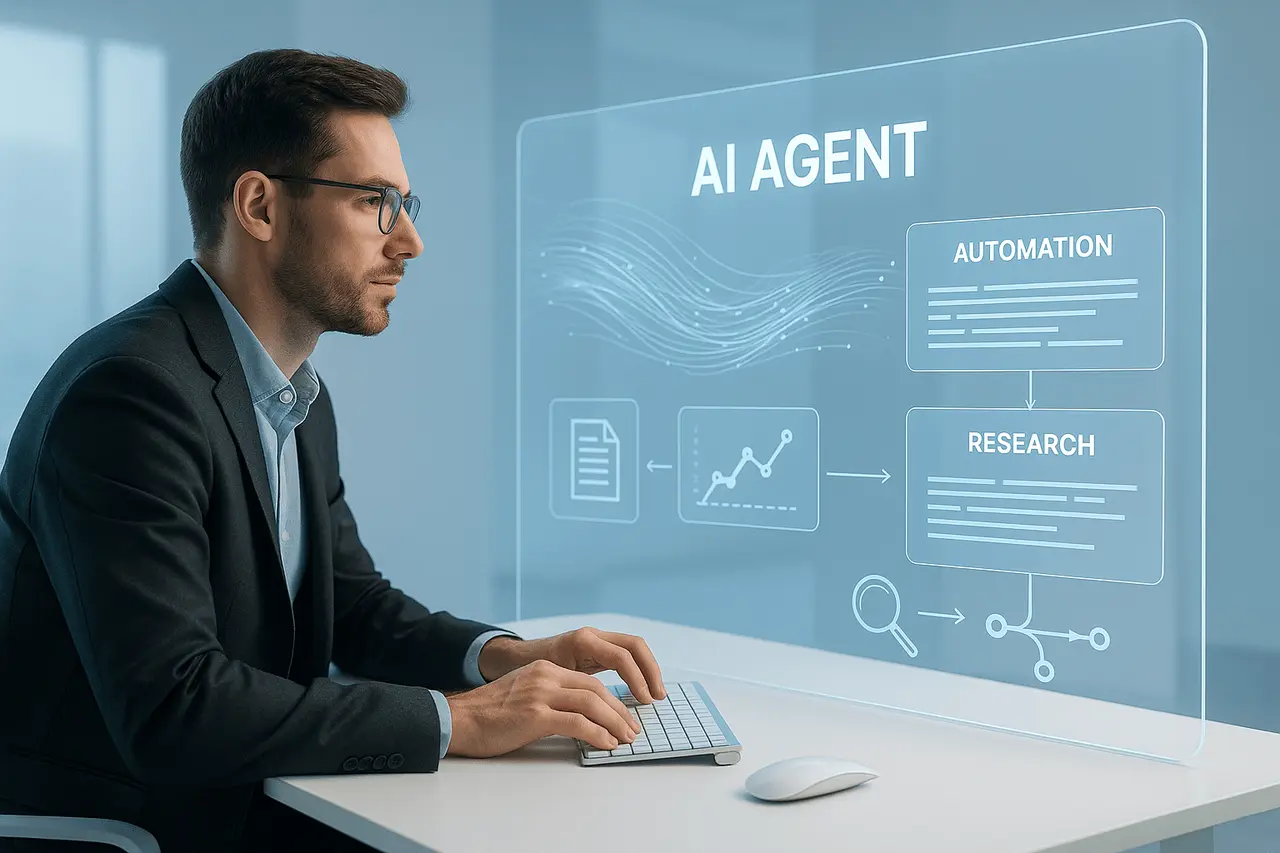
The data provide evidence that we are moving towards an intelligent hybrid economy, with humans working together with AI, not only as tools, but also as cognitive partners. AI agents are not only serving as “digital concierges”; they are also thought-provoking partners that can perform research analysis, workflow management, and more.
Gains in productivity from knowledge work
For knowledge workers and professionals, AI agents can reduce the burden of repetitive cognitive tasks, such as editing documents, summarising, and scheduling, allowing more time to think deeply and be more creative. This will result in significant productivity improvements, particularly in industries with high cognitive burden.
New models for learning and education
Given the large share of agent usage dedicated to research and learning, AI agents could become crucial tools in education, assisting students and researchers in sorting through data to synthesise information, analyse knowledge, and control learning workflows. This will help ease the way for self-learning and open up access to advanced information skills.
Social and economic divides may deepen.
But adoption is currently biased toward economically prosperous and educated users in high-knowledge areas. This could create a “digital divide” in which those outside these industries might not all benefit from AI-based productivity improvements.
Design and governance issues for AI developers
The diversity of uses and the evolution of how users employ agents suggest that designers should create adaptable, contextually aware agents. Furthermore, the widespread use of agents should prompt a rethink of laws, particularly regarding data privacy, authentication, access, and case management. Researchers have highlighted the need for a robust taxonomy and analysis of usage to aid the development of future agents.
AI Agent Uses: Limitations and What We Don’t Know Yet?
Although this study is a significant achievement, it’s vital to be aware of its limitations:
- The data comes from a single AI agent running in a single browser. Results may not be universal across all agents or different environments. They acknowledge that.
- The base of users is self-selecting. Early adopters are typically tech-savvy, well-educated, and working in specific professions. The behaviour of the general public may be different.
- The long-term effects of job design on productivity, inequality, and even human learning remain undetermined. The study tracks human behaviours over a narrow timeframe.
A future study, to be conducted across different agents, geographic regions, and user demographics, will be needed to construct an overall picture.
Final Thoughts
The first comprehensive research study on AI agent use reveals that these devices aren’t just digital aids; they’re becoming partners in cognitive work. With the majority of interactions focused on learning, productivity, and private tasks, AI agent models like the one studied are already altering the way people work, learn, and manage their daily lives. For businesses, developers, educators, and decision-makers alike, t message is simple: threats must be taken seriously. They are now the core of how human beings make sense of information, carry out tasks, and make decisions.
But the inequitable use of AI across occupational and socioeconomic lines is also a sign of a problem: the lack of equal access to the benefits of the hybrid-intelligence era. As we advance intelligent design, an inclusive implementation and a careful approach to control will be necessary to maximise the capabilities of AI agents while reducing risks.
Frequently Asked Questions (FAQ)
1. What exactly is an “agentic question”?
An agentic query refers to a request in which the AI assistant performs tasks for the user, for example, navigation through web pages, filling in forms, or making API calls, and not just responding to data.
2. Are AI agents mostly used for simple tasks, such as buying or booking flights?
No. Although these tasks appear to be obvious, the majority of use (57 per cent) is cognitive-based and focuses on productivity (e.g., editing documents and email filtering) or research and learning. Simple tasks comprise less of the.
3. Who is most likely to embrace and use AI agents extensively?
Users from countries with high GDP per capita and average levels of education, especially professionals working in knowledge-intensive or digital sectors (such as digital technology and finance, academia, marketing, entrepreneurship, and finance), are most likely to have the highest levels of usage and intensity.
4. Does agent usage change with the time of a user?
Yes. Many users begin with less risky personal tasks (travel and leisure, or basic browsing) before moving on to more demanding cognitive tasks such as learning, productivity, and work-related activities. This is a sign of growing confidence and comfort.
5. Does this study show that AI agents are taking over human labour?
It’s not exactly. The study reveals that AI agents are increasingly used to assist with cognitive tasks; however, they don’t provide a complete substitute for human thought. They are more collaborative, enhancing efficiency, learning, and information processing.
6. What are the main drawbacks of this study?
The data is derived from one AI agent/browser and an auto-selected user base geared toward professionals with a high level of education. The results might not apply to all people or the types of AI agents.