
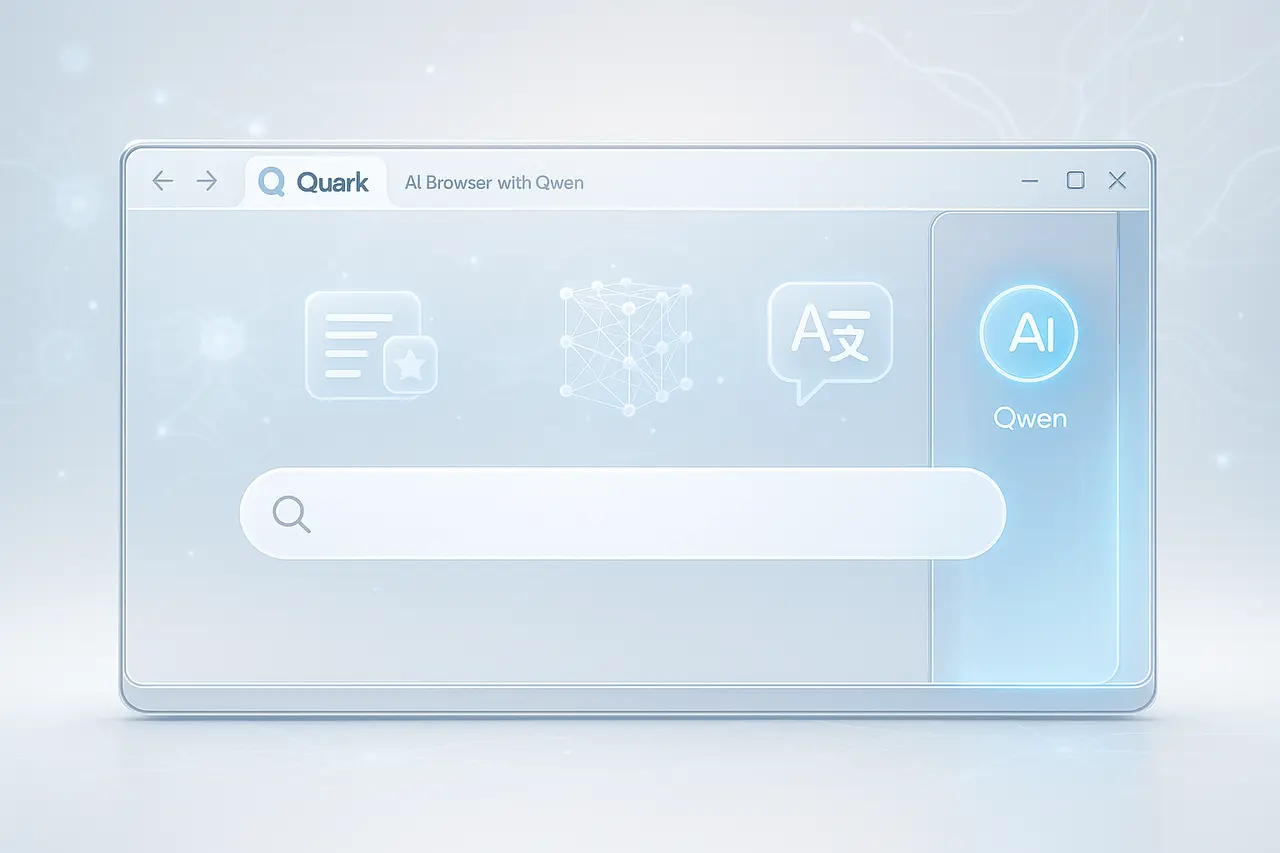
Alibaba Group announced in late November 2025 that Qwen, the core “system engine” of the browser, is now embedded deeply into the revamped Quark.
This integration places Qwen in the core of the browser, unlike a plugin or add-on. For the first time, Quark desktop users can access Qwen AI browser features directly from the browser interface. This includes the homepage search bar or sidebar.
Alibaba has stated that the aim is to have Qwen become more than just a chatbot. It will be the “intelligence engine” behind Quark’s browsing.
Features & Functionality of the Integration
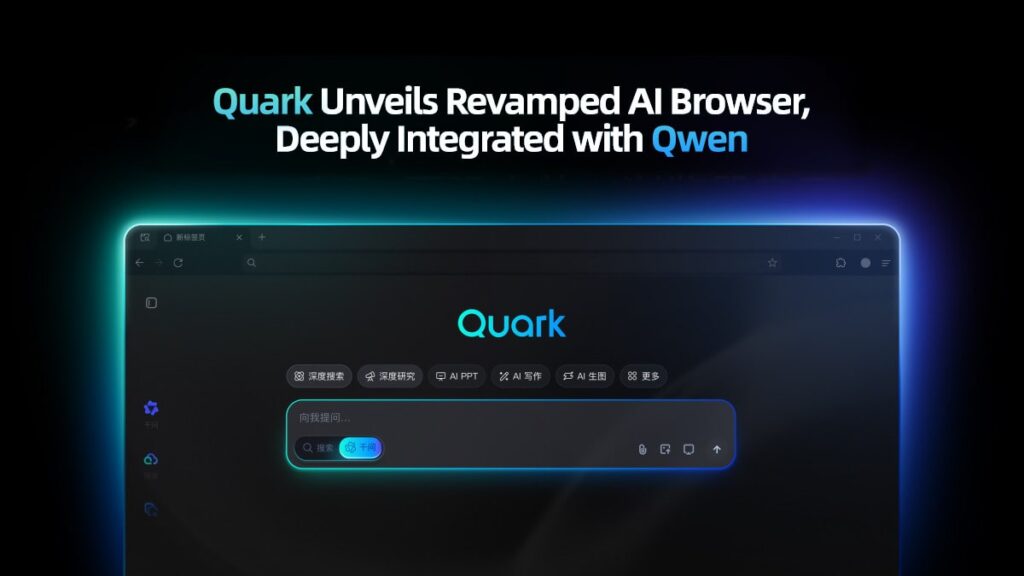
Quark AI Browser embeds Qwen to provide a native set of AI tools that are always available. The following are some of the most notable capabilities:
- A conversational assistant that is seamless while browsing: Users can interact with Qwen via a sidebar, overlay, or other interface without ever leaving the page. This feature allows users to summarize content, ask questions for clarification, or translate text.
- Real-time reading, summarizing, and editing: You can use Qwen to quickly summarize websites, extract key points or articles from PDFs or other documents, or transform the content. This could boost productivity.
- Always-on, persistent access via a desktop floating ball: Users can keep Qwen always resident on the desktop, enabling quick queries, notes, conversions, and other tasks.
- Multitasking Without Tab-Switching: The integration allows operations such as summarizing one article while reading another, or capturing content via a screenshot to quickly process it with Qwen using built-in tools. (text selection, screen-to-text, etc.).
The browser is transformed into a productive environment that uses generative AI.
The strategic importance of Qwen and Alibaba’s evolution
This is a significant milestone in Alibaba’s AI strategy. Qwen has been largely exposed to consumers through its AI app, recently rebranded as the Qwen App, and its cloud-based AI services, primarily targeted at enterprise clients.
Alibaba embeds Qwen in Quark to make the AI assistant an integral part of the daily workflows for millions of PC users. This makes the AI assistant the default tool, rather than a separate option. Observers say that Qwen is now the “core AI engine” for Alibaba’s consumer business.
Alibaba’s integration places it in a similar position to other major players experimenting with AI-powered browsing experiences. Sources claim that Quark is now in direct competition with AI browsers and tools embedded into applications.
What it could mean to users and typical use-cases?
Qwen’s deep integration with a browser such as Quark enables new use cases beyond traditional search and browsing.
- Fast research and reading: Students, professionals, and researchers can quickly summarize and extract key points from academic papers, articles, or other long-form content using Qwen. This saves time and improves comprehension.
- Transliteration, summarization, and editing on the fly: While reading dense documents or foreign-language sources, Qwen can translate, summarize, or edit text without leaving the current page.
- Productivity boost & Content Creation: Write articles, emails, or reports – with Qwen embedded deeply, users can rely on AI to draft, rewrite, or reorganize the content directly in the browser.
- Multitasking with no friction: Qwen is a floating or sidebar UI that lets users switch between browsing the web, chatting, summarizing information, and other tasks without opening new apps. This makes workflows more fluid.
- AI is accessible to many users: Due to Quark’s vast desktop user base and the embedding of Qwen, AI assistance will be available by default to a broad, non-technical audience, not only to those who actively seek AI tools.
What are the challenges & what is still uncertain?
While Quark-Qwen Integration promises much, there are still many questions.
- Data security and privacy: Qwen is deeply integrated into browsing, and there are concerns about how user data, browsing history, and interactions with content are stored or processed. Alibaba’s documentation is not yet (at least) clear on how privacy will be handled.
- Performance: Using a powerful AI engine in the browser can impact CPU and memory usage, particularly on older machines. Large-scale user testing is needed to confirm whether Qwen remains lightweight and efficient.
- Language/localization Constraints: While Qwen supports Chinese and many other languages, it may perform differently with content that is not in Chinese or with languages that are less well represented in the training data.
- Global feature availability: As of right now, most announcements are geared towards China and Alibaba’s main markets. Quark AI browser (with complete Qwen Integration) is not yet available in other countries.
- Fragmentation and competition: As more companies develop their own AI-powered tools or browsers, fragmentation can occur, leading to issues such as compatibility problems, inconsistent experiences, and AI fatigue for users.
What’s Next for Quark & Qwen?
Several future developments are likely, given the current momentum:
- Qwen App may even further converge with Quark AI Browser, offering integrated experiences across devices (desktops, mobiles, and maybe wearables). Alibaba has begun to expand Qwen’s capabilities beyond browsers and mobile apps.
- Qwen may also be enhanced with additional productivity features, such as AI-powered document editing, cross-device sync, live collaboration, and deeper integration with other Alibaba services.
- Alibaba’s Quark could become a global player in the AI browser space as Qwen’s model family develops (see the list of new versions available under the Apache 2.0 license).
- Growth of the AI ecosystem: Integrating AI on a “system foundation” may encourage third-party developers to create AI-native browser extensions and plugins, creating a richer AI-enabled web ecosystem.
What to watch and why it matters?
It is essential for many reasons that Qwen has been integrated into Quark AI Browser. It signals a change in how AI assistants are delivered to users: Instead of being optional downloads or applications, AI will become a seamless layer that is always on, built into foundational apps—like browsers.
Alibaba democratizes access to AI productivity tools by embedding AI deep into the widely used desktop browser. Users who might never have tried standalone AI apps can now use generative AI whenever they browse, read, or watch videos.
Third, it could change the expectations of what a web browser is – from a passive gateway to an active assistant. If this vision is realized, many daily tasks (reading research documents, summarizing the news, writing emails, and translating content) will become easier, faster, and more integrated.
This move could influence global tech trends. As companies rush to offer AI-enhanced experiences, embedding AI in foundational tools could become standard. This will change the way productivity software is used and the workflows of users worldwide.
FAQs (Frequently Asked Questions)
1. What is Qwen exactly?
Qwen belongs to Alibaba’s Large-Language Model (LLM) Family. Qwen, introduced initially as Tongyi Qianwen, has gone through several iterations, from Qwen2 up to Qwen3, and now includes versions that have multimodal capabilities (texts, images, audio, videos). It can be used for tasks such as conversation, summarization, reasoning, translation, and content generation.
2. Does the integration consist of a simple plugin, or does it go deeper?
It’s more than a plugin. Alibaba claims that Qwen forms the “system engine” for the Quark AI browser on desktops (macOS or Windows). This means that AI is natively and deeply embedded into the browser.
3. Who will have access to the new Quark AI Browser?
Quark desktop users — more than 100 million of them — can upgrade.
4. What kind of tasks can Qwen do inside the browser?
Qwen can handle tasks such as summarizing articles, translating content, extracting key information, rewriting or cleaning up text, generating drafts, editing documents, summarizing PDFs, and even processing screenshots. It turns the browser from a simple browsing tool into a productivity tool.
5. Do you know of any limitations or downsides?
Other potential downsides include privacy concerns, performance/resource overhead on some machines, limitations on languages other than Chinese, and uncertainty about global availability. It is also yet to be determined how real-world users will experience the technology (in terms of responsiveness, accuracy, and resource usage).