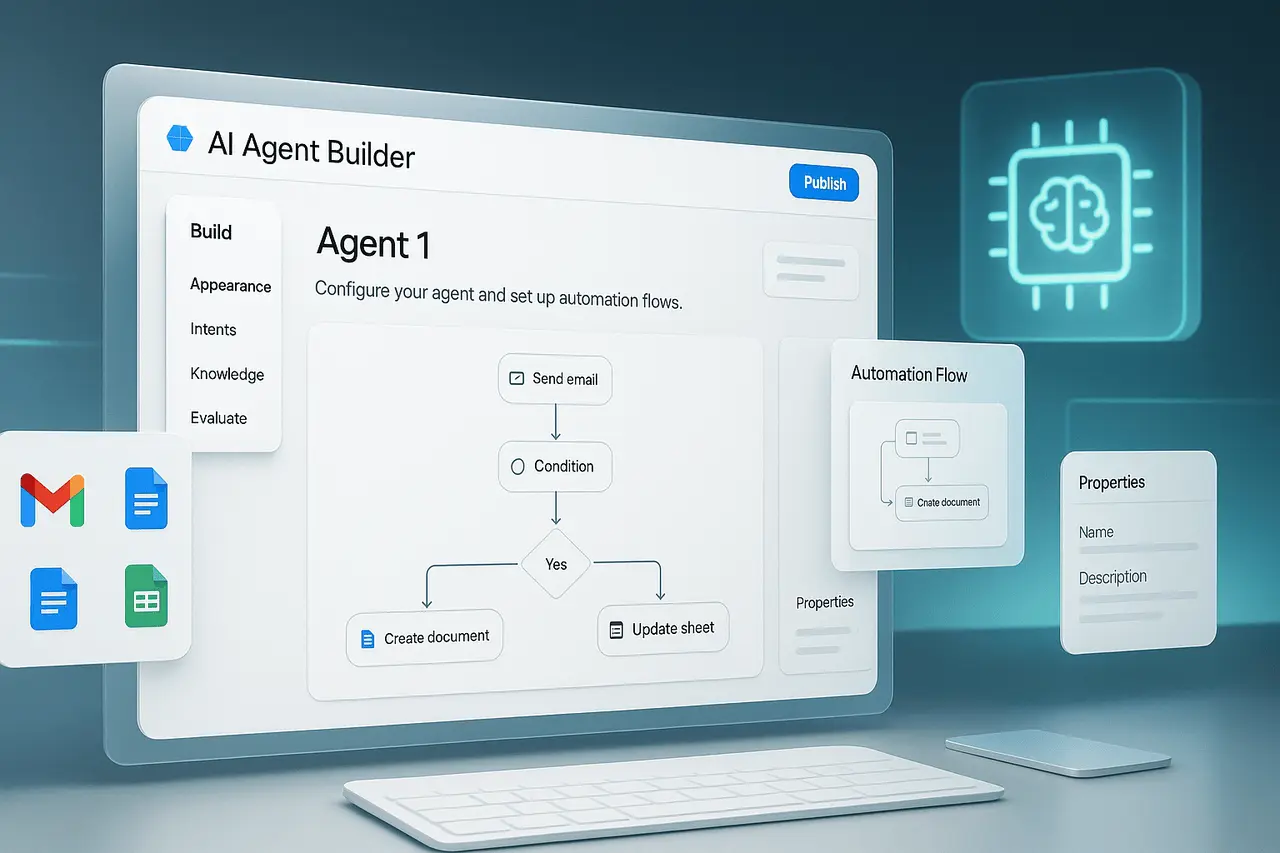


AI agents are quickly becoming more than simple task executors; they are becoming autonomous systems capable of thinking, making decisions, and interacting in complex environments. The vast potential of AI agents is not only in their automation capabilities but also in their ability to function as autonomous economic and creative participants. As advancements in machine learning, generative AI, and decentralized infrastructure converge, AI agents are emerging as a fundamental component of the digital economy to come.
This article examines the untapped potential of AI Agents, the basics of what AI agents do, the reasons they are significant, how they operate, and their real-world applications, which make them among the most critical advances in the field of artificial intelligence.
What Are AI Agents?
AI agents are computer programs designed to analyze their surroundings, make decisions, and perform actions to achieve set goals without human involvement. In contrast to conventional AI models, which respond to single requests, agents continuously operate, using memory, tools, and feedback loops.
Key characteristics include:
- A goal-oriented behaviour
- The ability to organize and carry out multi-step tasks
- Interaction with other APIs, tools, or human beings
- Learning from results and adapting strategies
These capabilities permit AI agents to act more like autonomous operators rather than non-active assistants.
Why the Untapped Potential of AI Agents Matters?
The importance of AI agents extends far beyond efficiency gains. Their autonomy opens up new scientific, economic, and artistic possibilities previously unattainable.
AI agents can:
- Operate at the speed of a machine and scale
- Coordinate across domains and do not fatigue
- Reduce friction in complex workflows
- Allow new incentive and funding models
This means that AI agents will change how industries are viewed, from entertainment to healthcare.
How AI Agents Work?
At a high level, AI agents combine multiple AI components into a single operation loop.
- Perception: Processing information from text, images, audio, or other structured inputs
- Thinking: Evaluating the options by using models and algorithms
- Planning: Breaking objectives into actionable steps
- Execution: Utilizing APIs, tools, or human collaboration
- Memory Recording information and outcomes to make future decisions
This structure allows agents to handle long-running tasks and to change their behavior over time.
Core Components of AI Agent Systems
| Component | Function |
|---|---|
| Foundation model | Language, vision, or multimodal reasoning |
| Memory layer | Short-term and long-term context retention |
| Tool interface | Access to external software and services |
| Control loop | Decision-making and task sequencing |
| Feedback mechanism | Performance evaluation and adjustment |
AI Agents in Creative and Economic Systems
The most intriguing areas of development are the autonomous production of creative content. AI agents can already create songs, images, scripts, and designs. If combined into a financially autonomous system, they can control all creative pipelines.
Potential capabilities include:
- Fundraising via decentralized platforms
- Allocating budgets to creative tasks
- Human collaborators can be hired as necessary
- The process of iterating on outputs, based on feedback from audience members
The technology converts AI agents from tools into producers capable of managing projects from beginning to end.
AI Agents in Scientific Research and Medicine
Beyond the realm of creativity, the untapped potential of AI agents is particularly significant in healthcare and science. Agents can analyze large datasets, generate hypotheses, and continuously run simulations.
In medical research, AI agents can:
- Model Protein Structures and Interactions
- Explore drug discovery pathways
- Analyze patient-specific data
- Help with personalized treatment plans
Although human supervision is vital, agent-driven systems will dramatically shorten research timelines.
Use Cases by Industry
| Industry | AI Agent Applications |
|---|---|
| Entertainment | Film production, music composition, asset coordination |
| Healthcare | Personalized medicine, diagnostics, research acceleration |
| Finance | Autonomous trading, risk modeling, portfolio optimization |
| Software | Code generation, testing, deployment orchestration |
| Science | Simulation management, hypothesis generation |
Benefits of AI Agents
AI agents have several advantages in structure over traditional Software systems.
- Scalability: Perform operations across a multitude of tasks in parallel
- Autonomy: Reduce dependency on constant human input
- Speed: Execute decisions in real time
- Flexibility: Adjust strategies based on the results
These advantages are particularly beneficial in dynamic, complex environments.
Limitations and Challenges
Despite their promises, AI agents face significant limitations that need to be addressed.
Key challenges include:
- Responsibilities: Errors are likely to be repeated over lengthy tasks.
- Alignment: Objectives should be defined carefully to avoid undesirable behavior
- Transparency: Processes of decision-making can be challenging to review
- Governance: The ethical and economic frameworks of the world are developing
If accurate data or safeguards are unavailable, the systems should not be used in high-risk situations.
Advantages vs Limitations
| Advantages | Limitations |
|---|---|
| Autonomous execution | Risk of goal misalignment |
| High efficiency | Dependence on data quality |
| Continuous operation | Limited explainability |
| Cross-domain coordination | Regulatory uncertainty |
Practical Considerations for Businesses and Users
Companies exploring AI agents should focus on controlled deployment and clear accountability.
Best practices include:
- Beginning with particular, well-defined objectives
- Human oversight must be maintained when making critical decisions
- Feedback loops, monitoring outputs, and monitors
- Integrating with workflows in place slowly
AI-based agents can be most efficient when used as collaborators, not replacements.
Future Outlook for AI Agents
The future of AI agents depends on advancements in memory, reasoning, and governance. As models improve and infrastructure improves, AI agents will likely become permanent digital actors with economic power.
Potential developments include:
- Agent-to-agent collaboration
- Budgeting and resource allocation
- Integration with decentralized financial systems
- Ownership of a long-term project and execution
These developments indicate that AI robots will play a significant role in the upcoming stage of artificial intelligence.
My Final Thoughts
The potential unexploited by AI agents lies in their capacity to operate as autonomous, goal-driven machines in economic, creative, and scientific domains. Combining reasoning, execution, and flexibility, they representrepresent a paradigm shift away from static AI tools toward dynamic digital actors.
As technology advances, AI agents are poised to transform how work is planned, funded, and completed. The long-term impact of AI will depend on the responsible design of its systems, careful management, and a thorough understanding of its capabilities and weaknesses.
FAQs About AI Agents
1. What is it that makes AI agents distinct from chatbots?
AI agents are constantly in operation; they pursue their goals and implement multi-step strategies, and chatbots respond to specific commands.
2. Can AI agents work without human intervention?
They can perform a range of tasks autonomously; however, effective deployment requires human supervision, particularly in highly sensitive areas.
3. Are AI agents secure to use in the present?
They are safe in controlled applications; however, their limitations in accuracy and alignment require caution in high-risk applications.
4. What are the implications of AI agents affecting jobs?
They are more likely to modify workflows than eliminate jobs, putting humans in control of creative strategy and direction.
5. Can AI agents handle the flow of funds or money?
Technically, yes, but financial autonomy depends on a robust governance system and precise regulation before it is widely adopted.
Also Read –
TrueShort AI Studio: AI-Powered Microdrama Streaming Platform
Claude Is a Space to Think: Deep AI Reasoning Explained