

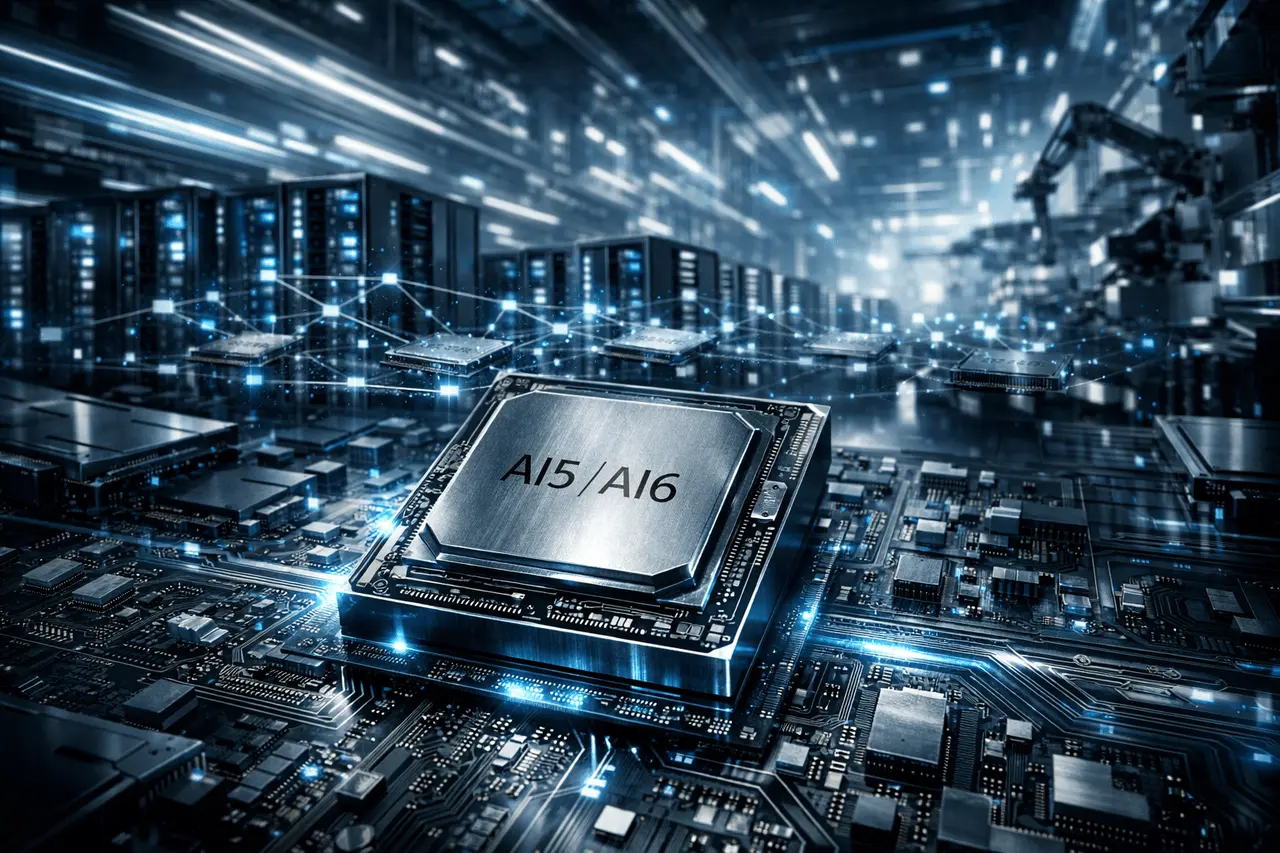
Tesla is quickly accelerating its internal AI hardware strategy. With AI5 nearly complete, AI6 already in development, and plans to move the next generation into lengthy 9-month cycles, Tesla will soon become one of the world’s top producers of high-volume Tesla AI chips. This isn’t a gradual move; it represents a significant shift in the way Tesla develops, refines, and implements silicon for autonomous robots, robotics, and massive-scale AI training.
What Are Tesla AI Chips?
Tesla AI chips are custom-designed processors for handling massive-scale machine learning applications. Contrary to general-purpose CPUs or general-purpose GPUs for consumers, the chips have been specifically designed to:
- Neural network training
- Real-time inference
- High throughput with constant latency
- In tight Integration with Tesla’s Software stack
They are Tesla’s AI infrastructure, internal to the company, which includes training systems as well as deployment environments that enable robotics and autonomous driving.
Why Tesla’s AI Chip Strategy Matters?
A majority of AI-focused businesses rely on external chip manufacturers. Tesla has chosen a unique route by vertically integrating their AI hardware. This method has numerous advantages for strategic reasons:
- Control Over Performance Per Watt: Chips are explicitly tuned for Tesla’s models.
- Accelerate the Iteration Cycle: Software and hardware are advancing together.
- Cost-Predictability at a Scale: Large production quantities reduce costs per unit.
- The Resilience of Supply Chains: Less dependence upon third-party road maps.
As AI demand worldwide rises, the ability to produce large numbers of specially designed chips internally is a significant competitive advantage.
AI5: Design Nearly Complete
The AI5 generation is the final stage of Tesla’s silicon roadmap. According to recent information, the AI5 design phase is almost complete, signaling the readiness to manufacture and deploy.
The most essential characteristics of AI5 are:
- Refinements to the architecture in incremental increments over previous generations
- Increased effectiveness for the training of large neural networks
- Improved scaling for clustered systems
The completion of AI5 lays the foundation for the next stage of Tesla’s development, which will involve overlapping chip generations instead of waiting for one generation to fully deploy before moving on to the next.
AI6: Development Already Underway
Even before AI5 fully enters production, Tesla has kicked off AI6 development. This kind of parallel approach is typical in top semiconductor companies and indicates the maturity of their operations.
AI6 will be focused on:
- Higher compute density
- New interconnects to support multi-chip systems
- Further optimizations for AI-specific work
The introduction of AI6 earlier reduces time across generations and keeps Tesla on a constant improvement curve.
The Shift to 9-Month Development Cycles
A significant change to Tesla’s AI hardware strategy is its move towards the nine-month design cycle for AI7, AI8, AI9, and beyond.
Why Shorter Cycles Matter?
Traditional chip development often spans 18-36 months. Tesla’s compressed cadence delivers:
- Accelerate the adoption of architectural enhancements
- Quicker response to model scaling requirements
- Continuous performance increases without plateaus for long periods
This strategy is similar to agile software development, but it is applied to hardware, which is a unique but increasingly important technology in the AI-intensive industries.
Production at Unmatched Scale
The Tesla AI chips are expected to be the most manufactured AI chips in the world, with a significant margin. This isn’t about selling chips to the outside world, but rather internal consumption within Tesla’s growing AI infrastructure.
Drivers of High-Volume Production
- Massive AI training requirements
- Increasing autonomy model complexity
- Expanding robotics and perception systems
- Global data center deployments
The high production volume allows Tesla to pay off the design cost quickly, while also increasing the performance.
How Tesla AI Chips Are Used?
Tesla’s chips handle multiple internal functions, enabling a connected AI system.
Core Use Cases
- Neural network training: Large-scale model development
- Optimization of inference: Running model-training efficiently
- Simulation and validation: Stress-testing autonomy systems
- Artificial intelligence for robots, helping industrial automation and humanoid robots
This unified usage model ensures that hardware decisions directly align with real-world workloads.
Tesla AI Chips vs Traditional AI Hardware
| Aspect | Traditional AI Hardware | Tesla AI Chips |
|---|---|---|
| Design focus | General-purpose | Tesla-specific workloads |
| Development cycle | 18–36 months | ~9 months (planned) |
| Integration | Vendor-dependent | Fully vertical |
| Production volume | Market-driven | Internal massive scale |
| Optimization | Broad use cases | Autonomy and robotics |
This comparison shows how Tesla’s strategy differs from other AI hardware-based strategies.
Benefits of Tesla’s AI Chip Approach
- Performance alignment: Chips match Tesla’s exact model needs
- Scalability: It was designed to allow for the expansion of clusters
- Iteration Speed: Rapid improvements are generated over generations
- Cost Effectiveness: Reduced dependence on external vendors
These benefits multiply when Tesla increases the model’s complexity and the size of deployment.
Tesla AI chips: Limitations and Challenges
Despite its advantages, Tesla’s plan is not without its challenges:
- Costs include the cost of initial R&D costs
- Coordination of complex manufacturing
- limited flexibility for workloads from outside
- Depends on the sustained internal demand
Controlling rapid cycle times without losing validation rigor is an engineering problem that is not easy to solve.
Practical Implications for the AI Industry
Tesla’s roadmap for chips signals an industry trend: many large AI-driven companies are creating increasingly custom silicon. This is a concern for
- Data center architecture
- AI model design constraints
- Demand for talent in hardware-software co-design
- Competitive dynamics among AI infrastructure providers
Tesla’s success could spur similar advances across industries.
My Final Thoughts
Tesla AI chips represent a significant shift to vertically integrated, high-speed AI software development. With AI5 almost complete, AI6 already underway, and future generations scheduled for 9-month intervals, Tesla is changing how fast and large AI chips can develop.
As production rises to new amounts, the strategy enables Tesla to maintain its leadership in AI-driven applications, defining the future of autonomous robotics, autonomy, and massive-scale machine intelligence.
Frequently Asked Questions
1. What are Tesla AI chips used for?
They drive Tesla’s internal AI tasks, including training and inference to improve autonomy, robotics, and large-scale simulations.
2. Is AI5 being developed?
AI5’s design is essentially completed, indicating it is ready for manufacturing and deployment.
3. What is the reason Tesla began AI6 before AI5 was fully available?
Parallel development reduces the gap between generations and enables continuous performance improvement.
4. What is Tesla’s expected speed for future chip cycles?
Tesla aims to spend around 9 months in development to deliver AI7, AI8, AI9, and subsequent generations.
5. Will Tesla be able to sell its AI chips for commercial use?
Present production is focused on internal use rather than the external market.
6. What is the significance of production volume?
Higher volumes decrease the cost per unit and enable rapid iteration across vast AI groups.
Also Read –
Tesla Robotaxi: Wireless Charging Without a Port Explained
Tesla Grok Navigation: Hands-Free Multi-Stop Routing Update