

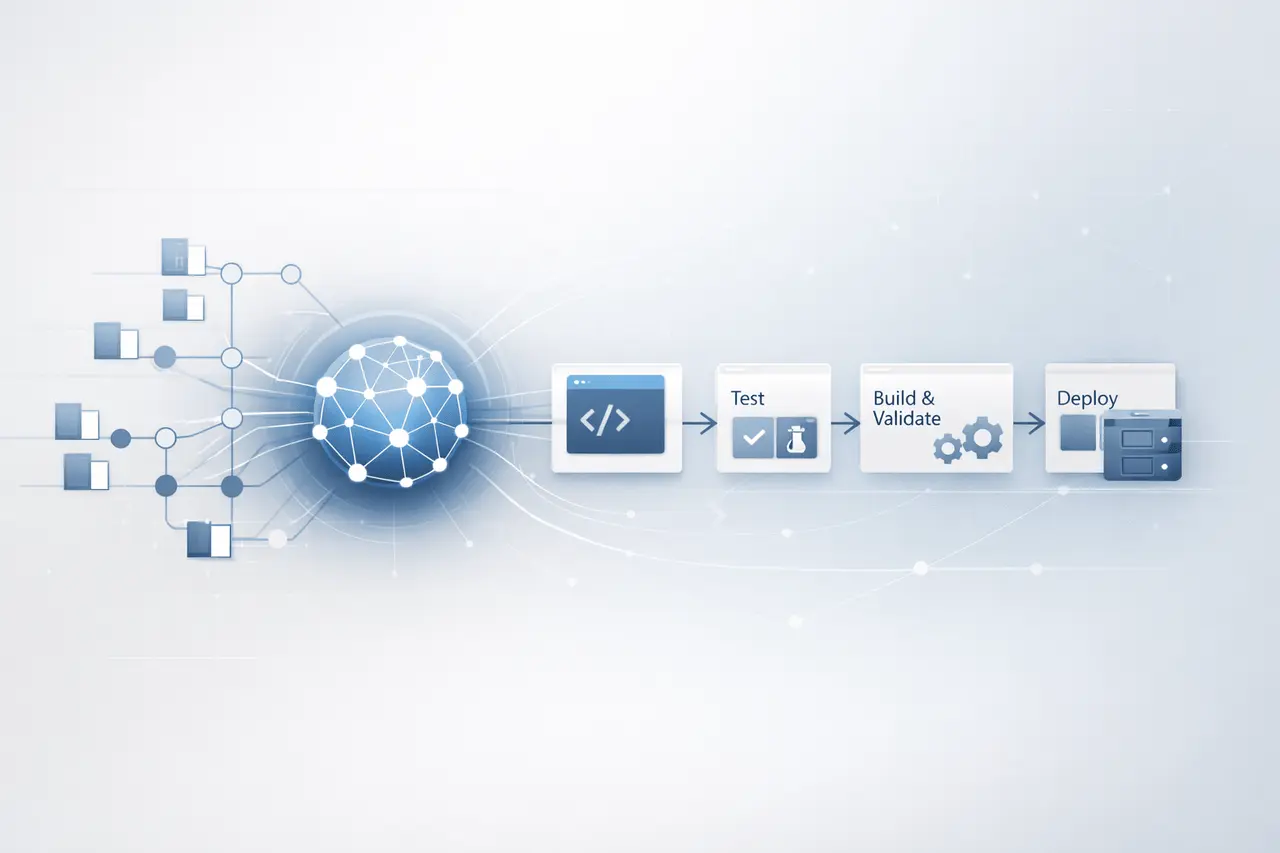
A new research SWE-CI benchmark offers an improved method for assessing AI software developers by evaluating their ability to maintain evolving software repositories through continual integration (CI) processes. The benchmark was announced in an article published in March 2026 that shifts the evaluation from isolated bug fixes toward long-term codebase maintenance, a fundamental task in real-world software engineering.
The test simulates how software evolves over several months, requiring AI agents to alter code, run tests, and prevent regressions. The method highlights a major problem: although Large Language Model (LLM) software developers can fix individual problems, ensuring the software’s quality throughout ongoing development cycles is far more challenging.
The Problem With Current Coding Agent Benchmarks
Recent advancements in large-language models have made it possible for AI systems to complete a variety of tasks related to software engineering, including:
- Bug fixing
- Code generation
- Test creation
- Code refactoring
However, most evaluation benchmarks measure short, isolated tasks.
Examples include:
- Making a function from scratch
- Fixing a single bug
- Making a patch to a GitHub issue
While these measures evaluate the correctness of functionality, they cannot show how software changes over time.
In reality, software development is mostly about updates and maintenance. Studies suggest that 60-80 per cent of the cost associated with software is due to maintenance, not the initial design.
Real-world engineering workflows require developers–or AI agents–to:
- Maintain compatibility with current systems
- Prevent regressions
- Make sure the tests are passing
- Maintain code quality throughout many modifications
The benchmark SWE-CI was created to test whether AI agents can handle these issues.
What is SWE-CI benchmark?
SWE-CI (Software Engineering Continuous Integration) is a benchmark for repository-level testing that was designed to test the effectiveness of coding agents in real CI pipelines.
Instead of evaluating only one change, SWE-CI benchmark simulates the longer-term evolution of software using actual projects’ histories.https://arxiv.org/html/2603.03823v1
Key characteristics include:
- 100 tasks in a repository
- Each project averages 233 days of code development.
- Around 71 consecutive commits per task
- Real-world repository histories
Agents begin with an initial commit, then modify the program until it reflects the state of the commit to be used, ensuring the project passes its tests.
This style is similar to engineering environments, where changes must integrate into an ever-changing codebase.
What is the SWE-CI Benchmark? and Does It Work?
The SWE-CI framework analyses AI coders through a simulated continuous integration loop.
CI Loop Workflow
The benchmark is based on an iterative process:
- Examine the state of the repository
- Generate new requirements
- Modify source code
- Test suites
- Look for any regressions
- Continue until you reach the state you want to be in.
Each step mirrors the typical CI pipelines used on the most modern development platform.
Agents have to keep updating the code and ensure that the functionality previously used continues to work.
Architect Programmer Setup
The test uses the two-agent system :
- An architect agent generates the requirements and changes to plans
- Programmer agent: Implements code modifications
This design reflects the emergence of agent-based software engineering systems, in which multiple AI agents collaborate to accomplish complex tasks.
EvoScore: Measuring Long-Term Maintainability
One of SWE-CI’s main contributions is EvoScore, a measure that assesses the extent to which an AI agent can support the future advancement of code.
Contrary to conventional measures that determine if code functions at all times, EvoScore evaluates:
- Stability across different iterations
- Support for future changes
- Long-term maintainability
Agents that make poor design choices early typically accumulate technical debt, making modifications later more difficult.
EvoScore detects this effect by examining how early choices impact the subsequent CI cycle.
Benchmark Design Overview
| Feature | SWE-CI Benchmark |
|---|---|
| Task Type | Repository-level software evolution |
| Number of Tasks | 100 |
| Average Development Span | 233 days |
| Average Commits per Task | 71 |
| Evaluation Method | Continuous integration loop |
| Primary Metric | EvoScore |
This format allows researchers to test longer-horizon logic and technological capabilities within AI code systems.
What is Continuous Integration? is Important in AI Coding Agents?
Continuous integration (CI) is among the most crucial workflows in modern Software Engineering.
A CI pipeline that is automatically:
- builds the project
- Tests are automated
- detects regressions
- Ensures compatibility
If AI programming agents are going to be autonomous developers, they must be able to operate within CI pipelines without compromising software systems.
The SWE-CI benchmark examines whether agents can:
- Maintain test coverage
- Preserve architectural consistency
- Avoid regressions across multiple iterations
The capabilities are crucial in AI-driven software development and autonomous code platforms.
Comparison with Coding Benchmarks
| Benchmark | Focus | Limitation |
|---|---|---|
| HumanEval | Function-level code generation | No repository context |
| MBPP | Small coding tasks | Limited complexity |
| SWE-bench | Issue-to-patch tasks | Single change evaluation |
| SWE-CI | Long-term CI workflows | More realistic engineering scenarios |
Previous benchmarks assess correctness at a single moment within time.
Instead, it measures the extent to which an AI system can support evolving software systems.
Key Research Insights
Experiments using SWE CI show a significant finding:
Even the most advanced AI programming agents struggle to maintain code quality over long periods of development.
Although models can initially produce patches that work, problems often surface later in the CI loop.
Common failure patterns include:
- Architectural inconsistencies
- Regression errors
- Increasing technical debt
- It is difficult to adapt earlier code decisions
This suggests that long-term thinking remains a major obstacle for AI Software agents.
Potential applications of SWE-CI
The benchmark may be a significant factor in evaluating the next generation of AI code systems.
1. Autonomous Software Engineering Agents
AI systems designed for development environments need to be evaluated based on their long-term performance.
2. Agent-Based Platforms for Development
Emerging developer tools increasingly use multi-agent architectures.
Benchmarks like SWE-CI can help measure coordination between agents.
3. CI Pipeline Automation
The AI system of the future could automatically:
- Refactor code
- update dependencies
- maintain tests
SWE-CI provides a platform for testing capabilities.
Limitations of this Research
While SWE-CI provides an important evaluation model, the benchmark has several limitations.
Limited Task Size
The current benchmark includes 100 activities, which could be limiting the coverage of the statistics.
Programming Language Scope
The dataset focuses specifically on Python repository sites that may not reflect the diversity of contemporary technology ecosystems.
Test-Based Evaluation
Because the benchmark relies heavily on test suites, agents can be more focused on passing tests than on creating a stable architecture.
Future work might extend the benchmark to include additional languages and more repositories.
My Final Thoughts
SWE-CI benchmark highlights an important shift in how researchers analyse AI code systems. Instead of focusing solely on software tasks or programming, it evaluates the extent to which AI agents can maintain code quality over time, even during long-term development.
Initial results suggest that, despite rapid advances in code-generation models, maintaining large code databases remains an issue for AI agents. This gap highlights the significance of benchmarks that reflect actual engineering workflows, including CI pipelines, regression testing, and iterative design.
While AI-powered software engineering systems continue to improve, benchmarks such as SWE-CI could become crucial for evaluating the next generation of autonomous software development agents and agent-based technologies.
FAQ
1. What exactly is SWE-CI and its role in AI research?
SWE-CI is a test designed to assess AI programming agents by evaluating their ability to maintain up-to-date software repositories through continuous integration.
2. What is the difference between SWE-CI and SWE-bench?
SWE-bench tests whether an AI model can fix the issue. GitHub issue, and SWE-CI tests whether an AI model can maintain code quality throughout numerous changes and CI cycles.
3. What exactly is EvoScore?
EvoScore is a measure introduced in the benchmark SWE-CI that evaluates how well an AI agent supports the long-term evolution of code and its maintainability.
4. What is the reason CI workflows are essential for code agents?
Continuous integration ensures that any code changes don’t affect existing functionality. AI programming agents must operate with a high degree of reliability within CI pipelines to be effective and useful in the real-world development environment.
5. Can current AI models maintain large codebases?
Recent research suggests that, even though AI models can create patches or fix bugs, they face challenges in maintaining long-term, changing computer systems.
6. How many tasks are covered in SWE-CI?
The benchmark consists of 100 projects, each representing the real-world evolution of a repository spanning an average of 233 days and 70 commits.
Also Read –
NVIDIA SideQuest: Smarter KV Cache Management for Long-Running AI Agents