

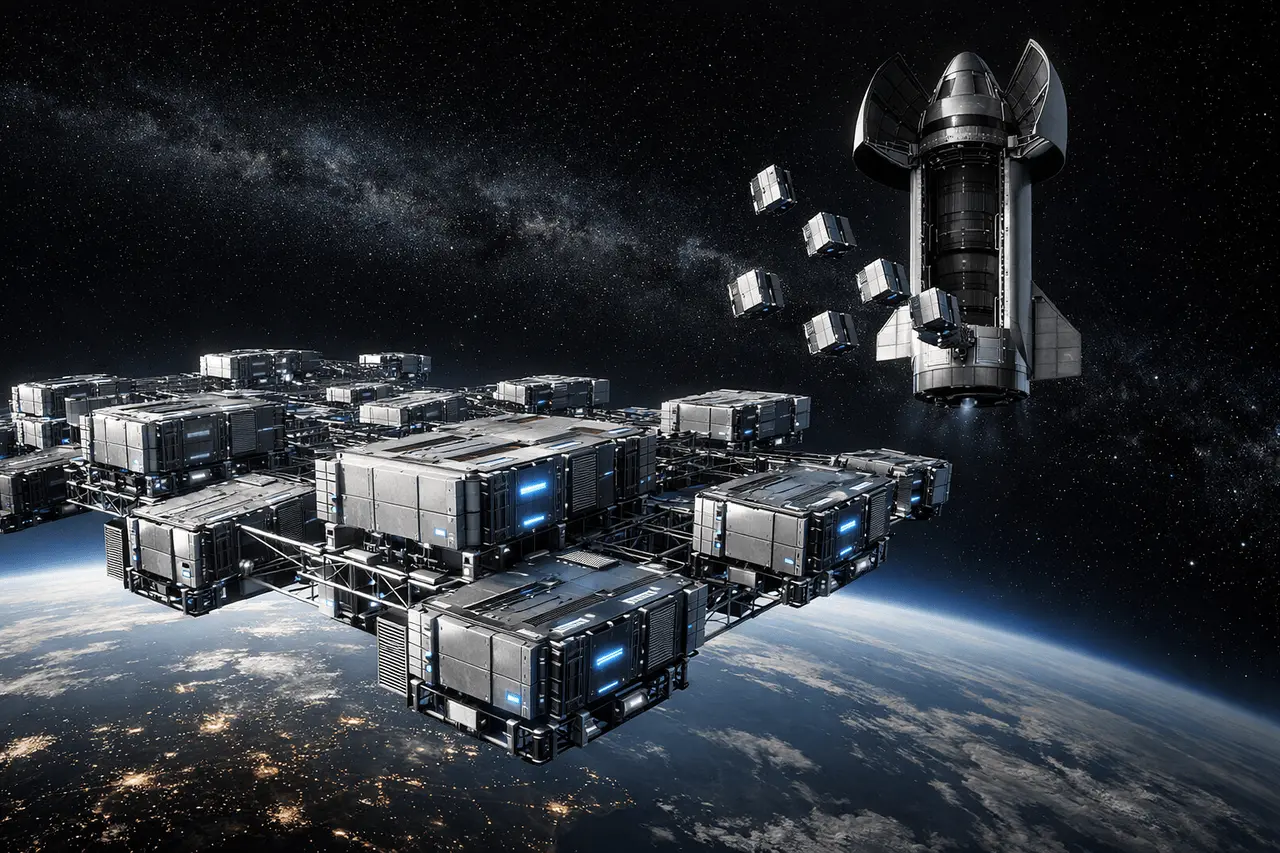
The orbital centres for data are gaining momentum as a radical alternative to meet the rapidly growing . As AI models grow larger and more energy-intensive, conventional ground-based data centres are facing physical, financial, and energy constraints. Modernisations in launch systems for heavy lift, including Starship V3, are shifting orbital data centres from theoretical to practical infrastructure. By using unprecedented payload mass to orbit at a lower cost, Starship fundamentally changes how large-scale computing can be utilised in the universe beyond Earth.
What is Orbital Data Centers?
The orbital data center is a computing facility located in Earth orbit, rather than on land. Instead of storing servers in buildings on the ground, computing hardware is put on orbital satellites or on modular orbital platforms.
These systems are designed to offer:
- Massive parallel compute capacity
- Lower dependence on the terrestrial power grids
- Global Access paths with low latency
In contrast to the previous experimental satellites, modern orbital data centers are designed as industrial-scale infrastructure rather than small-scale technology platforms for researchers.
Why Orbital Data Centers Matter?
AI workloads are increasingly limited by power supply, cooling efficiency, and geographical latency. Orbital environments have distinct advantages that tackle these bottlenecks.
Key Drivers Behind Orbital Computing
- Energy Restrictions: Ground data centers are competing with industrial and city centers for power.
- Limits on Cooling: Dense AI accelerators generate heat that is costly to dissipate into Earth’s atmosphere
- Time and Coverage: Global AI requires consistency in performance across regions.
The orbital data center introduces a new computing paradigm in which compute location is separated from the limitations of terrestrial infrastructure.
How Starship V3 Makes Orbital Data Centers Viable?
The previous launch vehicles lacked the payload capacity and cadence needed for large-scale space computing. Starship V3 is designed to override these limitations.
Heavy-Lift Capability
Starship V3 is engineered to deliver 200+ metric tonnes into orbit on every flight, enabling the launch of hundreds of dense-computation satellites on a single mission. The same capacity as older rockets, such as the Falcon 1, would require hundreds of launches over time.
Utilizability, Rapid Cadence, and Reuse
Reusability is essential to enable multiple launches with no cost increase. This is essential for scaling the orbital centers of data centers from prototypes to operational networks.
Cost Effectiveness at Scale
In a way that amortizes launch costs across a huge load-bearing Starship, allows for lower costs per Kilowatt of compute capacity than conventional space launches, and narrows the gap in cost between ground-based and orbital infrastructure.
Space-Only Advantages to AI Compute
Data centers benefit from climatic conditions that are not available anywhere else on Earth.
Vacuum Cooling
A vacuum in space enables advanced designs for radiative cooling that are less complex mechanically and consume less energy than terrestrial cooling systems that rely on liquids.
Continuous Solar Power
Orbital platforms have access to constant solar energy, thus reducing dependence on fossil fuels or the regional power grids.
Worldwide Coverage and Latency Pathways
Nodes for space-based computation can transmit data worldwide with fewer terrestrial hops, ensuring greater consistency for latency-sensitive AI inference and communication tasks.
Feature Comparison: Ground vs Orbital Data Centers
| Aspect | Ground Data Centers | Orbital Data Centers |
|---|---|---|
| Power source | Regional electrical grids | Solar-dominant |
| Cooling | Energy-intensive mechanical systems | Radiative vacuum cooling |
| Geographic reach | Location-dependent | Global by design |
| Expansion speed | Years for permits and construction | Launch-driven scaling |
| Physical limits | Land, water, and grid constraints | Payload mass to orbit |
Application Real-World from Orbital Data Centers
Orbital compute infrastructures are not an alternative to physical data centres. Instead, it is a complement for highly specialized use instances.
AI Model Training and Inference
Large-scale inference for users distributed across the globe can benefit from compute nodes that reduce the time required for cross-continental routing.
Earth Observation and Scientific Computing
Processing satellite images and sensor data in orbit reduces downlink bandwidth requirements and speeds up the generation of insights.
Securing as well as Resilient Infrastructure
Data centers orbital are completely shielded from a variety of terrestrial threats, such as natural disasters as well as isolated power outages.
Emerging Space Economies
As organizations such as AI push towards larger AI systems, orbital computing could become the foundational element of space-based AI products.
Real-world Challenges as well as Limitations
Despite their promises about orbital data centers, they face fundamental limitations that need to be addressed.
Hardware Maintenance
Repairs and upgrades to in-orbit servers are much more complex than maintaining ground-based servers.
Radiation Exposure
Cosmic radiation can increase the risk of hardware degradation, which requires special shielding and fault-tolerant system design.
Regulative and Orbital Management
Prominent constellations must comply with space traffic coordination and debris reduction requirements.
Upfront Capital Costs
Even with reusable launch systems, deploying orbital data centers will require substantial initial investments.
Orbital Data Centers vs Traditional Scaling Approaches
| Scaling Approach | Primary Advantage | Key Limitation |
|---|---|---|
| Larger ground facilities | Familiar and proven | Grid and land constraints |
| Distributed edge computing | Lower local latency | Fragmented capacity |
| Orbital data centers | Global, energy-efficient scale | Launch and maintenance complexity |
Future Outlook
Starship V3 marks a structural transition point for orbital infrastructure. Reducing deployment times from decades to years speeds up the transition of data center orbital centers from a concept of experimentation to functional systems.
As launch frequency increases and orbital hardware improves, space-based computing is expected to become more integrated with ground-based clouds and AI systems.
My Final Thoughts
Orbital data centers mark an essential shift in how large-scale AI infrastructure can be constructed and used. Through the use of an unprecedented amount of payload capacity, speedy reuse, and financial sustainability, Starship V3 transforms orbital computing from an elusive possibility into a near-term infrastructure. As AI demand continues to rise, the space-based computer is poised to play a key role in the near future of the global digital system.
FAQs
1. What is an orbital center?
A data center orbital is a satellite-based computing facility that houses servers or AI hardware in Earth orbit rather than on the ground.
2. Why are orbital data centers important in AI?
AI workloads demand massive power, cooling, and global connectivity–constraints that orbital environments can uniquely address.
3. How does Starship V3 change the orbital computing economy?
Its ability to send over 200 terabytes of compute per flight drastically reduces the cost per deployed compute unit compared with earlier-launched systems.
4. Orbital Data Centers are designed to replace the ground data centers?
No. They are intended to supplement land-based infrastructure for specific, large-scale, and globally distributed work.
5. What are the most significant dangers of data centers located in space?
Radiation exposure, maintenance issues, and regulatory requirements coordination remain the main challenges.
Also Read –
Typeless AI Voice Keyboard: Secure Cross-Platform Typing