
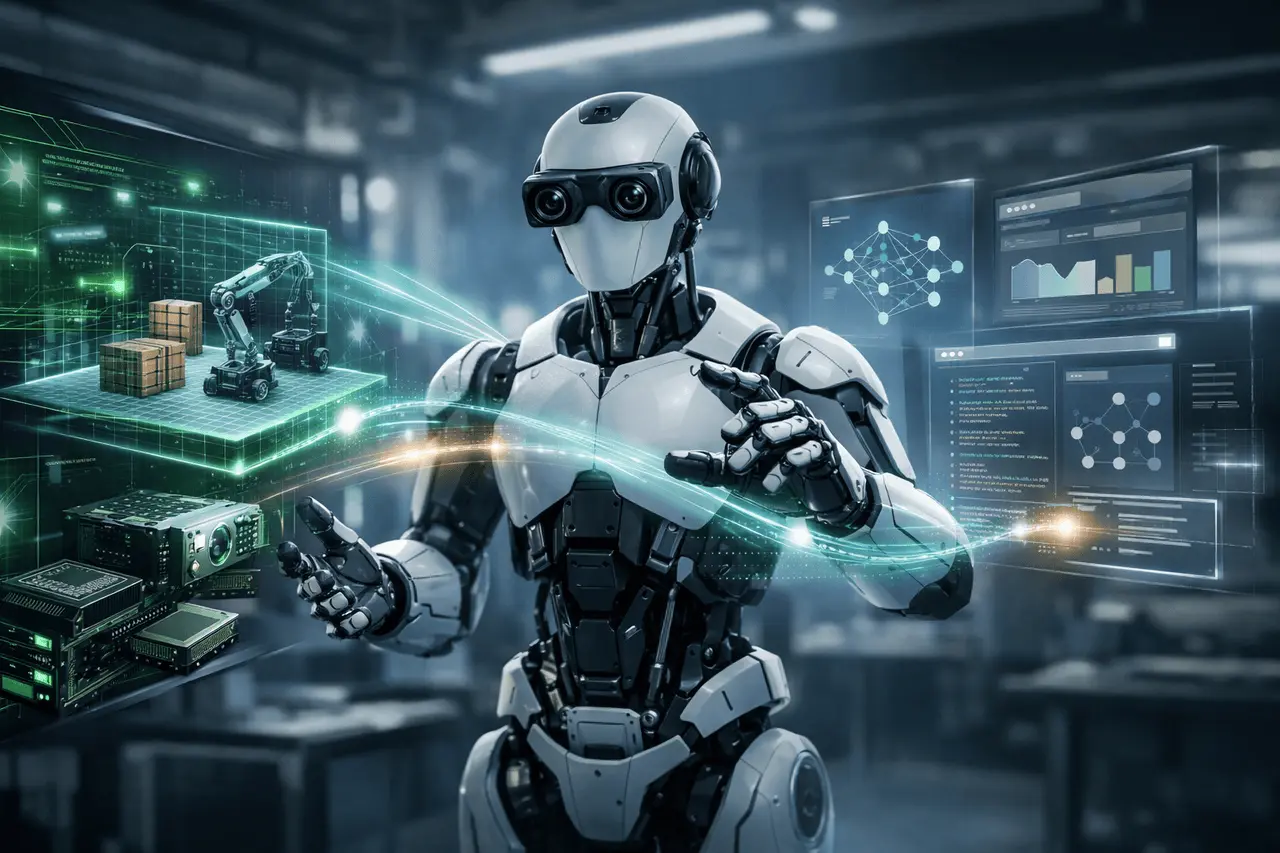
Open-source software has revolutionised the field of artificial intelligence; however, robotics has been slow to catch up because of the difficulty of hardware in the tools and programs, as well as the expensive development costs. A new partnership that is being developed between NVIDIA and Hugging Face aims to change this trend. Through the integration of NVIDIA’s open source Isaac robotics technology with the LeRobotHF framework, the two ecosystems have joined forces to make robot development from beginning to end quicker, easier to access, and more adaptable.
The initiative brings together millions of developers from AI and robotics communities. It aligns simulation, training and deployment workflows. It also includes real hardware that ranges from small robotics for education to more advanced humanoid platforms. The result is a more straightforward route from research into models to robotic systems that are often referred to as physical AI.
In this article, you will explore NVIDIA Hugging Face open-source robotics and how it accelerates end-to-end physical AI development.
Bridging Two Massive Developer Ecosystems
The primary goal of the partnership is scale. The robotics ecosystem of NVIDIA includes more than 2 million developers. Hugging Face’s membership comprises more than thirteen million AI builders. Combining these groups reduces the friction between the AI creation of models and the deployment of robots.
Hugging Face is now a significant site for sharing datasets, models, and training recipes, especially for large language models (LLMs) or vision-based language models. NVIDIA offers hardware acceleration as well as simulation and robot-specific stacks of software. Their integration ensures that advancements in AI reasoning and perception can be tested quickly and refined before being deployed on robots that are physically active without re-inventing infrastructure in each step.
Isaac Technologies Meet LeRobotHF
The heart of this endeavour is integrating the NVIDIA Isaac techniques into the LeRobot framework of Hugging Face. Isaac offers simulation as well as learning and deployment tools designed specifically for robotics tasks. Through the inclusion of these tools within LeRobotHF, developers get the benefit of a single workflow that includes:
- Synthetic and simulation data generation
- Training robot policies using modern AI models
- Evaluation in real-world environments
- Deployment on real hardware
Two essential Isaac parts are currently included in LeRobotHF; Isaac Lab-Arena, which allows for rigorous benchmarking and experiments, and GR00T N, which is a robot foundation model that is designed to be able to adapt across different jobs.
This integration dramatically reduces the time needed for moving from experiments to working prototypes, particularly for teams with significant robots.
Robot Foundation Models and VLAs
A significant focus of the collaboration is support for vision-language-action (VLA) models, systems that combine visual perception, language understanding, and motor control. VLAs are now seen as the base for general-purpose robots able to follow directions, adapting to new demands, as well as communicating in a natural way with humans.
The LeRobotHF framework can now run any compatible VLA, including Isaac GR00T, across a variety of hardware platforms. This flexibility lets researchers test different architectures, refine models, and then deploy them in a consistent manner, regardless of whether they are working locally or advancing to larger systems.
Reachy 2 and Jetson Thor: Scalable Physical AI
The most prominent hardware pairings that are highlighted by the team can be Reachy 2 combined with Jetson Thor. Reachy 2 is a humanoid robot that is used for research and advanced prototyping. Jetson Thor provides on-device AI computation optimised for robotics tasks.
Together, they allow developers to run complicated VLA models directly on the robot, which reduces dependence on cloud connectivity and increases the speed of response. This configuration is advantageous when it comes to applications that demand real-time perception and decision-making, such as navigation, manipulation, and human-robot interactions.
Reachy Mini and DGX Spark for Local Development
The collaboration also provides accessibility issues for smaller groups, educators, and individual developers. A less compact configuration connects Reachy Mini with DGX Spark. This configuration can support local, LLM-powered robot development without the need for massive infrastructure or data centres.
Through enabling local training as well as inferences, researchers are able to rapidly develop new ideas and ensure privacy for data. This setup lowers the barrier to access to physical AI experiments while still being in sync with the stack of software utilised on larger systems.
Accelerating End-to-End Robot Development
The traditional approach to developing robotics is joining disparate tools to create simulation and perception, control and deployment. The collaboration between NVIDIA and Hugging Face aims to make this process more efficient and provide a seamless experience. Developers now can:
- Prototype behaviours in simulation using Isaac tools
- Learn and fine-tune models in Hugging Face’s ecosystem. Hugging Face environment
- Benchmark performance using standardised environments
- Deploy directly on hardware platforms that are supported
This complete approach not only speeds up development but also improves the quality of work and collaboration between teams.
Implications for Open-Source Physical AI
By allowing open-source key components and linking them to widely used AI frameworks, the collaboration is a shift towards sharing infrastructure in robotics. Researchers can build upon one another’s work with greater ease. Startups can test their ideas without the expense of a large corporation, and teachers can teach advanced robotics concepts through useful tools.
The most important thing is that the initiative doesn’t make developers dependent on a single model or configuration of hardware. It instead focuses on interoperability by allowing several VLAs, robot platforms, and computing options within a single framework.
My Final Thoughts
The incorporation of NVIDIA Isaac technologies into the LeRobotHF framework is a significant step towards the democratisation of physical AI. Through connecting the vast developer community that supports both high-end and accessible hardware, as well as improving the flow from simulation to implementation, NVIDIA, as well as Hugging Face, help robotics catch up with the open-source movement that is evident across other fields of AI.
While physical AI continues to develop, collaborations such as these will be crucial in translating research findings into tangible, real-world automated systems.
Frequently Asked Questions
1. What’s physical AI? Robotics?
Physical AI is a reference to AI systems that see the world, think, and act within the actual world, and combine vision as well as language and control to control real robots.
2. How does LeRobotHF help robotics developers?
LeRobotHF is an open-source framework for learning, benchmarking, deploying, and training robot policies. It is now enhanced by NVIDIA Isaac technology.
3. Do developers have the ability to run models locally, without a cloud service?
Yes. Configurations such as Reachy Mini, together with DGX Spark, allow the development of robotics locally, using LLM and testing.
4. What kinds of models are accepted?
The framework supports vision-language-action models, including NVIDIA’s Isaac GR00T, as well as other compatible open-source models.
5. Does this collaboration make sense for those who are new to the field?
Although there are advanced features, the accessibility of open-source software, simulator environments and hardware platforms that are smaller allows it to be accessible to learners and teachers.
6. Does the integration restrict the choice of hardware?
No. The method is flexible and allows developers to work with various robot platforms and compute setups in the same ecosystem of software.
Also Read –
NVIDIA Jetson T4000: Blackwell-Powered Edge AI Module
NVIDIA Cosmos Reason 2: Physical AI Reasoning Model Explained