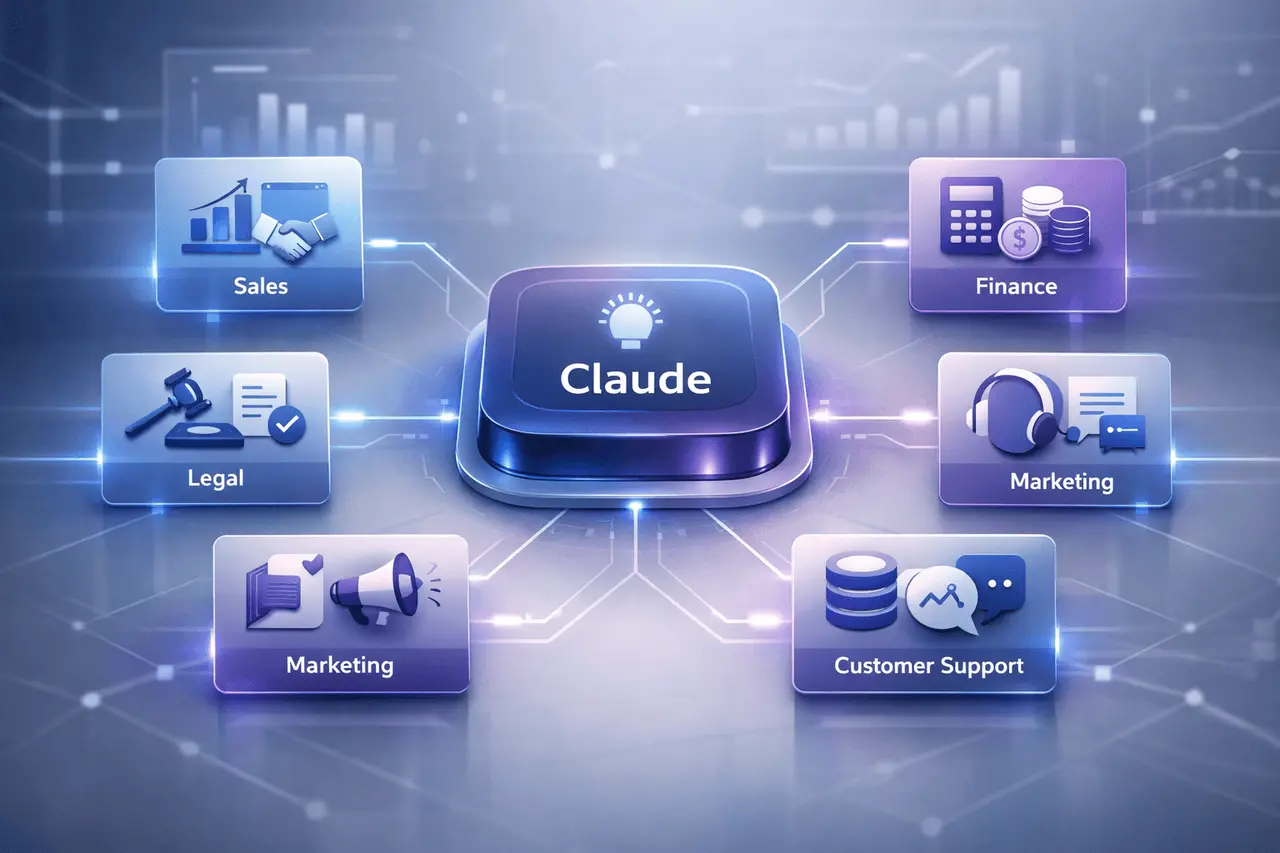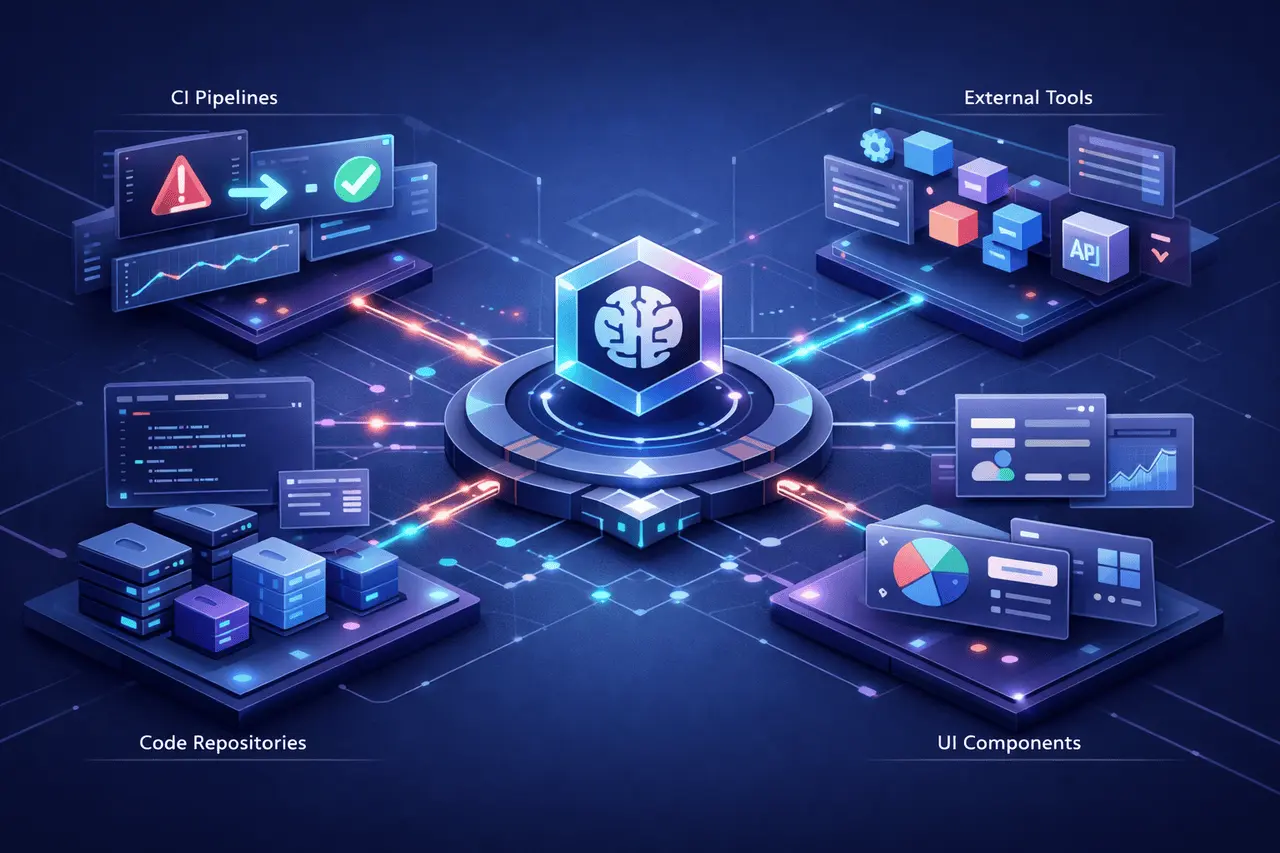
MCP integrations are now the foundational element of modern software engineering tools powered by AI. Recent updates to the top AI development tools highlight how MCP-based connectivity is being used to automate workflows, integrate capabilities from other sources, and accelerate continuous integration. Some notable developments include MCP integrations and a newly released CI Fixer feature, currently in beta for Jules SWE Agent, along with early indications of MCP-driven UI capabilities within the Claude Cowork. Together, these changes indicate a broader shift towards a modular, extensible AI platform for developers.
What are MCP integrations?
MCP integrations use the Model Context Protocol (MCP) to connect AI agents to external services, tools, and application-specific logic. Instead of relying solely on the AI system’s built-in capabilities, MCP enables agents to consistently use remote tools.
Key characteristics include:
- Structured interfaces that connect AI Agents and Tools
- Allows remote execution as well as data exchange
- Extensibility that does not require modification of the base AI model
By separating intelligence from execution, MCP integrations enable AI agents to expand across a variety of evolving environments.
Why are integrations with MCP important in Software Engineering?
Modern software design requires complex toolchains, such as version control and CI systems, as well as testing frameworks. MCP integrations help with this by providing AI agents that function as orchestrators rather than independent agents.
The benefits of HTML0 include:
- Manual intervention is reduced for repetitive tasks
- Faster feedback loops during development
- Interactions are consistent across heterogeneous tools
As AI agents assume greater responsibility in code writing and maintenance, MCP becomes a critical source of trust and security.
MCP integrations within Jules SWE Agent
A Jules Agent is introducing MCP integrations to broaden how the agent works with the development infrastructure. These integrations permit Jules to communicate with external systems via standard MCP interfaces.
CI Fixer Feature (Beta)
One of the most important enhancements is CI Fixer, which is currently in beta. CI Fixer automates the resolution of continuous integration errors.
The most essential features of CI Fixer comprise:
- Detection of CI pipeline issues
- Analysis of the failure logs that are context-aware
- Guided or automated fixes that align with the project configuration
CI Fixer can help reduce the time developers spend identifying failed builds, especially in rapidly moving repositories.
How CI Fixer Works with Integrating MCP?
CI Fixer relies on MCP integrations to communicate with CI systems and retrieve execution context. This lets:
- Access to CI data without embedding credentials into the agent
- Flexibility across various CI providers
- Incremental improvement as MCP capabilities evolve
With MCP acting as an integration layer, CI Fixer is still modular and adaptable.
Traditional CI Debugging vs MCP-Enabled CI Fixer
| Aspect | Traditional CI Debugging | MCP-Enabled CI Fixer |
|---|---|---|
| Failure detection | Manual review | Automated analysis |
| Context gathering | Developer-driven | MCP-based retrieval |
| Time to resolution | Variable, often slow | Reduced through automation |
| Tool portability | CI-specific scripts | Standardized MCP interfaces |
This contrast demonstrates how MCP integrations shift CI troubleshooting from reactive to proactive workflows.
MCP Capabilities Emerging in Claude Cowork
The parallel developments occurring in Claude Cowork suggest broader experimentation with MCP-driven interaction. It is being developed to support @-mention triggering, which allows users to use specific MCP capabilities directly within conversations.
# Mention support as well as MCP Apps
The planned @-mention feature lets users explicitly use certain MCP-powered features. Initial placeholders seen on the interface contain references to:
- “MCP Apps”
- “Imagine” Widgets to HTML and SVG components
These placeholders indicate an architectural direction, not a confirmed feature set.
Rendering UI Components via MCP
The presence of placeholders for widgets suggests that MCP apps might eventually be able to render UI components directly as responses. This will enable AI agents to return:
- Interactive SVG visualisations
- Structured HTML components
- Rich outputs, driven by tools, that go above simple text
These capabilities could extend MCP integrations beyond backend execution to frontend display.
Compatible with other MCP-based App Models
The idea behind MCP apps rendering UI components is similar to the approaches found within other AI ecosystems, remote MCPs that provide both presentation and logic. These models:
- MCP handles tool invocation as well as data flow
- A UI framework renders structured responses
- Agents are still light and contextually focused
This alignment strengthens MCP’s function as a unified protocol for the AI platform.
Use Cases Supported via Advanced MCP Integrations
| Use Case | MCP Role | Practical Benefit |
|---|---|---|
| CI troubleshooting | Access logs and pipelines | Faster build recovery |
| Code analysis | Invoke static analyzers | Higher code quality |
| UI generation | Render SVG/HTML widgets | Improved developer insight |
| Tool orchestration | Coordinate multiple services | Simplified workflows |
These cases show how MCP integrations go beyond automation to design experience.
Advantages of MCP Integrations AI Agents. Agents
MCP integrations give constant benefits regardless of the particular agent’s implementation
- Modularity: Toolkits can be removed or added to models without having to retrain models
- Scalability: The agents can interact with systems that can be enterprise-scale
- Interoperability: Shared protocols reduce vendor lock-in
For companies that are adopting Artificial Intelligence-supported development (AI), these gains result in lower operational friction.
Specifications: Limits and Aspects
Despite their promises, MCP integrations present several issues that teams need to address:
- Controls for security are required to allow remote access to tools
- Latency can increase when using external MCP services.
- Standardisation is changing across all platforms.
Companies should assess MCP capabilities in conjunction with existing infrastructure and conformity requirements.
My Final Thoughts
MCP integrations are rapidly developing the future technology of artificial intelligence-powered software engineering assistants. The launch of CI Fixer in Jules SWE Agent demonstrates how MCP directly enhances developer productivity by making it easier to automate CI troubleshooting. Additionally, new MCP application concepts within Claude Cowork hint at richer interactions with agents that are based on standard protocols. As MCP integrations mature, they are expected to become an integral part of developing reliable, flexible, and future-proof AI technology platforms for developers.
FAQs
1. What are the MCP integrations into AI tools for development?
MCP integrations enable AI agents to communicate with external services and tools via standard protocols, enabling efficient, flexible workflows.
2. How do you make CI Fixer use MCP integrations?
CI Fixer uses MCP to access CI records and the execution context, enabling automated investigation and issue resolution.
3. Are CI Fixers available for all projects?
CI Fixer is currently in Beta, with availability dependent on the project’s compatible CI systems and configurations.
4. What does @ mention support mean in Claude Cowork?
@mentioning support permits people to activate specific MCP features in conversations and make the tool’s invocation easier.
5. Do MCP apps provide UI components?
Placeholders indicate that there is a plan for capabilities for rendering SVG and HTML components; these capabilities aren’t officially verified.
6. Why are MCP integrations important for the future of AI SWE agents?
They offer a scalable, modular framework that enables AI agents to evolve alongside development tools and without continuous redesign.
Also Read –
Claude Code Desktop Updates: Plan Mode and Notifications Explained