
GLM-OCR is an advanced optical recognition device that is designed to manage complicated, real-world documents that are highly accurate and efficient. With a compact model containing only 0.9 billion parameters, GLM delivers top-of-the-line results across a variety of benchmarks in document understanding. It excels at tasks such as table extraction, formula recognition, and structured data retrieval, making it an ideal tool for businesses working with heavy, dense layout documents.
When organizations digitize contracts, economic reports, educational documents, and scan PDFs, traditional OCR tools are often ineffective. GLM-OCR can address these issues with an engine that is optimized for accuracy and speed.
What is GLM-OCR?
GLM-OCR is a sophisticated document OCR model optimised for more intricate layouts rather than straightforward text extraction. Contrary to traditional OCR systems, which primarily focus on character recognition, GLM-OCR focuses on understanding a document’s full text.
The includes
- Accurate recognition of text in a variety of formats and fonts
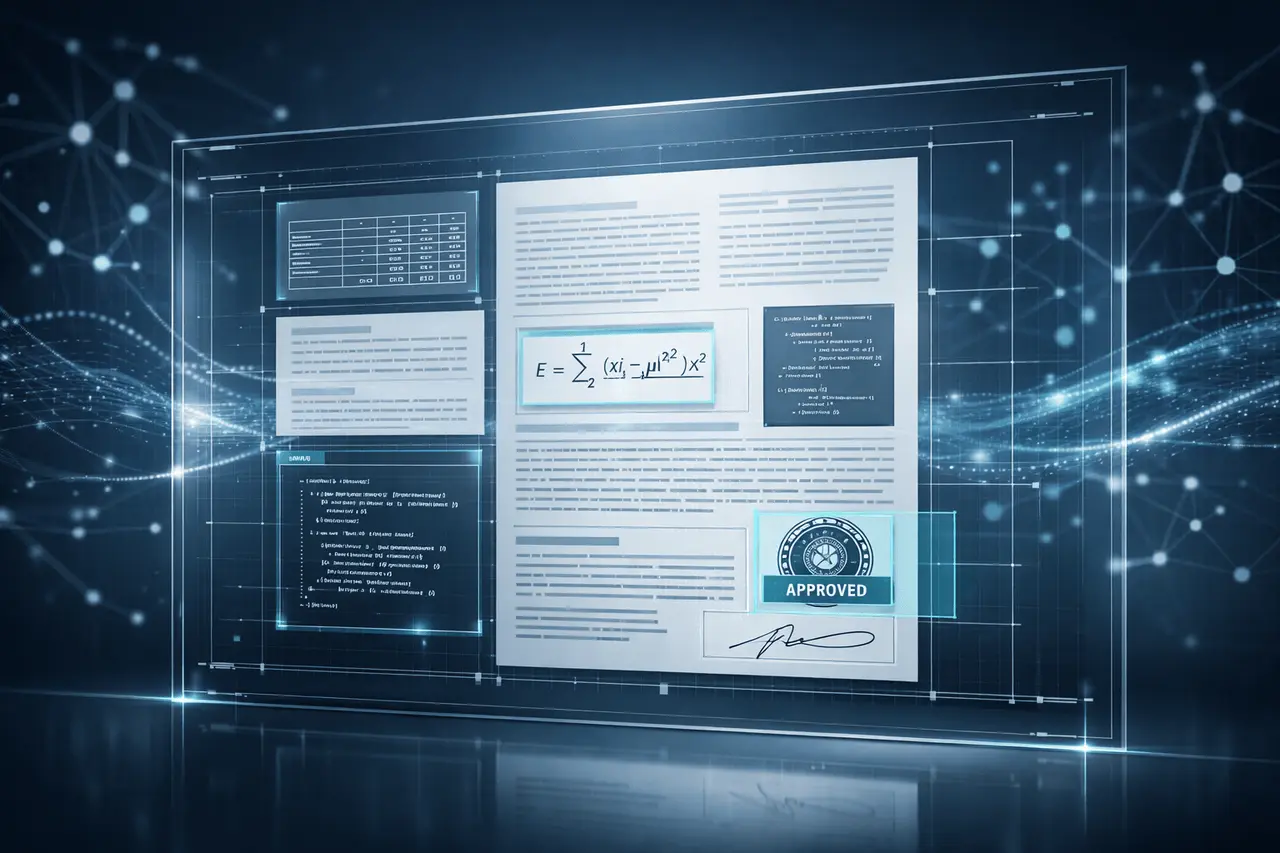
- Structure-awareness of formulas, tables, and multi-column layouts
- The robust use of graphic elements like seals and stamps
Despite its small dimension, GLM-OCR offers the same performance as much more powerful models.
Why GLM-OCR Matters?
Modern documents aren’t just simple text. They usually contain embedded code blocks, mathematical formulas, tables with nested tabs, and other visual symbols that have significance. Incorrect extraction of information could result in compliance risks and data loss, or costly manual reviews.
GLM-OCR is important because it:
- Reduces post-processing time and manual correction
- Allows for the efficient automation of workflows for documents
- Accuracy is balanced by operational efficiency
For businesses that process documents at scale, this combination directly affects speed and cost.
How GLM-OCR Works?
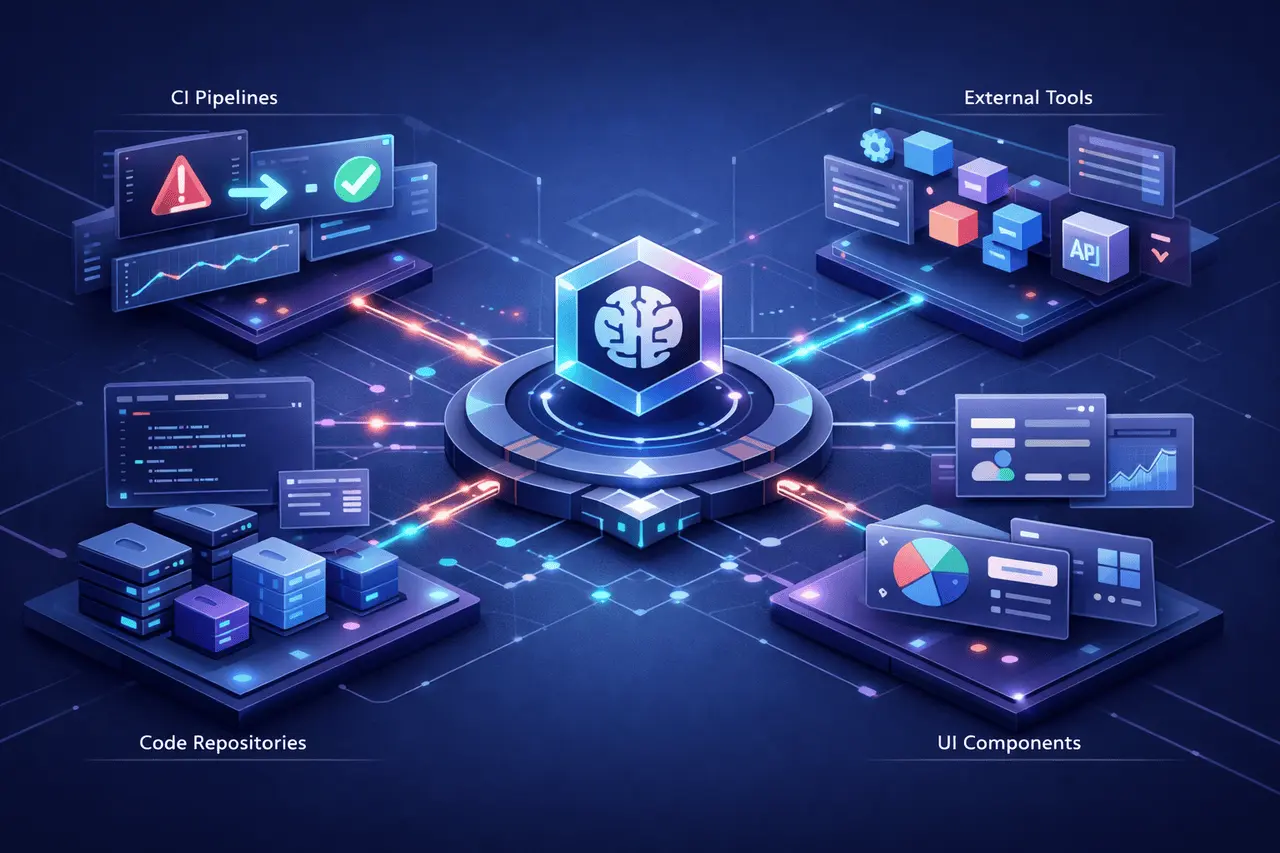
GLM-OCR is an advanced multi-component architecture designed explicitly for understanding documents rather than raw text scanning.
Core Architecture Components
The system integrates three fundamental elements:
- Visual Encoder: An encoder based on CogViT that has been trained using large-scale image-text information to record fine-grained textual and visual cues
- Cross-Modal Connector: A light connector that connects language and visual tokens, while effectively reducing redundant data
- Language Decoder: A GLM-based 0.5B parameter decoder designed to generate structured text
This design allows GLMOCR to keep high accuracy while avoiding unnecessary computational overhead.
Two-Stage Document Pipeline
GLM-OCR utilizes two-stage processing pipelines:
- Layout Analysis: It is split into logical areas, such as tables, text blocks, formulas, and figures
- Parallel Recognition: Every region of the HTML0 is processed in parallel, which improves speed and recognition quality.
This technique guarantees consistent results across different document layouts.
Performance and Throughput
GLM-OCR has been optimized for deployment in the real world, where speed is just as important as precision.
Processing Speed
- PDF documents: 1.86 pages per second
- Image inputs: 0.67 images per second
These throughput figures dramatically outperform those of comparable OCR models while maintaining the highest recognition quality.
Benchmark Accuracy
GLM-OCR has the latest results across:
- Formula recognition benchmarks
- Cell structure and table recognition tasks
- Information extraction evaluations
Its high performance is noteworthy considering the model’s small number of parameters.
GLM-OCR’s Key Capabilities
Complex Table Recognition
GLM-OCR accurately preserves:
- table boundaries, hierarchies, and even the borders of the table
- Cells that have been merged and rows
- Textual and numeric alignment
This makes it ideal for invoices, financial statements, and analytical reports.
Formulas and Coding Understanding
The model is responsible for:
- Equations and mathematical symbologies
- Technical documents with a lot of code
- Text and symbol content mixed
This feature is handy for engineering, academic, and research-related use cases.
Highly Effective Processing of Audio Noise
GLM-OCR is an excellent choice for documents that contain:
- Seals of the government and seals
- Background noise
- Incorrect formatting
Traditional OCR systems are often ineffective in these situations.
Feature Comparison Overview
| Capability | Traditional OCR | GLM-OCR |
|---|---|---|
| Plain text extraction | Strong | Strong |
| Table structure recognition | Limited | Advanced |
| Formula recognition | Weak | State-of-the-art |
| Layout awareness | Basic | Comprehensive |
| Throughput efficiency | Moderate | High |
Real-World Applications
GLM OCR is perfect for businesses that rely upon structured data in documents.
Common Use Cases
- Financial: The automated processing of financial statements, as well as invoices
- Legal: Digitalization of compliance and contract documents
- Search: Extraction of tables and formulas from academic documents
- Government: Forms that are processed by the government using seals and stamps
By reducing manual review, GLM OCR increases accuracy and turnaround speed.
Benefits as well as Limitations
Advantages
- High accuracy for complex document layouts
- High performance and small model size
- Efficient parallel processing pipeline
- Effective handling of formulas and tables
Limitations
- Optimized for documents, rather than natural scenes text
- Best results require clean document scans or images
- Advanced deployment may require technical integration expertise
Understanding these elements can help organizations implement the model efficiently.
Practical Options for Adoption
Before integrating GLM OCR, teams must consider:
- Types of documents along with layout difficulty
- The required throughput and latency limitations
- Downstream systems for the consumption of structured data
Aligning these requirements will ensure the highest ROI.
My Final Thoughts
GLM-OCR is a significant advancement in optical character recognition of complex documents. By combining layout-aware processing with robust formulas, table recognition, and rapid throughput, it eliminates several limitations of conventional OCR systems. As document automation expands across all industries, GLM-OCR enables scaling and provides a solid foundation for accurate document understanding, positioning it as the key technology to ensure future-proof digital workflows.
FAQs
1. What distinguishes GLM-OCR from other traditional OCR tools?
GLM-OCR focuses on a complete understanding of documents, including tables, layout, and formulas, rather than just character recognition.
2. Can GLM-OCR process PDFs that have been scanned?
Yes, GLM OCR is designed to work with PDF files and can process the documents efficiently and with high precision.
3. Are GLM-OCR compatible with mathematical documents?
Formula recognition is among its strengths, making it suitable for both academic and technical content.
4. How effective is GLM-OCR in production settings?
It has a high throughput of 1.86 pages/second in PDFs, ensuring speed is balanced with accuracy.
5. Does GLM-OCR work with complicated tables?
Yes, it precisely recognizes tables, merged cells, and nested layouts.
6. Which industries will benefit the most from GLM-OCR?
Legal, finance, research, and government sectors greatly benefit from its understanding of structured documents.
Also Read –
GLM-4.7 Open-Source AI Model: Performance, Features, and Real-World Use