
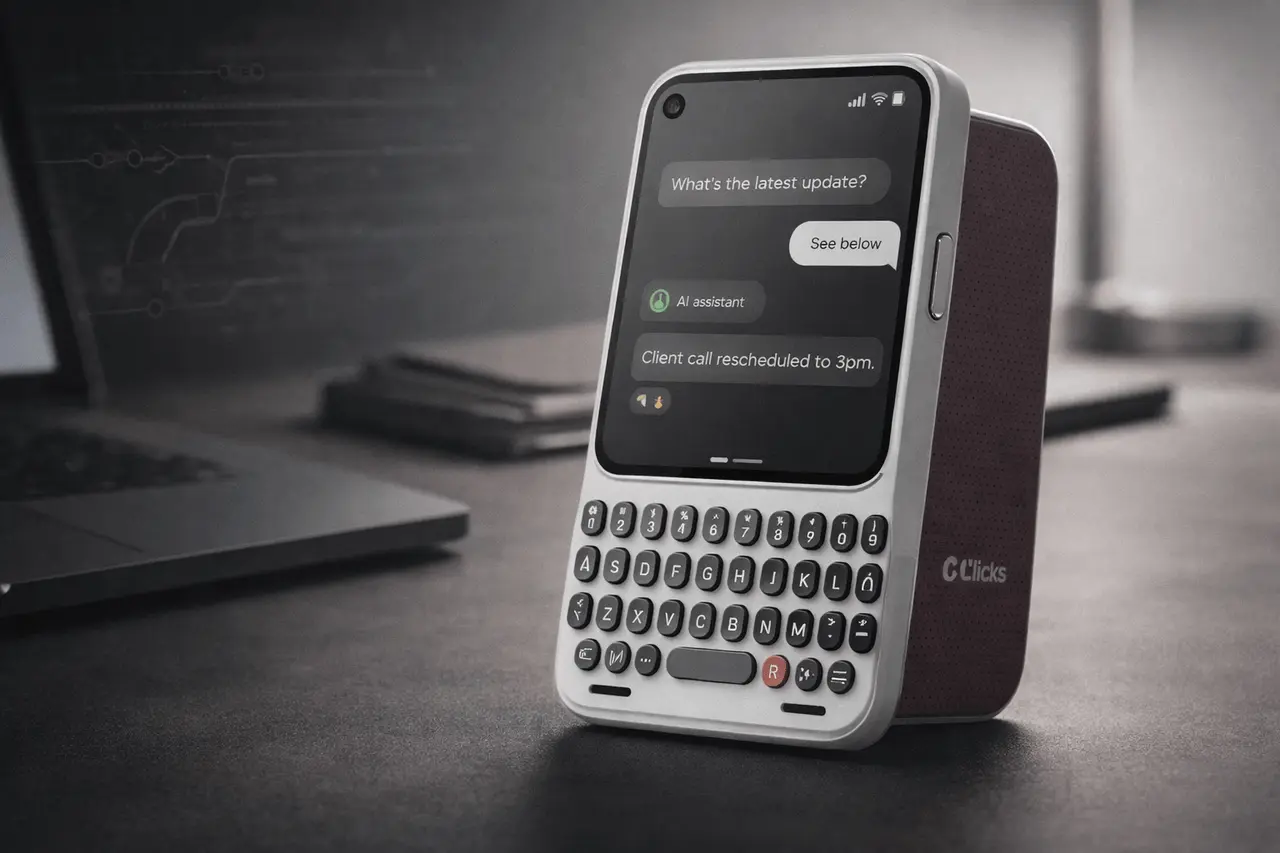
In a world where the top smartphones are dominated by big screens, media consumption, and AI-powered features, an English-based company has taken a risk. It is going back to the basics using Clicks Communicator. Clicks Communicator is a purpose-built smartphone that focuses on productivity and communication, featuring a dedicated QWERTY keyboard and a streamlined interface. The announcement was made in early January 2026. The Communicator offers a new perspective on mobile design and how we interact with online conversations in a chaotic world.
A Return to Purpose-Built Devices
Clicks, which was previously popular for its smartphone keyboard accessories, like the well-known Clicks Keyboard Case, revealed the Communicator with a simple goal to create a device that focuses on meaningful interactions, not incessant consumption. It was designed to complement, rather than replace, top-of-the-line devices from leading makers. The Communicator is a symbiotic device that focuses on messaging.
In contrast to traditional smartphones that focus on multimedia, social media, and apps, The Communicator is designed around the concept of context, input, and control. It is intended for those who live the dual-phone life, with one device powerful enough to run apps and media, and a smaller, lighter device for communication, triage, and rapid response.
Physical Keyboard Meets Modern Android
One of the most distinctive features of Clicks Communicator is its tactile QWERTY keyboard. This tactile keyboard harkens back to the keyboards that once set the standard for professional communication, including BlackBerry models, but offers modern improvements in speed, accuracy, and ease of use. The keyboard is compatible with a wide variety of Latin alphabets and gives a more secure typing experience than screen-based alternatives.
With the rise of physical keyboards among specific users, the Communicator is designed to bridge the gap between nostalgic and modern needs. The keyboard’s presence allows for a smaller device profile, a smaller screen area devoted to content, and a greater emphasis on typing efficiency.
The device’s underside runs Android 16, which gives users access to the latest smartphone features, security updates, and compatibility with mainstream apps. The launcher and interface have been designed to focus on productivity and messaging applications like Telegram, WhatsApp, Slack, and Gmail, putting messaging at the forefront.
Hardware Overview: Compact but Capable
The hardware of the Communicator reflects its intended use. Although it’s not designed to be an all-purpose media device, the Communicator provides an array of features that are sufficient to handle everyday tasks and provides connectivity:
- Android 16 OS with commitments to updates.
- Physical QWERTY keyboard with authentic keys and tactile feedback.
- The small form factor, reminiscent of old communicator-style phones, improves mobility and makes it easier to use with one hand.
- A custom-designed communication launcher that puts notifications and messaging apps at the top of the list.
Early-reservation pricing for the Communicator starts at $399 (with discounts for pre-orders), and the total retail price is around $499. This makes it a reasonable alternative to heavier, content-driven phones.
Clicks Communicator: Messaging-First Design Philosophy
What makes Clicks from other devices is the Clicks Communicator’s design principle. In a world where many devices feature large screens and cameras, high-performance gaming, and AI-based ecosystems, Clicks asserts that communication is a mobile experience that has not been fully embraced.
With features such as a side Signal Light that alerts users to messages from specific applications or contacts, and an intelligent layout that puts typing and fast access at its core, it aims to cut down on distractions and focus on its purpose.
This strategy aligns with a broader trend: some users are opting for a minimalist, focused mobile experience. A two-device configuration with one device for communication and the other for media reflects the habits of professional users, privacy-conscious people, and those looking to improve their digital boundaries.
AI Agents and the Future of Interaction
Although the Communicator itself doesn’t overtly focus on artificial intelligence (AI), generative AI, or self-contained AI agents, the release coincides with broader industry shifts toward AI-based task automation. The research into agent-based AI systems indicates that the next generation of devices will increasingly employ AI agents to handle tasks such as scheduling, summarizing communications, and automating routine processes. They can be independent of traditional chat interfaces and could signal an era in which text conversations may no longer be the only communication method.
Click’s claim that “Chat isn’t the final model for AI” reflects a future-oriented perspective. As AI agents grow increasingly sophisticated, gadgets such as the Communicator can serve as vital platforms for managing AI-generated information and decisions, as well as for context-specific prompts, rather than simply displaying screens of static data.
Who Should Consider the Clicks Communicator?
The Communicator was explicitly designed for a specific target audience:
- Professionals who prioritize productivity and messaging over entertainment.
- Two-phone users seeking a lightweight communication device alongside a flagship phone.
- Minimalists with a wish to reduce distractions and concentrate on the most critical tasks.
- Keyboard lovers with a preference for typing on a physical keyboard for speed and precision.
Although it’s not designed to compete directly with top-of-the-line Android and iOS phones for raw capability or camera, the Communicator’s innovative design and messaging capabilities can redefine the concept of “a second phone” in today’s mobile market.
Final Thoughts
Clicks Communicator isn’t trying to compete with flagship smartphones, and that’s precisely its advantage. It is a sign of growing awareness that, as AI agents become increasingly adept at handling task-related work, summaries, and tasks, and more, humans require more explicit, logical ways to communicate, think, and react. By focusing on texting or messaging and prioritizing awareness over endless scrolling, the Communicator appears less like an old-fashioned relic and more like a pioneering experiment in post-chat design for mobile devices. For minimalists, professionals, and people who use two phones, it’s a smart bet on where human-device interaction might be headed next.
Frequently Asked Questions
1. What is it that makes the Clicks Communicator different from other smartphones?
The Communicator is a device that prioritizes messaging and communication. It comes with a physical QWERTY keyboard and an app launcher focused on messaging apps, unlike most devices, which are focused on consuming content.
2. The Communicator can be used as a primary phone?
Yes, it runs Android 16 with support for apps and network connectivity, but it’s designed for communication tasks, not gaming or media performance.
3. Is the Communicator compatible with popular messaging apps?
A targeted launcher puts widely used apps such as WhatsApp, Slack, Telegram, and Gmail at the forefront, making them easy to access quickly.
4. Does the device have AI capabilities?
Although it is not solely focused on the generative aspect of AI, the release context hints at the possibility of future interactions with AI agents that can automate communication tasks, suggesting the development of interaction models.
5. What is the cost of the Communicator? Cost?
Early reservations start at $399, and the total retail price is $499.
6. Can the Communicator be used by international users?
Yes, the QWERTY keyboard is compatible with languages that use the Latin alphabet. It also has extensive access to languages for international communication.
Also Read –
Typeless Keyboard for iOS: A Smarter AI Dictation Keyboard