
Exa AI has launched Exa Agent Ultra, a new highest-effort mode for its AI research agent designed for tasks where completeness matters more than speed. The system coordinates multiple subagents across large numbers of web sources to handle deep research, large-scale list building and difficult entity-enrichment tasks.
Unlike a conventional search query, Agent Ultra is intended for research assignments that can require many separate investigations before producing a final answer. Exa says its agent divides a task into subtasks, assigns subagents to different research areas and combines the results into a single output.
The launch was announced by Exa in late September 2026, with the company’s current announcement page dated September 25. The accompanying documentation identifies Ultra as the highest-effort option available in Exa Agent.
Quick summary
- Exa Agent Ultra is the highest-effort mode of Exa Agent.
- It is designed for exhaustive deep research, large-scale list building and entity enrichment.
- The system divides complex tasks into subtasks and uses multiple subagents across research domains.
- Exa says Ultra performed strongly across WANDR, WideSearch, DeepSearchQA and its Find-All Company benchmark.
- Complex runs typically take around 30 minutes, with documentation allowing runs of up to 3 hours.
- The default maximum cost is $20 per run, with configurable budgets from $1 to $100.
- The API can be used with
effort: "ultra". - Exa positions it for AI companies, financial research and GTM/account research.
- The benchmark and cost comparisons should be described as Exa-reported results, rather than independently verified performance.
Exa Agent Ultra Focuses on Exhaustive Research
The central difference between Agent Ultra and ordinary AI search is the amount of work the system is prepared to perform before returning its results.
Exa positions Ultra for research problems such as finding all companies that meet a set of criteria, compiling papers and repositories related to a particular technology, verifying information across multiple sources or building structured company datasets.
For example, a research request could ask an agent to identify companies in a particular market, determine their founders and customers, verify their funding and provide evidence for each entry. Exa says Ultra can distribute that assignment across multiple research subtasks rather than relying on a single search-and-answer cycle.
This makes the system particularly relevant to deep research, entity enrichment and list-building workflows. Exa also highlights use cases in financial diligence, KYC research, market mapping, model-provider research and go-to-market intelligence.
How the Agent Ultra Research Architecture Works?
Agent Ultra builds on the existing Exa Agent architecture rather than introducing a standalone language model.
Exa Agent already combines language models with Exa’s web-search infrastructure and can divide large assignments into subtasks. The company introduced Exa Agent in June 2026 as an API for deep research, list building and entity enrichment, with multiple effort levels ranging from lightweight queries to more demanding research runs.
Ultra takes that approach to its highest effort setting. Exa says it uses a mixture of frontier and more cost-efficient models, allowing the system to use more capable models where they are needed while using faster models for less demanding steps.
The underlying retrieval infrastructure is also important. Exa says its search index contains more than 100 billion documents, while its broader search infrastructure is designed specifically to supply web information to AI systems.
Exa has also been working on reducing the amount of web content that agents need to send into model context. Its Dynamic Highlights system, introduced in August, selects query-relevant passages across retrieved documents and reported an average 95% reduction in token count compared with sending full page content.
That work provides useful context for Agent Ultra’s emphasis on large-scale research without simply pushing entire webpages into an AI model.
Agent Ultra Benchmark Results
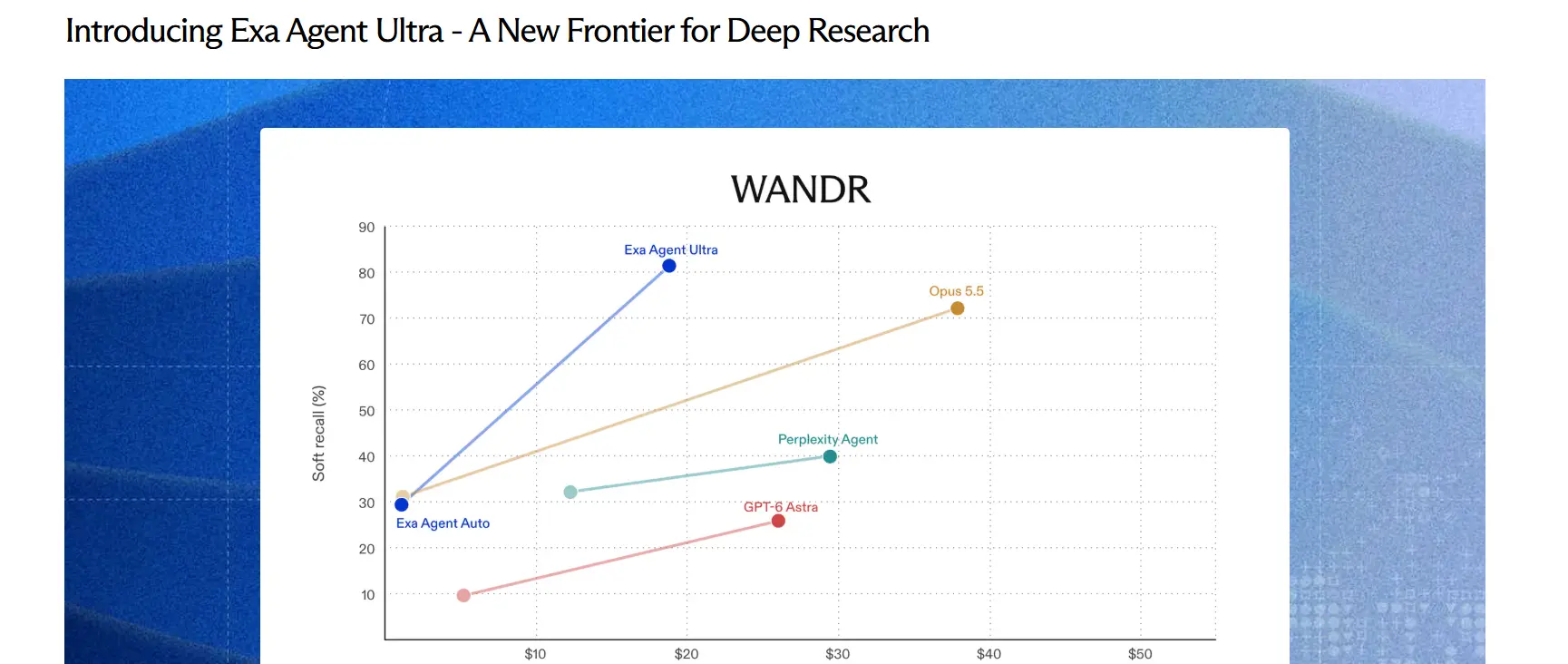
Exa reports that Agent Ultra leads the systems it compared against on four evaluations: WANDR, WideSearch, DeepSearchQA and Find-All Company. The company compared Ultra against systems including GPT-6 Astra, Claude Opus 5.5 and Perplexity Agent at their respective maximum-effort configurations.
Some of Exa’s reported results include:
| Benchmark | Exa Agent Ultra | Reported comparison |
|---|---|---|
| WANDR | 81.4% | 72.3% for Claude Opus 5.5 |
| WideSearch | 58.9% | 56.0% for Perplexity Agent |
| DeepSearchQA | 93.9% | 85.3% for GPT-6 Astra |
| Find-All Company | 229 rows/task | 60 for GPT-6 Astra |
Exa also reports lower cost per task on several of these evaluations. On WideSearch, for example, it reports a cost of $3.85 per task, which it says was lower than the comparison systems. On WANDR, Exa reports that Ultra was 44% cheaper per task than Opus 5.5 and 20% cheaper than GPT-6 Astra.
These figures should be interpreted as vendor-reported benchmark results, rather than independent confirmation that Agent Ultra will outperform every competing research system across real-world workloads. Exa notes that its WANDR evaluation used the benchmark’s existing grading logic but changed elements including the contents tool, transport layer and judge model; where competitors had not published results on the same setup, Exa ran the benchmark itself.
Agent Ultra Can Run for Hours
The increased research effort comes with a different latency profile from conventional search.
Exa’s documentation says Agent Ultra runs typically take around 30 minutes for complex tasks, while particularly difficult assignments can take as long as three hours. Developers can set a maximum duration between five minutes and three hours.
The API also provides a spending limit. Agent Ultra is billed according to Exa’s standard Agent usage rates, with a default maximum of $20 per run. Developers can configure a different maximum cost, from $1 to $100, and the documentation says runs that finish early cost less.
Developers can also stop a running job and retain the results gathered up to that point. This makes Ultra better suited to asynchronous research workloads than interactive searches where an answer is expected within seconds.
Who Is Exa Agent Ultra For?
Exa is targeting users and developers who need more than a conventional answer from an AI search system.
Potential applications include:
- Market research: building comprehensive company or industry lists.
- Due diligence: checking organizations against multiple criteria and sources.
- KYC and compliance research: collecting evidence from filings, regulators and other public sources.
- Academic and technical research: finding papers, repositories and implementations across the web.
- Go-to-market research: creating and enriching lists of potential customers.
- Entity enrichment: adding structured information and evidence to existing datasets.
The ability to supply an existing list and ask Ultra to expand it while excluding entities already present is also designed for iterative list-building workflows.
Availability and Developer Access
Exa Agent Ultra is available now through the Exa Agent API. Developers can enable it by setting the Agent run’s effort parameter to "ultra". The same API supports structured output, input data and streaming.
The documentation also provides Python, JavaScript and cURL examples for creating and monitoring Ultra runs. Developers working with OpenAI’s Responses API can additionally use reasoning.effort: "ultra" under the documented streaming or background configurations.
The launch therefore represents an expansion of Exa’s existing agentic search architecture rather than a new standalone foundation model. Exa Agent Ultra is essentially an additional high-compute research mode built around longer-running, multi-step web investigation.
For users whose primary requirement is a quick factual lookup, that additional compute may not be necessary. But for research assignments where missing relevant companies, documents or evidence can materially reduce the value of the result, Exa is positioning Agent Ultra as an option that can spend substantially more time searching, checking and enriching information before returning an answer.
Also Read –
Perplexity Photon: Faster AI Search Infrastructure
Source
Exa – Introducing Exa Agent Ultra