

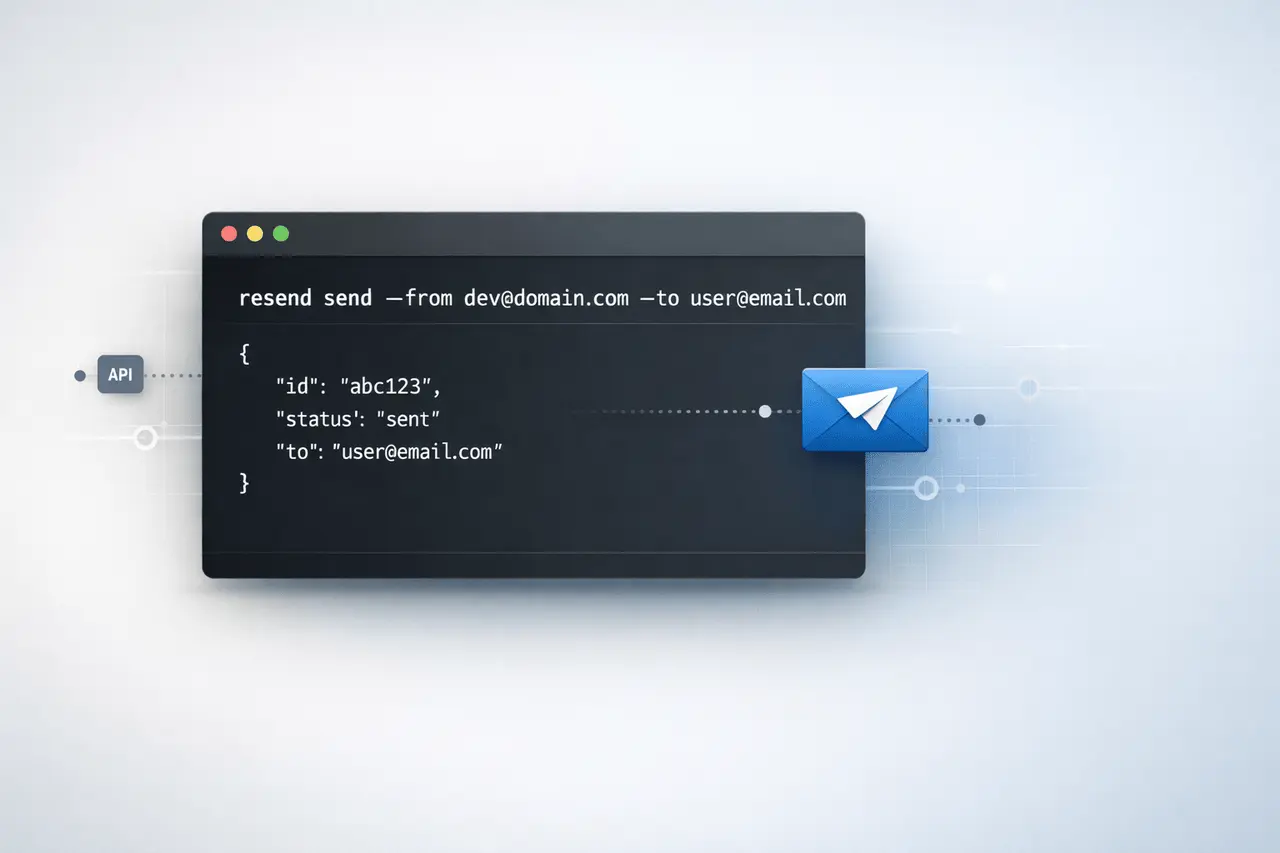
Platform for the email infrastructure Resend has released its Resend CLI, which is an open-source command-line interface that is designed to help developers manage and send email directly from a terminal. The tool comes with 53 commands that enable users to handle domains and API keys, email broadcasts and webhooks, without relying exclusively on web dashboards and API manual calls.
It also includes a Resend CLI that is compatible with both AI and humans. Resend CLI also introduces features designed for humans as well as automation systems. These include interactive suggestions to speed up email transmission and well-structured JSON outputs to CI pipelines, as well as AI agents. The release represents a steady trend towards a more developer-centric email infrastructure and automated tools.
What the Resend CLI Is and Why It Matters?
Resend CLI is an application that runs on the command line, allowing developers to connect to Resend’s Resend messaging platform directly through their personal terminal.
Instead of writing code or even navigating through a web-based interface, users can carry out the majority of platform functions using CLI commands. The program is built for speed and efficiency, which allows developers to integrate email functions directly into workflows for development.
This technique is becoming popular across various platforms for developer infrastructure, since the command line interfaces make it easier to integrate into CI/CD pipelines and workflows for DevOps and automated systems that are powered by AI.
Its key advantages include:
- Faster email testing during development
- Automation in CI/CD pipelines
- Access to APIs of the platform through the terminal
- Simpler writing, as well as workflow and integration
For developers of applications that heavily rely on transactional email, like SaaS platforms, authentication systems, or notification services, the CLI can greatly streamline processes.
Key Features of the Resend CLI
1. A Full Command Suite for Email Infrastructure
Resend CLI contains 53 command lines, which encompass the entirety of the device.
Developers can manage the important email infrastructure functions directly from the terminal, which includes:
- Domains: create, verify, and configure sending domains
- API keys: generate scoped tokens for specific domains
- Contacts: manage subscriber data
- Broadcasts make and schedule bulk email marketing campaigns
- Webhooks create endpoints, and then subscribe to events
This degree of control lets teams manage the transactional as well as marketing processes without ever leaving the command line.
2. Send Emails Directly From the Terminal
One of the best-known features that comes with CLI is the capability to send an email immediately via the terminal.
Developers can rapidly send emails during debugging or development sessions without the need to write extra scripts.
For example:
- Test emails via the CLI
- Deliver email messages via the local environment
- Trigger notifications during build processes
The tool can also be used for emailing templates for existing HTML templates for email, directly from files on local storage, which makes it easier to conduct the process of testing email templates and layouts.
3. Interactive Mode for Faster Email Workflows
Resend CLI has the Interactive mode specifically designed for human users.
This mode offers beneficial features like:
- Auto-suggestions for domains that are verified
- Common sender prefixes
- terminal tables, loading indicator and other tables
- Command prompts for guidance
These features cut down on typing and speed up the process, such as sending emails or setting up domains.
For developers who frequently test transactions in email, this interactive experience could drastically reduce the amount of friction that occurs during development.
Designed for Both Humans and AI Agents
One of the most notable design decisions that Resend CLI relies on is its dual-useability, as it was designed to be used by developers as well as programmers and automatized platforms.
Structured Output for Automation
In non-interactive settings, for example, CI pipelines or scripts, the CLI automatically generates JSON that is structured. JSON.
The help for the program to be integrated into:
- CI/CD workflows
- DevOps automation scripts
- AI agents managing infrastructure tasks
- monitoring and log systems
Structured outputs permit machines to process responses programmatically, which allows automated workflows, such as:
- creating domain-specific API keys
- deploying infrastructure changes
- creating automated emails to notify users
This feature is compatible with the development trend towards automated development pipelines and agent-based automated instruments.
Example Use Case: CI Pipeline API Key Management
A practical use of the Resend CLI is an API that is secure and key generation in CI settings.
Developers can create APIs with domain-specific keys directly from their terminals and incorporate the keys into automation workflows.
This method has several advantages:
- Scoped access to security
- automated key rotation
- simplified environment configuration
These capabilities are particularly beneficial for teams that operate in different locations.
Multi-Team and Multi-Account Support
This CLI offers the ability to move between different teams or accounts.
Developers who are working on different projects or organisations can change profiles without having to log out and log back in again.
This function is particularly useful for:
- agencies managing multiple clients
- developers working across several SaaS products
- massive engineering teams working in separate environments
By reducing the management of accounts, the CLI can reduce friction in complicated development setups.
Supported Operating Systems
Resend CLI was made to be usable on all the most popular operating systems.
Installation can be accomplished with a single terminal command, using an installation script for the shell.
This support across platforms guarantees that the tool is utilised on all platforms for development.
Resend’s Growing Developer Infrastructure Ecosystem
The introduction of Resend CLI is a reflection of the company’s greater goal of developing tools for developers.
Resend is gaining traction in the world of developers due to its contemporary alternative to the traditional email infrastructure providers. It focuses on:
- developer-friendly APIs
- improved email deliverability
- contemporary frameworks as well as their integrations
Command-line tooling is an integral part of the modern infrastructure for developers that complements dashboards and APIs.
Platforms like cloud providers, containers, orchestration tools, and deployment platforms are now offering strong CLI interfaces, which allow professionals to streamline workflows and control infrastructure right from their terminals.
How does the Resend CLI compare to API-Only Workflows?
| Capability | API-Only Workflow | Resend CLI |
|---|---|---|
| Send test emails | Requires scripts | Direct terminal command |
| Manage domains | API requests | Single CLI command |
| CI/CD integration | Custom tooling | Native JSON output |
| Email template testing | Requires deployment | Send HTML locally |
| Multi-account management | Manual config | Profile switching |
In reducing the requirement for API interaction, manual CLI makes routine tasks for email infrastructure significantly quicker.
My Final Thoughts
The release of the Resend Command Line marks an important step towards a user-centric email infrastructure. By integrating features for managing email into commands, the program lets engineers send emails and manage domains, as well as generate API keys and automate workflows, without using dashboards only and manually made API calls.
With support for interactive usage by developers and well-structured outputs for automation systems, the CLI was designed and built to integrate perfectly in conjunction with the latest DevOps automated pipelines, as well as AI-driven systems.
While the tooling for developers continues to improve, command-line interfaces such as the Resend CLI are increasingly becoming crucial elements of the scalable software infrastructure.
FAQs
1. What is the Resend CLI?
The Resend Command Line is an open source command-line interface that enables programmers to forward emails and manage domains, as well as generate API keys and automate workflows for email through the terminal.
2. Does the Resend CLI come with open source?
Yes. The CLI is open source, allowing programmers to look over the codebase, add modifications, or even customise it according to their needs.
3. Which operating systems are compatible with Reend’s CLI?
The tool works with macOS, Linux and Windows, making it compatible with all development environments.
4. Can the Resend CLI be utilised in the CI/CD pipelines?
Yes. In automated environments, the CLI generates structured JSON that allows easy integration into CI pipelines as well as automation scripts.
5. Can the CLI deliver HTML mail templates?
Yes. Developers can upload locally-generated HTML files directly to the CLI, making it simpler to test the design of emails without having to deploy them first.
6. Who can benefit from Resend’s CLI?
The tool was designed mostly to be used for:
- creators creating applications that incorporate features for email.
- DevOps engineers managing automated workflows, teams integrating email into CI/CD pipelines.
Also Read –
AgentCard Enables AI Agents to Make Payments and Buy Services