MiniMax MaxClaw AI agent is a new “always-on” mode within MiniMax Agent. It allows users to create a fully operational AI agent in just 10 seconds. Created for continuous automation, MaxClaw integrates directly with platforms such as Telegram, WhatsApp, Slack, and Discord and provides access to over 10,000 templates designed by experts.
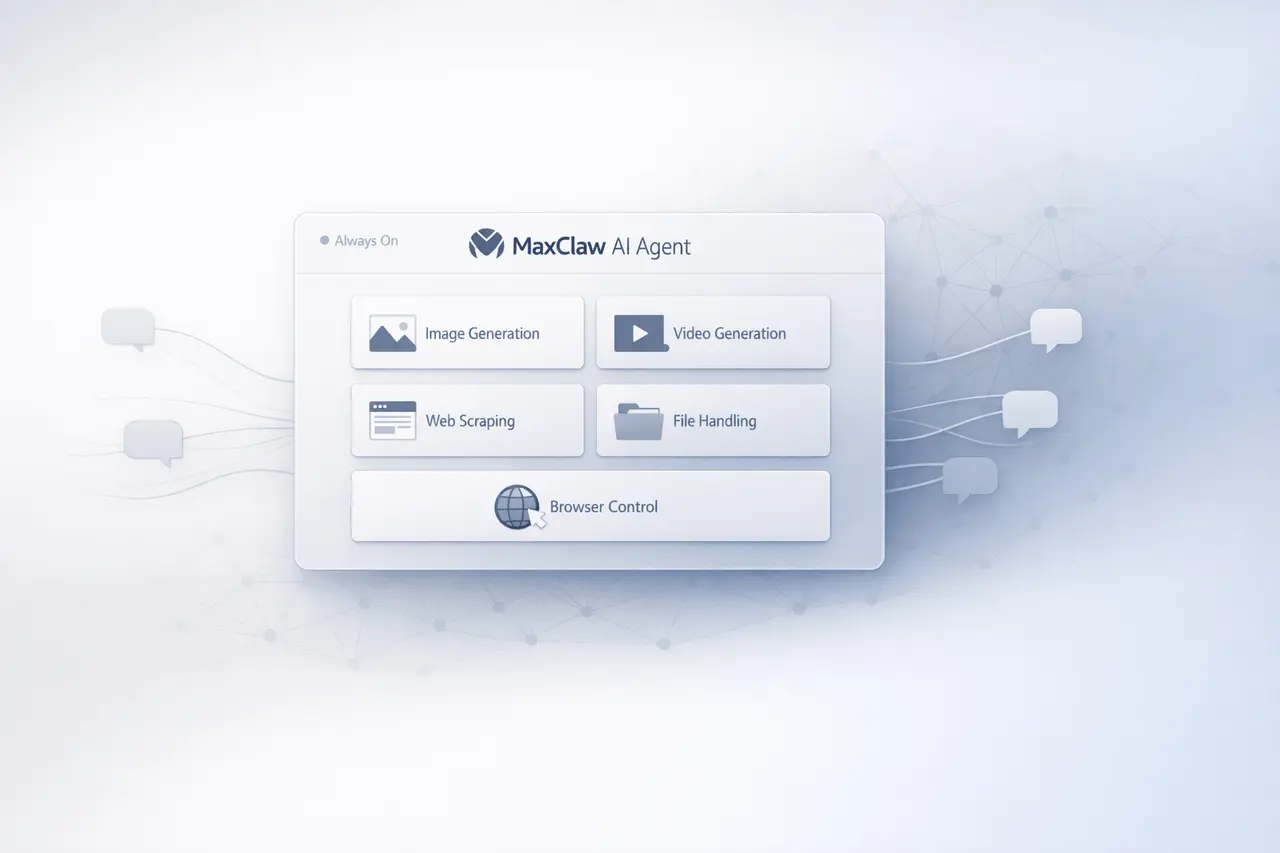
Under the hood, MaxClaw runs on MiniMax’s M2.5 model, which is engineered to deliver high-quality code performance, cost-efficiency, and multimodal capabilities such as image generation, web scraping, video generation, file handling, and browser control.
This article explains what MaxClaw is, how it operates, the reasons why it’s important, and where it fits within the constantly evolving AI agent environment.
Key Takeaways
- MiniMax MaxClaw AI agent enables always-on automation with instant deployment.
- Powered by M2.5, it delivers strong coding performance and cost efficiency.
- Supports image, video, web scraping, and browser control in one system.
- Integrates with Telegram, WhatsApp, Slack, and Discord.
- Offers 10,000+ expert templates for fast, scalable AI workflows.
What Is MiniMax MaxClaw AI Agent?
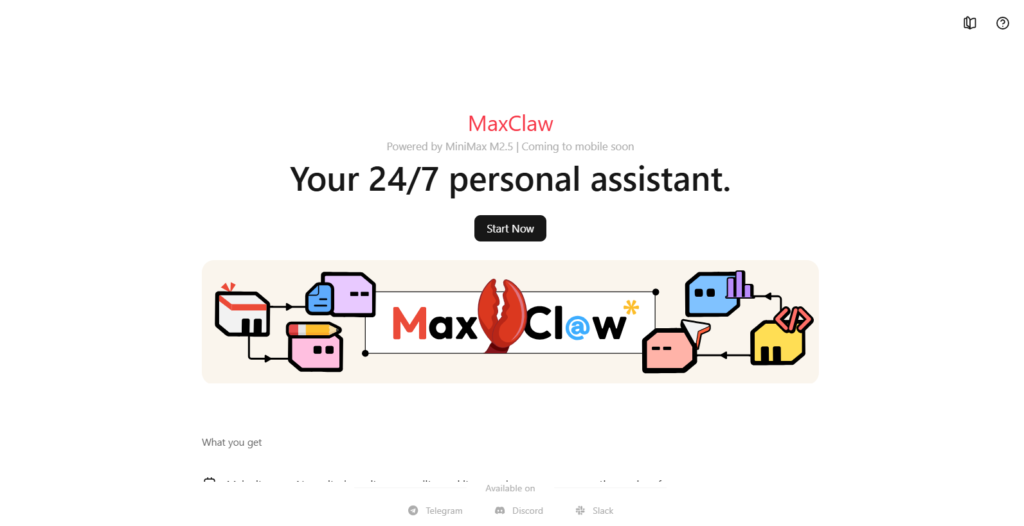
MiniMax MaxClaw is an on-all-the-time AI agent mode integrated into MiniMax Agent. Contrary to chat assistants that are based on sessions, MaxClaw operates persistently, staying on to be monitored, run and respond across all connected platforms.
Key characteristics include:
- Instant deployment (under 10 seconds)
- Always-on operational mode
- Integration with message platforms
- 10,000+ pre-built “Expert” templates
- Multimodal capabilities (text, image, video, web automation)
This position makes MaxClaw a lightweight yet effective automation layer for people or teams, as well as for developers seeking long-lasting AI process workflows.
How MaxClaw Works?
Powered by MiniMax M2.5
MaxClaw is based on MiniMax M2.5, an exclusive large language model designed to:
- Coding tasks
- Agent-based workflows
- Cost-efficient inference
The model is said to achieve 80.2 per cent on the SWE-Bench, a benchmark designed to test the real-world capabilities of software engineering.
SWE-Bench tests how well AI systems can resolve GitHub problems using real repositories. A high score indicates that M2.5 can handle complex, multi-step development tasks – an important characteristic of autonomous agents.
Built-In Multimodal Tooling
MaxClaw has native tools rather than relying solely on external integrations. The tools include:
- Image generation
- Video generation
- Web scraping
- File handling
- Browser control
This helps reduce the need for fragmented third-party workflows. It also allows automating all aspects within a single agent environment.
Platform Integrations
MaxClaw was designed to work in areas where users already communicate and work.
Supported Platforms
- Telegram
- Slack
- Discord
These integrations enable an AI agent:
- Monitor messages
- Response automatically
- Trigger workflows
- Background tasks can be executed
For teams, this means AI-powered automation can be implemented within existing collaboration environments without requiring additional dashboards.
Feature Comparison Table
| Feature | MaxClaw | Traditional Chatbots | Manual Automation Tools |
|---|---|---|---|
| Always-On Operation | Yes | No | Conditional |
| Multi-Platform Integration | Yes | Limited | Depends on setup |
| Pre-Built Templates | 10,000+ | Few | No |
| Coding Performance | High (SWE-Bench 80.2%) | Moderate | Not applicable |
| Image & Video Generation | Built-in | Rare | Separate tools required |
| Browser Control | Yes | No | Requires RPA setup |
| Cost Efficiency | Optimized (1/10th Claude Opus 4.6 cost, reported) | Varies | Tool-dependent |
This test demonstrates how MaxClaw integrates agent autonomy with multimodal generation and native integration with platforms.
10,000+ Expert Templates: What It Means
A MaxClaw’s best feature is access to more than 10,000 Expert templates already built.
These templates are likely to be structured workflows that are tailored to specific usage scenarios, like:
- Lead generation
- Customer support automation
- Coding assistants
- Social media monitoring
- Content drafting
- Research aggregation
Instead of creating the AI workflow from scratch, users can use an expert-configured setup and modify it according to their requirements.
It drastically reduces barriers to entry for non-technical users while increasing productivity for more experienced teams.
Cost Efficiency and Competitive Positioning
MiniMax states that M2.5 performs tasks at around one-tenth of the cost of Opus 4.6. Pricing structures can differ across providers. Cost efficiency is a major factor in:
- Always-on agents
- Continuous monitoring systems
- Large-scale automation
- Startup and SMB adoption
Persistent AI agents could be costly if inference is expensive. Optimised efficiency enables MaxClaw to keep operational activities without imposing a huge cost.
Real-World Use Cases of MiniMax MaxClaw AI Agent
1. Customer Support Automation
A constantly-on agent within Slack as well as WhatsApp could:
- Answer FAQs
- Route tickets
- Handle repetitive queries
- Escalate complex cases
2. Software Development Assistance
With a strong SWE-Bench performance, MaxClaw can:
- Debug code
- Refactor scripts
- Pull requests for review
- Automate repetitive engineering tasks
3. Content and Media Generation
Built-in image and video generation enables:
- Marketing creatives
- Social media assets
- Product visuals
- Explainer video drafts
4. Data & Research Automation
By scraping the web as well as browser controls, MaxClaw can:
- Monitor competitor websites
- Aggregate market data
- Collect structured information
- Track pricing changes
Use Cases by Industry
| Industry | Example Application | Benefit |
|---|---|---|
| E-commerce | Automated customer chat | Faster response times |
| SaaS | DevOps monitoring assistant | Reduced manual workload |
| Marketing | Content generation workflows | Faster campaign launches |
| Education | Always-on tutoring assistant | 24/7 learner support |
| Startups | Multi-platform automation | Lower operational costs |
Benefits of MaxClaw
Persistent Automation
In contrast to session-based chat AI, MaxClaw remains active, enabling continuous monitoring and implementation.
Multimodal Capabilities
The system combines text, images, video, and browser controls into one platform.
Fast Deployment
In just 10 seconds, the setup process reduces implementation friction.
Scalability
The cost-effective architecture allows for continuous operation.
Accessibility
Pre-built templates reduce the technical hurdle.
Limitations and Considerations
While it is promising users, they should take into account:
- Integrity and reliability across all platforms
- Data privacy implications
- Ongoing cost structure
- Template customization flexibility
- Monitoring and governance of independent tasks
As with any AI agent, system supervision and security are vital to prevent unintended actions.
Why Always-On AI Agents Matter?
The transition from reactive chatbots to persistent, proactive AI agents is a significant shift in AI technology.
Always-on agents:
- Act rather than simply responding
- Monitor the environment continuously
- Execute multi-step workflows autonomously
- Integration directly in operational pipelines
MaxClaw joins the market at a time when it features advanced agent frameworks and tools-enabled language models; however, its focus on speed, efficiency, and cost makes it highly accessible.
My Final Thoughts
MiniMax MaxClaw’s AI agent represents an important step towards enabling continuous AI automation. With its rapid deployment, high programming efficiency, multimodal capabilities, and platform integration, it transforms AI from a reactive agent into a dependable digital operator.
With over 10,000 professional templates and numerous cost-efficiency benefits reported, MaxClaw lowers the barrier to the acceptance of autonomous AI across industries. As companies move towards automated continuous processes and connected AI workflows, agents that are always on, such as MaxClaw, will be positioned to become essential infrastructure rather than experiments.
The next stage of AI advancement isn’t just about smarter models, but about smarter, permanent systems. MaxClaw confirms that this change is already in progress.
Frequently Asked Questions (FAQs)
1. What exactly is the MiniMax MaxClaw AI agent used to do?
It is designed to allow constant automated messaging across platforms, workflows that code as well as content creation, and internet-based activities.
2. How quickly can MaxClaw be set up?
MaxClaw can be launched in the MiniMax Agent environment in less than 10 seconds.
3. What model powers MaxClaw?
MaxClaw is based on MiniMax M2.5, an engine that scores 80.2 per cent on the SWE-Bench test and has been optimised for agent-based coding and workflows.
4. Does MaxClaw provide support for video and image generation?
Yes. The generation of video and images is a built-in feature that goes along with the ability to scrape websites and control browsers.
5. What platforms do MaxClaw connect to?
It works with Telegram, WhatsApp, Slack, and Discord.
6. Is MaxClaw more cost-effective than other models?
MiniMax has reported that M2.5 costs about one-tenth as much as the Claude Opus 4.6 for similar tasks.
Also Read –
MiniMax API Keys Explained: Coding Plan vs General API
MiniMax M2.1 Open Source: SOTA AI Model for Developers