

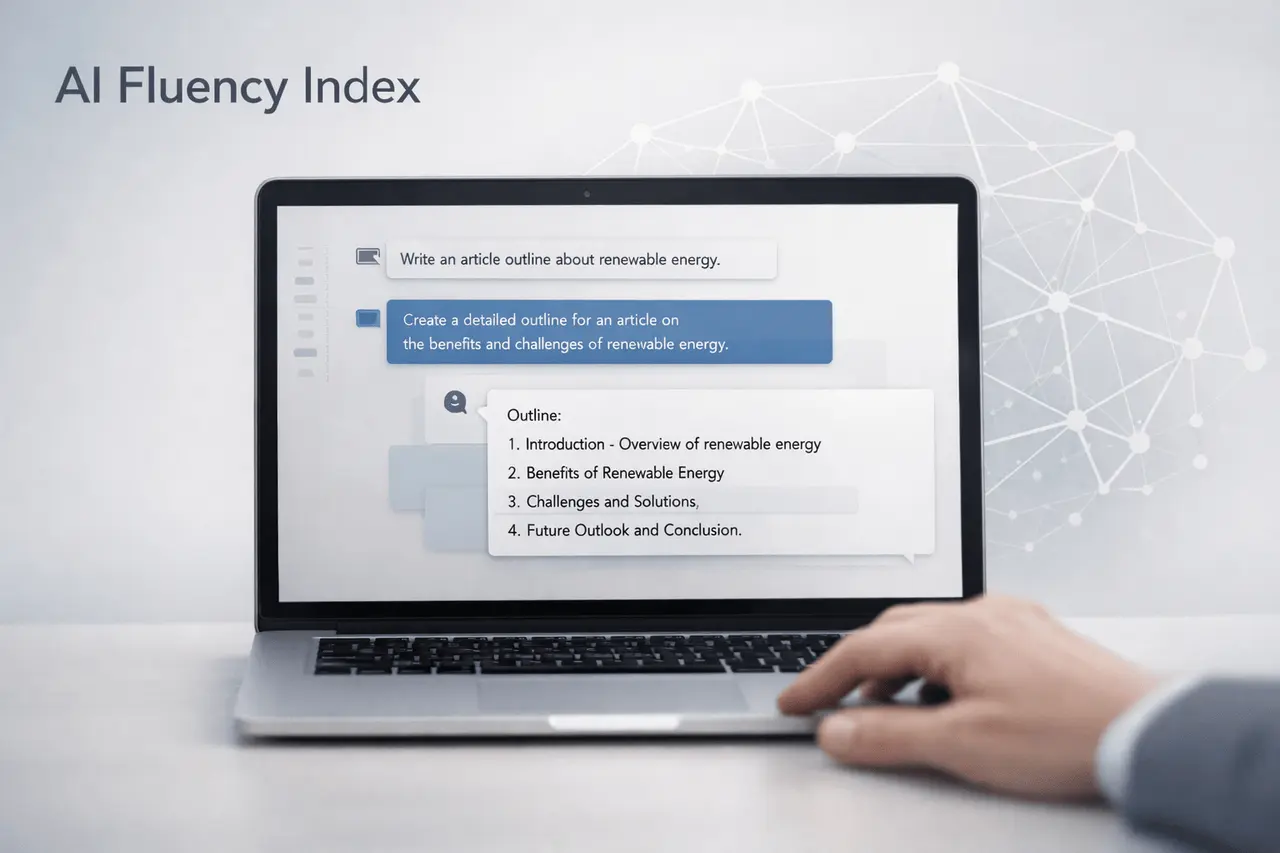
The AI Fluency Index is a new research framework created by Anthropic to assess how well humans cooperate with AI systems. Based on myriad real-world interactions with Claude, the index tracks 11 behaviour indicators that reveal how users refine, iterate, and collaborate using AI.
As generative AI is integrated into everyday processes, understanding not only its use but also the quality of collaborative work is becoming increasingly important. The AI Fluency Index aims to determine the extent of this change.
What Is the AI Fluency Index?
The AI Fluency Index is a measure of behaviour designed to assess how individuals interact with AI systems.
Instead of analysing raw usage metrics, such as the number of prompts or session length, it focuses on patterns of collaboration. They include the frequency at which users
- Refine outputs
- Ask clarifying follow-ups
- Iterate toward better results
- Modify instructions based on AI responses
- Engage in multi-step workflows
In essence, the index will determine the extent to which users view AI as a single tool or as a partner in active thinking.
Why AI Fluency Matters?
Over time, as AI tools advance from being new to the realm of infrastructure, users’ skills working with them become an advantage in competition.
AI fluency affects:
- Increased productivity from generative AI
- Quality of output in research as well as writing
- Decision-making accuracy
- Organisational adoption success
Advanced AI fluency shows that users know how to collaborate, not only be commanded.
It is becoming increasingly relevant in professional settings that utilise AI to assist workflows and replace traditional approaches.
How the AI Fluency Index Works?
Anthropic’s research looked at hundreds of discussions on Claude.ai. The researchers identified 11 behaviours that can be measured as indicators of successful collaboration.
Core Behavioural Dimensions
While the full set of behavioural signals comprises eleven signals, this index largely examines patterns like:
- Iterative prompting
- Output refinement
- Context expansion
- structured instruction
- Task decomposition
- Feedback incorporation
The actions indicate that users are actively directing the AI rather than passively accepting responses.
Key Behavioural Categories
Below is an uncomplicated description of collaboration actions that are reflected by the: AI Fluency Index:
| Behavioral Category | What It Measures | Why It Matters |
|---|---|---|
| Iteration & Refinement | Reworking prompts and outputs | Improves precision and depth |
| Clarification Requests | Asking AI to explain or expand | Enhances understanding |
| Task Structuring | Breaking complex tasks into steps | Leads to better results |
| Context Enrichment | Providing detailed background information | Increases relevance |
| Multi-step Collaboration | Ongoing dialogue toward a shared goal | Reflects true co-creation |
These signals allow you to distinguish the use of a surface from more sophisticated AI cooperation.
AI Fluency vs Basic AI Usage
Numerous Users engage linearly with AI in a linear fashion :
- Ask a question
- Receive an answer
- Move on
AI fluency, however, involves:
- Refining the request that was made initially
- Comparing alternative outputs
- Asking for improvements
- Reframing the issue
The distinction is the same as using a calculator rather than working with a researcher.
Why Anthropic’s Research Is Significant?
Anthropic’s AI Fluency Index marks a shift in how AI adoption is assessed.
Traditional metrics include:
- Active users every month
- Prompt volume
- Session duration
Its AI Fluency Index rather focuses on the depth of behaviour. It is designed to assess the extent to which humans can adjust to AI collaboration.
This method can have an impact on:
- Enterprise AI deployment
- Workforce training
- Educational curriculum design
- Product UX optimization
It redefines AI reading as a quantifiable skill set.
Practical Applications of the AI Fluency Index
The index could have applications in a variety of domains.
1. Enterprise AI Adoption
Organisations can assess:
- How employees use AI only superficially
- Which teams exhibit advanced collaboration patterns
- What is the best place to find AI Training programs for teachers?
2. Education and AI Literacy
The focus of educators can change to:
- “How to use AI”
To:
- “How to collaborate effectively with AI systems”
This distinction is critical as AI becomes a standard productivity layer.
3. Product Design & UX
AI companies may use the fluency signal to
- Identify friction points
- Improve prompting guidance
- Build structured workflows
- Offer adaptive coaching inside AI tools
Advantages and Limitations of Measuring AI Fluency
Like all behaviour indices, the AI Fluency Index has strengths and weaknesses.
| Advantages | Limitations |
|---|---|
| Moves beyond usage metrics | Dependent on platform context |
| Encourages better AI collaboration | Behaviors may vary by task type |
| Supports workforce readiness | Hard to standardize across AI models |
| Informs training and design | Does not directly measure output quality |
The index is a measure of collaboration patterns, but does not guarantee the accuracy or quality of outputs.
How to Improve Your AI Fluency?
Individuals can improve their AI proficiency by adopting structured collaboration methods.
Practical Strategies
- Please provide a full context before providing output
- Break complicated tasks into small steps
- Request multiple variants
- Reasoning for a request or written explanations
- Reiterate instead of allowing first drafts
- Use AI for critique and refinement
These behaviours closely align with those tracked in The AI Fluency Index.
AI Fluency and the Future of Work
As generative AI tools are integrated into everyday workflows, AI fluency may become as essential as digital literacy.
In fields with high-skill requirements, like:
- Software development
- Legal research
- Content production
- Data analysis
The ability to work effectively with AI will significantly improve output quality and effectiveness.
Businesses that focus on AI fluency training could get better returns from AI investment.
My Final Thoughts
The AI Fluency Index marks a significant shift in the way AI adoption is perceived. Anthropic created it and shifted the focus away from mere usage metrics toward quantifiable collaboration patterns in actual Claude conversations.
By tracking iteration refinement, structured interactions, and multi-step workflows, the AI Fluency Index provides more detailed information about how humans and AI systems interact.
As AI tools are integrated into creative and professional environments, AI fluency may emerge as a key skill in the new digital era. Learning and enhancing this skill will determine the future of AI-driven innovation and productivity.
Frequently Asked Questions
1. What is the AI Fluency Index?
The AI Fluency Index is a research framework designed by Anthropic which measures the effectiveness with which individuals work together with AI systems such as Claude.
2. What measures does the AI Fluency Index measure in collaboration?
It is a tracking tool that monitors 11 behaviour signals observed in actual AI conversations, such as refinement, iteration, and structured task execution.
3. Are AI fluency equivalent to AI literacy?
But not really. AI literacy is the ability to understand how AI operates. AI proficiency focuses on how one can collaborate with AI in real life.
4. What is the reason AI fluency is essential for businesses?
Higher AI proficiency can increase efficiency, decision-making quality, and overall ROI through AI software.
5. Does the AI Fluency Index measure output quality?
No. It is a measure of collaboration behaviour, not the actual precision or quality of the outcomes.
6. How can AI fluency be increased?
Yes. Users can enhance their AI proficiency by repeatedly reciting prompts, giving context, improving outputs, and participating in multi-step collaborative activities.
Also Read –