
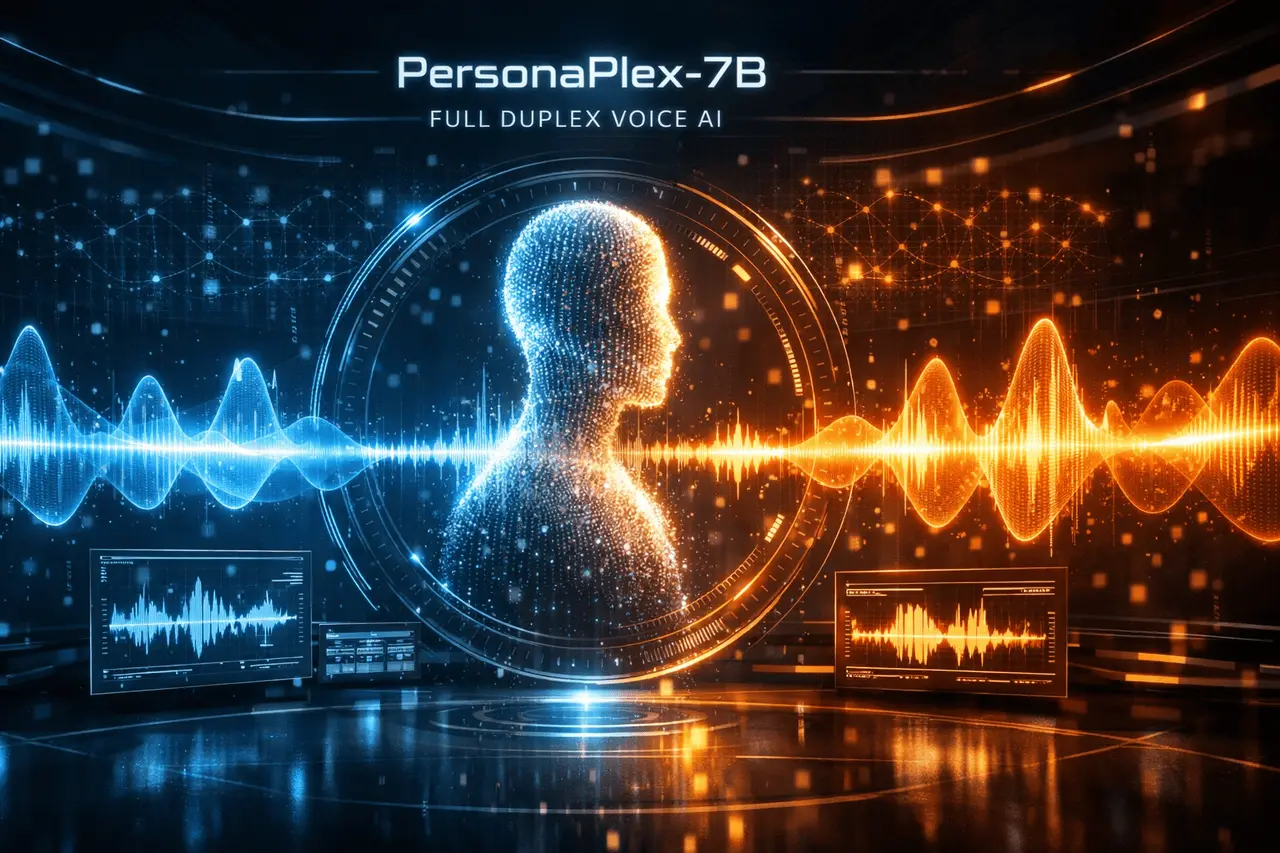
NVIDIA PersonaPlex-7B is an innovation in conversational artificial Intelligence that lets you experience a natural, authentic spoken dialogue. In January 2026, this open-source model can listen and speak simultaneously without pauses or rigid turn-taking. delivering a smooth, real-life conversation and user experience.
In conventional technology, voice input must be completed before the response can begin, creating artificial delays and “walkie-talkie”-like interactions. PersonaPlex fundamentally alters this by integrating listening and response generation into a single, real-time system.
What is PersonaPlex-7B?
PersonaPlex-7B is an open-source full-duplex speech-to-speech model developed by NVIDIA. Model’s 7 billion variables allow it to:
- Listen and speak simultaneously in real time
- Manage natural interruptions and backchannels
- Maintain the same identity, tone, and context by prompts
- Runs using freely accessible codes and weights that are under open-licensed licenses
In contrast to typical voice assistants, which rely on distinct languages and speech detection and synthesis processes, PersonaPlex uses a unified model that processes both incoming audio and speech tokens sent out. This enables extremely interactive, human-like conversations.
Full Duplex Explained: How PersonaPlex can communicate with humans?
Limits of Traditional Voice AI
Most existing voice systems follow a pipeline architecture:
- Automatic Speech Recognition (ASR) converts speech into text
- A Large Language Model (LLM) generates a response
- Text-to-Speech (TTS) converts text back into audio
Each stage introduces a delay, and the system cannot react before the user ceases speaking. Interruptions are ignored, and dialogue is considered mechanical and turn-based.
Full Duplex Architecture
PersonaPlex alters the model by integrating speaking and listening into a single model. It employs continuous audio encoders and can predict text as well as audio tokens at the same time, which allows this system:
- React prior to pauses occurring
- Natural interruptions and acknowledgements
- Keep context even if the user talks to the model
- Create a smooth, conversational rhythm with no gaps
This is accomplished via a dual-stream Transformer device that records user audio and PersonaPlex speech simultaneously, sharing internal state to provide real-time updates to the context.
Persona Control Voices and Roles with No Limits
One of the most important PersonaPlex characteristics includes individual conditioning via hybrid prompts
- Voice Prompt: A brief audio sample that defines accents, voice quality, and prosody
- Text Prompts: A description of the role of background in the conversational behavior
These inputs allow developers to alter the assistant’s voice and personality dynamically, whether for friendly tutoring, professional customer service, or interactive experiences based on character.
Technical Capabilities and Performance
| Feature | Details |
|---|---|
| Model Type | Full duplex speech-to-speech conversational model |
| Parameters | 7 billion |
| License | Open source (MIT for code; NVIDIA Open Model License for weights) |
| Latency | Real-time responses with near-zero pause |
| Custom Prompts | Voice and role conditioning |
| Language Support | Initially English (future expansion likely) |
| Deployment | Self-hostable via GitHub and Hugging Face |
| Benchmarks | Higher naturalness compared to commercial rivals |
Actual-world Naturalness Metrics
Benchmarks show that PersonaPlex surpasses or matches existing full-duplex commercial systems in conversational naturalness, turn-taking, and interruption handling, making conversations feel more natural and less human.
Why is PersonaPlex important?
1. A Natural Conversation
The ability to listen and speak simultaneously can bring AI interactions closer to human ones, enabling more enjoyable customer service, education, and personal assistant use cases.
2. Customization for Developers
Developers can design custom roles and voices by using prompt inputs without retraining the whole model.
3. Open Source and Free to Use
Contrary to many private voice-based AI platforms, PersonaPlex and its weights are available for free research and commercial experimentation under open licences.
4. Self-Hosting and Control
Teams can use PersonaPlex on their own servers to avoid vendor lock-in while maintaining full control over data, conversation behavior, and integrations.
Limitations and Practical Questions
While PersonaPlex is a significant technological advancement, it has practical limitations:
- Performance Requirements: Real-time benefits require GPU acceleration with the best NVIDIA GPUs that can deliver full performance.
- Language Support: The model is initially compatible with English and other languages; however, additional languages could be added in the future.
- Application Readiness: It’s a tool for researchers and developers, not a final consumer product. It may require some tweaking for production use.
Use Cases for PersonaPlex
PersonaPlex’s natural capabilities for dialogue let you use a wide range of applications:
- Customer Service Agents: real-time, conversational bots that behave like human agents.
- Virtual tutors or Coaches: Learners who engage with them communicate fluidly.
- Interactive Characters: Dynamic, role-based characters for games and storytelling.
- Healthcare Assistants: Tools for supporting patients through conversation during patient intake or assistance.
My Final Thoughts
NVIDIA’s PersonaPlex-7B is a major advancement in the field of voice AI, providing open-source, full-duplex, natural-sounding conversations with a range of customizable roles and voices.
The ability to talk and listen simultaneously with human-like synchronization is a breakthrough for traditional voice assistants. While it’s best for developers using machine learning technology, the flexibility and open design are expected to impact the future generations of interactive AI products.
FAQs
1. What is it that sets full-duplex voice models apart from standard voice assistants?
Fully-duplex systems process hearing as well as speaking at the same time, eliminating turns and pauses, unlike pipelines that handle every step sequentially.
2. Is PersonaPlex-7B a free application to use?
Absolutely, PersonaPlex is open source, with weights and code available under permissive licenses on GitHub, along with Hugging Face.
3. Can PersonaPlex run without internet access?
Yes, it’s possible to use local hosting and self-hosting, but GPU resources are recommended for maximum performance.
4. What languages can PersonaPlex support?
In the beginning, it supported only English and Spanish, but plans are to support more languages in the future.
5. What are the typical uses for PersonaPlex?
The use cases include customer support bots, virtual tutoring, voice-based interactive characters, and real-time chat assistants.
6. Does PersonaPlex require special hardware?
To ensure real-time performance, dedicated GPU hardware is highly recommended, especially for larger-scale deployments.
Also Read –
Mastra Observational Memory Achieves SOTA on LongMemEval