
Modern e-commerce teams face an issue that is not new: the planning of promotions is too time-consuming and expensive, and it fails to provide context for the competition. The data is scattered across a myriad of sources, historical pricing is insufficient, and strategy decks usually provide a single, rather than a long-term, view of market dynamics.
Pokee Ecommerce Strategy Agent addresses this issue by automating the entire analysis and planning of campaigns. It is designed as a special agent within the Pokee Agent Marketplace that uses structured research and data aggregation over a long-term horizon to create ecommerce marketing strategies ready for execution in minutes, not days.
What is an E-commerce Strategist Agent from Pokee?
Pokee Ecommerce Strategies Agent is a specialized AI agent designed to serve as an e-commerce strategy analyst. It is a computerised method for gathering market data, analysing competitors, and developing structured campaign plans for every product category.
In contrast to common-purpose AI instruments, this one is a task-specific AI tool. It was created to assist marketing strategies for eCommerce by using:
- Multi-source data aggregation
- Historical pricing and promotional analysis
- Structured outputs that are aligned with business operations
This agent was initially designed for large agencies and is now available through the Pokee Agent Marketplace.
Reasons Why an Automated Ecommerce Strategy is Important
Price dynamics, promotion timing, and channel coordination drive the competition in e-commerce. Manual planning can lead to a variety of constraints:
- Langed research cycles slow the process of making go-to-market decision-making
- A lack of historical information leads to the idea of a short-term view
- The high cost of agency and analyst costs limits the number of iterations
Automation can transform the way strategy is viewed. By reducing the analysis timeframe and standardising their outputs, organisations can explore more concepts, respond more quickly to competition, and make decisions based on a long-term view rather than relying on preconceived notions.
How does the Pokee Agent work?
Structured Deep Research Framework
The core for the agents is Pokee’s Structured Deep Research (SDR) framework. SDR is designed to work with different data sources, apply specific analysis logic, and produce outputs that teams can use immediately.
Key features of SDR are:
- Flexible data source across all ecommerce platforms and channels
- Analyse custom-made according to product specifications and the set of competitors
- Output formats are aligned with actual workflows in business
Long-Horizon Competitive Analysis
One of the agent’s most distinctive abilities is the ability to create a twelve-month “time machine” to track promotions and pricing. Instead of looking at a single moment in time, the agent collects historical data on competitors over a long period.
This enables:
- The identification of the recurring promotional patterns
- Identification of seasonal pricing strategies
- Benchmarking against long-term competitor behaviour
In Raw Data to Campaign Execution
The agent can automate the entire promotion planning process, from research to final deliverables.
Inputs Processed
- Prices of competitors and discount history
- Promotion timing across channels
- Product-level positioning signals
Outputs Delivered
- Shorts with structure
- Tables and data
- Presentation-ready slides
- Shareable PDFs
Every output is formatted to allow immediate execution without requiring any additional synthesis tasks.
Essential Features in a Glance
| Feature | Description | Business Impact |
|---|---|---|
| Automated Data Collection | Aggregates data from dozens of sources | Eliminates manual research |
| 12-Month Pricing History | Builds long-term promotion datasets | Improves strategic accuracy |
| Structured Outputs | Produces briefs, tables, and decks | Reduces rework |
| Channel-Level Tactics | Breaks strategy by paid, email, organic, retargeting | Improves coordination |
| Rapid Turnaround | Compresses planning cycles to minutes | Faster execution |
Structured Campaign Plan Outputs
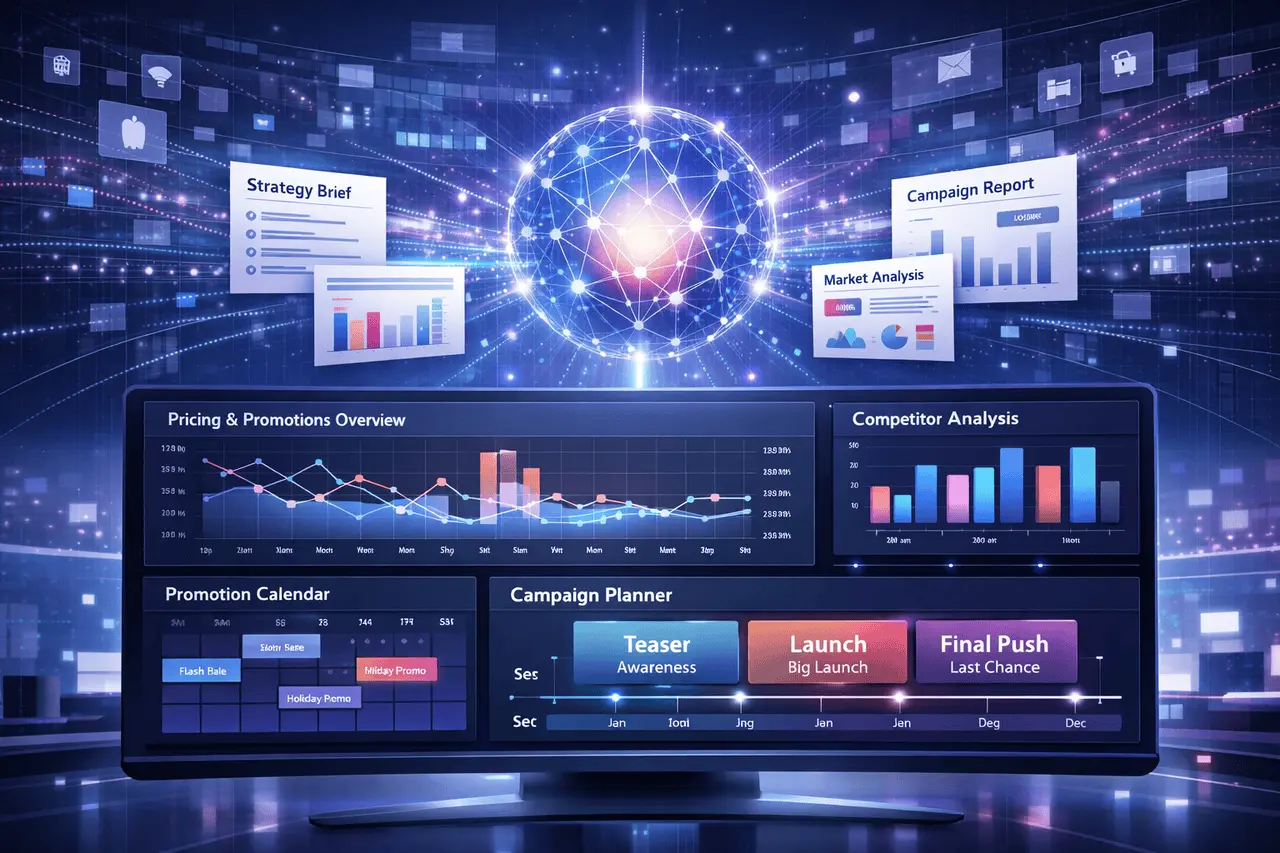
Final deliverable includes a complete executed, ready-to-go promotional plan that includes:
- Theme of the campaign and message
- Pricing bundles, tier discounts, and bundles
- Three-phase rollout strategy
- Teaser Phase
- Launch phase
- Final push
- Channel-specific tactics that include email, paid media, organic, retargeting, and paid media
The outputs are produced in both slide and document formats, ready for internal alignment or delivery.
Timing and Cost Efficiency
The main benefit of the Pokee Ecommerce Strategy Agent is effectiveness at scale. The tasks that have traditionally required substantial analyst involvement are now automated from start to finish.
Traditional vs Automated Approach
| Aspect | Traditional Planning | Pokee Strategy Agent |
|---|---|---|
| Data Collection | Manual, fragmented | Automated, multi-source |
| Analysis Time | Multiple days | Minutes |
| Historical Depth | Limited snapshots | 12-month datasets |
| Output Formatting | Manual | Automated |
| Cost Structure | High analyst cost | Significantly reduced |
Real-World Usage Context
The agent was designed for agencies with large scales where a repeatable strategy workflow is vital. Several brands and agencies now use it to help plan ecommerce promotions on scale.
The usage focuses on the importance of:
- Consistency across brands
- Speed without the loss of depth
- Outputs are aligned with the workflows of both in-house and agency teams.
Benefits and limitations
Key Benefits
- Rapidly reduced planning time
- Low cost for each iteration
- Improved historical and competitive context
- Execution-ready outputs
Practical Aspects
- The effectiveness of HTML0 is dependent on the availability of data across markets
- is best suited to targeted ecommerce promotional use cases
- Enhances, not substitutes, human judgments about brand nuance
My Final Thoughts
The Pokee Ecommerce Strategy Agent is an evolution in the way ecommerce promotion planning is conducted. By combining structured deep analysis with long-term competitor data, the strategy is transformed from a slow, manual process into a quick, repeatable, and easy-to-follow one.
As competition in e-commerce grows and planning times get shorter, tools that reduce time while enhancing analytical depth will become more important. Agents with this specialization suggest a future in which strategies are both more efficient and more grounded in data-driven insights.
Frequently Asked Questions
1. What is it that makes Pokee Ecommerce Strategy Agent different from other AI tools?
It was designed specifically to help you plan your e-commerce promotion, using a structured research logic and long-term competitive analysis rather than generic text generation.
2. Can it be used in any product?
Yes. The agent can modify its analyses to fit any product by adjusting the data inputs and benchmarks.
3. Does the agent substitute for human strategists?
No. It is a computerized system that automates analysis and task planning, allowing strategists to focus on creativity, judgment, and decision-making.
4. What types of formats will the agent provide?
Outputs include tables, structured briefs, slides, and PDFs that are suitable for sharing and implementation.
5. How can the analysis of historical prices help improve the results?
The analysis of 12 months of data reveals patterns and competitors’ behaviours that are not apparent in quick snapshots, enabling more informed strategic decisions.
Also Read –
Claude Code Integration for Agentic Applications