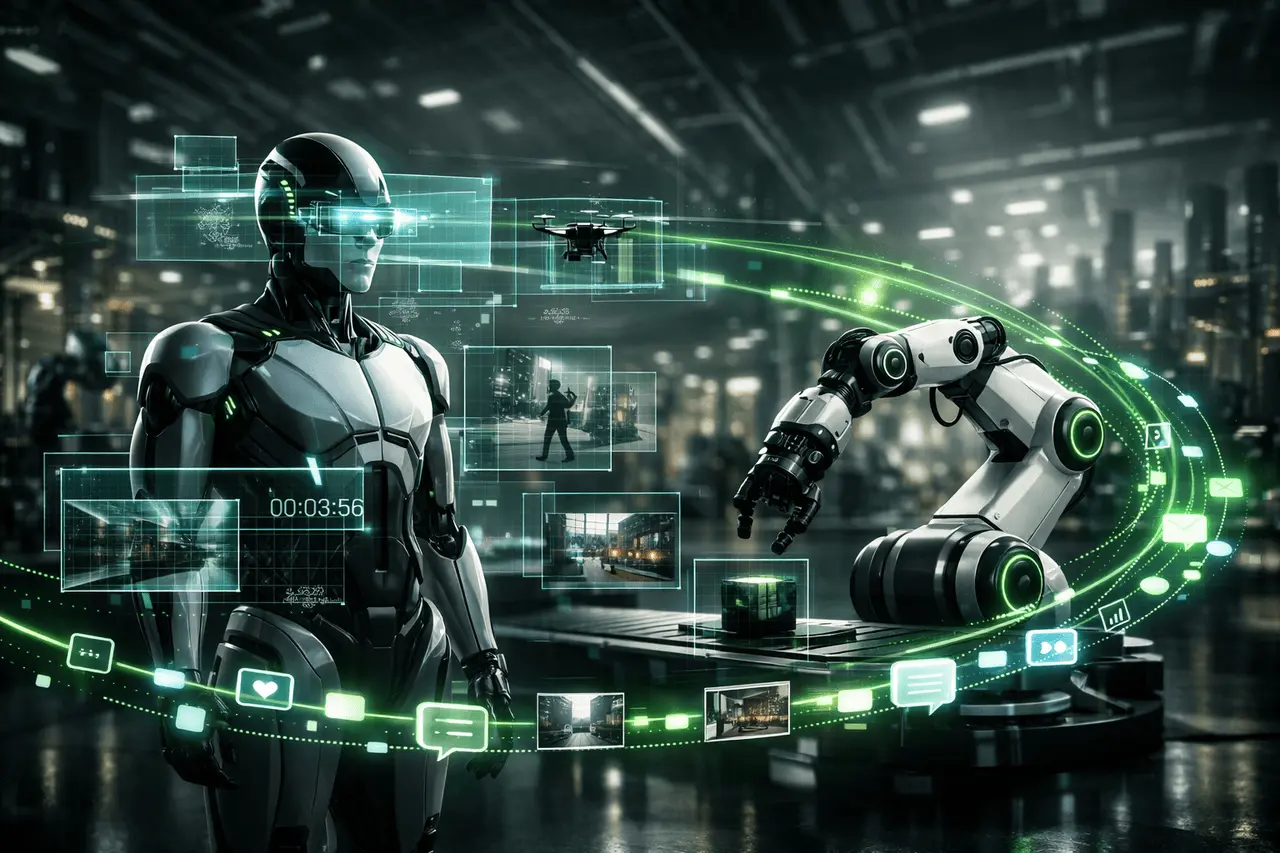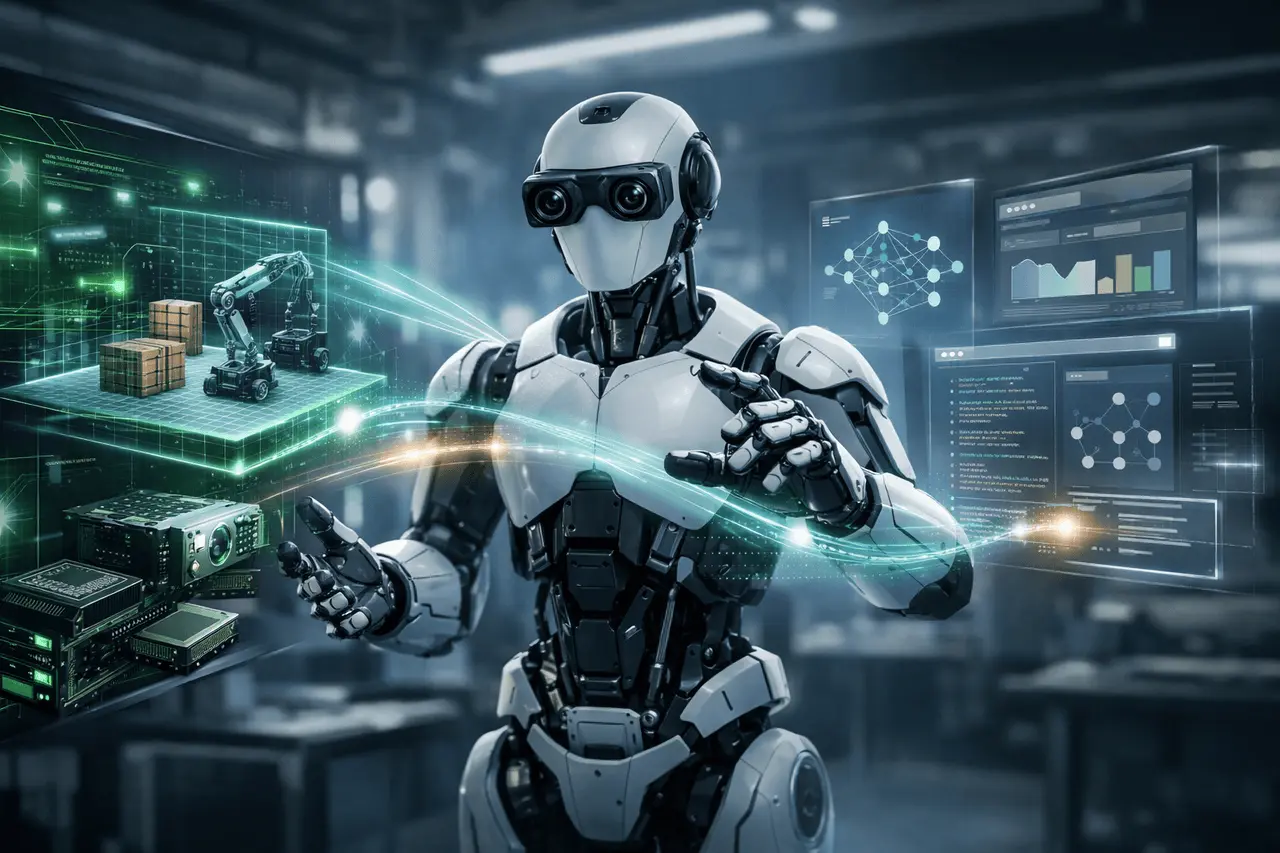

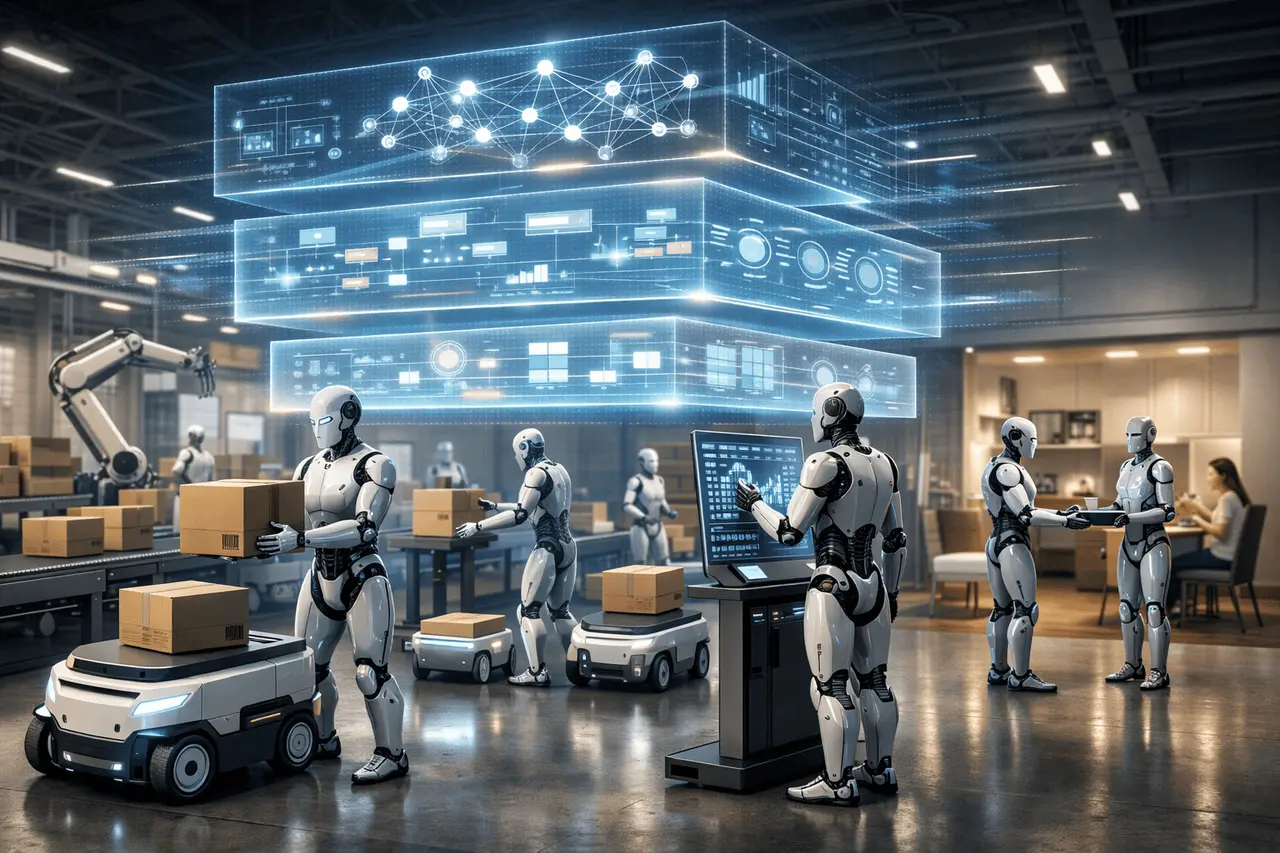
KinetIQ AI framework represents a breakthrough in how humans manage robots in service, industrial, and domestic environments. It is designed to handle robots with different hardware designs, ranging from wheeled platforms to bipedal humans. KinetIQ integrates multiple layers of AI to handle everything from high-level task assignments to real-time monitoring. The KinetIQ system, launched on 5 February 2026, is a step towards scalable, flexible, innovative robotics systems with unifying AI control.
This article explores what KinetIQ is, how it manages robot fleets, what it does, why it is crucial for automation and robotics, and the issues and real-world consequences it poses.
What Is KinetIQ AI Framework?
KinetIQ can be described as an AI framework that orchestrates the end-to-end operation of humanoid robot fleets, capable of controlling multiple robot platforms and optimisingoptimising their behaviour both independently and together. The framework spans a variety of timescales and cognitive layers, each designed to address aspects of fleet performance from strategic planning to physical execution.
The idea is to enable an integrated system that coordinates robots with different morphologies (e.g., wheeled or wheeled-bipedal robotics) and roles, allowing them to cooperate to accomplish complex tasks promptly.
Why It Matters?
KinetIQ is crucial because it addresses a range of major robotics issues.
- Heterogeneous Fleet Coordination: Robots with different physical builds and capabilities can be controlled by a single AI system.
- Adaptive Decision Making: Planning and real-time reasoning allow robots to adjust to evolving environments and objectives.
- Scalability: This layering architecture enables scaling across different areas and tasks with varying complexity.
- Generating: The use of information and knowledge across robots increases fleet efficiency over time.
These capabilities are pushing the boundaries of autonomous robotics. Robots must function with confidence in chaotic, unpredictable environments, a long-standing goal of embedded AI research. Adaptive robots and multi-robot coordination may affect manufacturing, logistics, retail, home help, and much more.
KinetIQ Architecture and How It Works?
KinetIQ’s design utilises a multi-layer cognitive hierarchy to dissect robotic control into manageable levels of abstraction.
Four Cognitive Layers
Four layers that operate at different levels of abstraction. The four layers are:
- System 3 – Fleet Orchestration:
- assigns tasks and goals across the entire fleet of robots.
- Integrates with facilities systems and adapts to the changing priorities, tasks and the need for exceptions.
- Allocates resources to maximise throughput and time to uptime.
- System 2 – Robot-Level Reasoning:
- Converts high-level goals to executable tasks.
- uses an omni-modal language model to interpret the perception of the environment and the commands from Systems 3.
- Produces dynamically updated workflows as well as sequences.
- System 1 – VLA-Based Task Execution:
- A vision-language-action (VLA) model produces target-pose predictions for parts of the robot’s body (e.g., limbs and torso).
- Work at sub-second intervals to perform actions such as manipulating objects, navigating, and even placing objects.
- System 0 – RL-Based Whole-Body Control:
- Makes use of reinforcement learning (RL) to convert poses and targets into stable joint movements at 50 the rate of.
- Continuously ensures stability and dynamic motion stability, vital for bipedal mobility and precise tasks.
This design layering enables high-level coordination and low-level physical execution to work together and align strategic goals with real-time robotic actions.
Feature Comparison: Traditional vs AI-Driven Robot Coordination
| Feature | Traditional Rule-Based Systems | AI-Orchestrated (KinetIQ) |
|---|---|---|
| Task Planning | Manual scripting | Adaptive automated planning |
| Scalability | Limited | High |
| Embodiment Support | Single type | Multiple robot types |
| Real-Time Adaptation | Moderate | High |
| Learning Capability | Static | Improves with data |
| Coordination | Predefined | Dynamic & optimized |
Key Applications
Industrial Operations
KinetIQ can control teams of wheeled robots to perform tasks in factories, warehouses, and logistics centres, ensuring workflow productivity and reducing idle time.
Service and Home Use
Bipedal humanoid robots under KinetIQ’s management can be used to perform service-oriented tasks like interfacing with people, handling food items, or helping with everyday chores, providing possibilities for caregiving solutions and intelligent environments.
Multi-Robot Collaboration
Complex tasks require coordination among different types of robots. KinetIQ enables integrated tasks in which wheeled and legged robots work seamlessly, sharing context and execution feedback.
Benefits
- Unity Control: A single platform that can manage a range of robotic devices.
- Improved Adaptability: The system learns from interactions and improves its future decision-making.
- Automation of workflows: Automated workflows reduce manual intervention and improve operational speed.
- Data Sharing: Information gained from a robot’s experiences can be shared with others, enhancing overall performance.
Limitations and Challenges
Although promising, multi-robot AI orchestration is not without problems:
- Simulation-to-Real Transfer: Reinforcement learning and VLA control typically require substantial simulation data to operate effectively in the real world.
- Security and Predictability: Ensuring reliability in unstructured environments requires robust validation and safety layers.
- Computing Resources: Planning, real-time multimodal thinking, and control consume significant resources.
- Generalisation Across Tasks: Diverse real-world situations may require continuous learning and adaptation.
Practical Considerations
For organisations adopting KinetIQ-like frameworks:
- Infrastructure Integration: Link AI and facilities management software and corporate software.
- Data Pipelines: Ensure you have high-quality sensor input and data collection to enable ongoing learning.
- Safety Procedures: Implement strict testing and monitoring to mitigate operational risks.
- Human-AI Interaction: Create interfaces for human oversight as well as intervention when required.
My Final Thoughts
KinetIQ is a prime example of the next step in robotic fleet orchestration, bringing together strategic coordination and tactical execution across a variety of robot platforms. The multilayer architecture addresses key automation issues by integrating autonomous planning, multiple-modal vision, dynamic whole-body execution, and control.
As AI improves, frameworks such as KinetIQ can enable the mass adoption of humanoid and wheeled robots in areas where coordination is crucial, such as smart factories, and for personalised robotics assistance. With real-world deployments in the near future, the future of intelligent fleet robotics lies in the seamless integration of AI and physical and mental decision-making.
Frequently Asked Questions
1. What kinds of robots can KinetIQ handle?
KinetIQ is designed to coordinate robots with different configurations, including wheels for industrial applications and bipedal humanoids for household and service purposes.
2. What can KinetIQ increase the efficiency of robot fleets?
By optimising workflows and enabling real-time adjustments, KinetIQ automates task allocation, reducing manual planning and boosting operational throughput.
3. Does KinetIQ work in the home environment?
Yes. KinetIQ’s reasoning and control layer can handle the delicate, interconnected tasks required for smart homes and service roles.
4. What are the technologies that underlie KinetIQ’s system of control?
KinetIQ uses vision-language-action models for task execution and reinforcement learning for stable whole-body control.
5. Does KinetIQ have the ability to learn from real-world knowledge?
Yes. The system uses data collected across various embodiments to improve fleet efficiency over time.
6. What is the future-proofing of frameworks such as KinetIQ?
Robotics of the future will be aided by AI orchestration systems that can coordinate heterogeneous robots across domains ranging from manufacturing and logistics to medical and everyday living assistants.
Also Read –
Humanoid Robots in Industrial Logistics: Real-World Factory Test