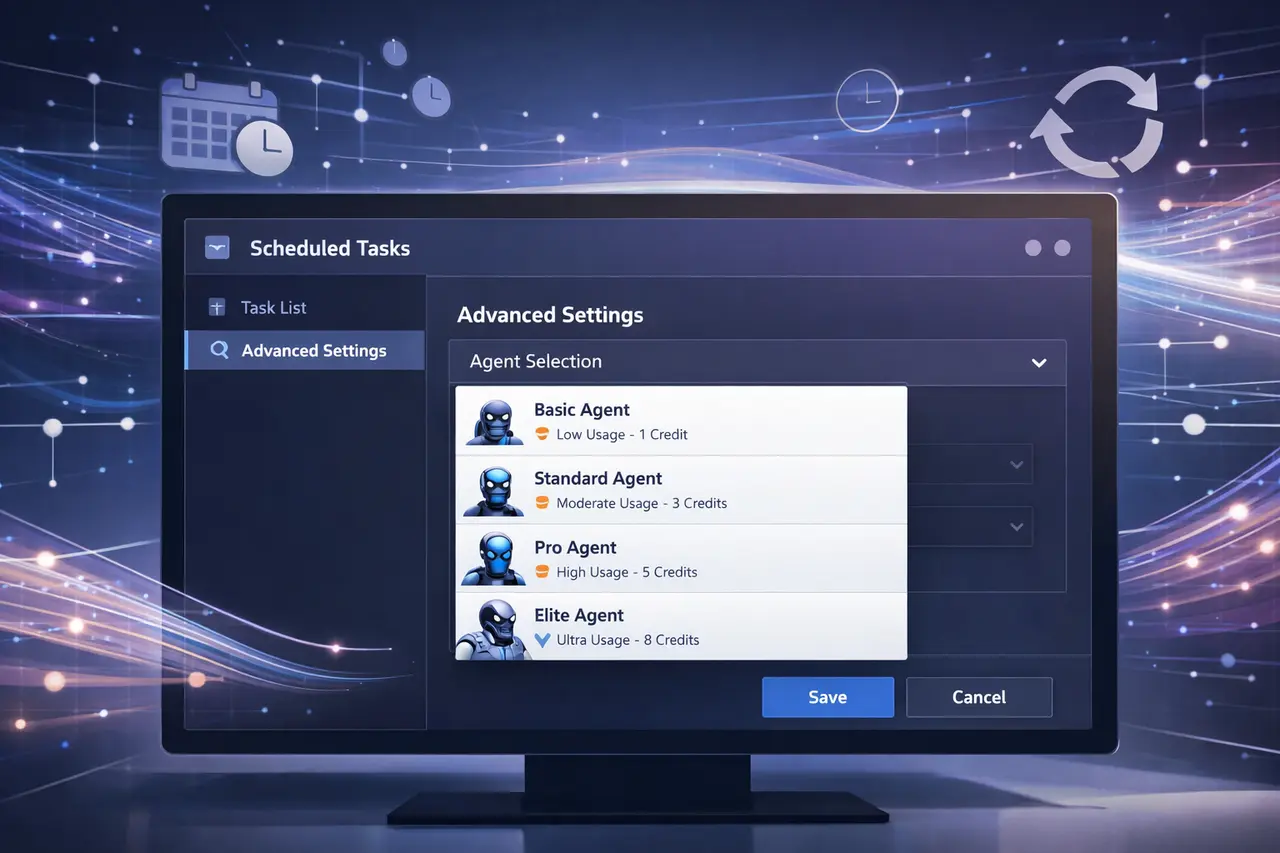
Manus agent choice to perform scheduled work is a newly added feature that allows users to control which agent executes automated workflows. The update addresses a growing need for autonomous AI systems that balance task performance, reliability, and credit usage. As companies increasingly rely on automated workflows that are scheduled by AI and processes, precise execution control becomes crucial for cost efficiency and operational transparency.
This article will explain about Manus agent selection for scheduled tasks, and the process of selecting agents in Manus, and why it’s important, how it functions, and how users can use it efficiently, based solely on the confirmed behavior of the platform and the standard design patterns for autonomous agents.
What Is Agent Selection in Manus?
The Manus agent selection lets users select an agent based on a task’s schedule.
Previously, scheduled tasks were performed by a default, automatically-assigned agent. With this upgrade, users can specify which agent will take over the task, enabling greater alignment between task requirements and agent capabilities.
The HTML0 Agent within Manus is an execution environment that has certain characteristics, like:
- Reasoning depth
- Execution cost (credits)
- Response and speed
- Appropriateness for tasks of varying complexity
Why Agent Selection Matters in Scheduled Tasks?
Scheduled tasks are usually executed with no direct human oversight. Over time, even small errors can lead to excessive credit use.
Agent selection matters because it enables:
- Improved credit management via assigning agents with lower costs to perform routine tasks
- Predictable execution behavior for recurring workflows
- Improved resource allocation across multiple automations
- Transparency operates within the manner in which credits are used
For teams with numerous workflows that repeat, this feature provides an efficient layer of cost management.
How Manus Agent Selection Works?
The function is available directly in the scheduled task configuration process.
Configuration Path
Users can access the agent selection through:
- Settings
- Scheduled Tasks
- Advanced Settings
With advanced options, the user can select the agent that executes the task each time it runs. After saving, the task will always use that agent, unless it is manually altered.
This design separates tasks from their execution choices, enabling optimization without rewriting workflows.
Agent Selection vs Automatic Execution
Understanding the distinction helps to understand the significance of this upgrade.
Automatic Agent Execution
- The system decides which agent will run the task.
- Less predictable credit usage
- Limited control for optimization
Manual Agent Selection
- The user explicitly assigns an agent
- Controllable and predictable costs
- Improved alignment with the importance of the task
Feature Comparison Table
| Aspect | Automatic Execution | Manual Agent Selection |
|---|---|---|
| Credit predictability | Low | High |
| Execution control | Limited | Strong |
| Optimization potential | System-driven | User-driven |
| Scalability | Moderate | High |
This change enables users to influence the automation economy without adding complexity.
Practical Use Cases in Manus
The selection of an agent is most efficient when tasks differ in importance and difficulty.
Low-Complexity Scheduled Tasks
Examples include:
- Routine monitoring
- Data formatting
- Status checks
These jobs can be assigned to lighter agents to reduce credit use without affecting results.
High-Impact Scheduled Tasks
Examples include:
- Business-critical reports
- Multi-step reasoning workflows
- Decision-support automations
Assigning a more skilled agent ensures consistency in quality and security.
Use Cases by Task Type
| Task Category | Recommended Agent Type | Primary Benefit |
|---|---|---|
| Background automation | Lightweight agent | Cost efficiency |
| Content or analysis | Balanced agent | Quality control |
| Strategic workflows | Advanced agent | Reliability |
| Monitoring jobs | Lightweight agent | Scalability |
Benefits of Agent Selection in Manus
Key benefits include:
- Optimized credit usage across recurring tasks
- Clearer execution planning for teams
- Reduced the use of the overpowered agents who perform simple tasks
- Improved scalability as automation volume grows
Over time, this benefit will increase, particularly in areas with high automation.
Limitations and Considerations
While extremely powerful agent selection is important, it requires careful use.
Potential Challenges
- The choice of the right agent could affect the outcome of the task
- requires an understanding of agent capabilities distinctions
- Adds an extra configuration decision
Best Practices
- Sort tasks by their degree of complexity
- Standardize agent options to ensure similar workflows
- Review the scheduled tasks regularly
- Agent assignments can be adjusted when workflows change
Agent selection must be considered an ongoing optimization tool, not a once-off setup.
Governance and Cost Control Implications
Agent-level control helps improve internal governance through:
- Avoiding the accidental use of agents that cost a lot.
- Encouraging intentional automation design
- Making credit usage simpler to predict
For teams that manage the shared credit pool, this option provides a useful security feature.
My Final Thoughts
Manus agent choice for scheduled tasks provides an essential level of control for automation, through allowing users to choose what tasks will be executed, not only the time they are executed–the platform allows more efficient credit utilization, better management, and more flexible workflows.
Since autonomous systems are incorporated into operating systems, features such as agent selection are likely to play an essential role in ensuring that automation is reliable, efficient, and durable over the long run.
FAQs
1. What is the agent selection process in Manus?
Agent selection enables users to choose which agent will perform a scheduled task, giving them greater control over costs and efficiency.
2. How can this aid in managing your credit?
By assigning agents to simpler tasks at a lower cost, users can limit the amount of credit they use.
3. Are different tasks scheduled to make use of different agents?
Yes. Each scheduled task can be assigned its own agent.
4. Is the selection of an agent required for all assignments?
No. It’s optional but very useful for recurring, high-volume workflows.
5. Can changing the agent impact the logic of the task?
No. The task logic stays the same, but the execution agent’s role changes.
6. How often should assignments of agents be reexamined?
Periodic reviews, like quarterly or monthly, are recommended, particularly since automation requires changes.
Also Read –
Manus Meeting Minutes: Turn Meetings Into Actionable Work