
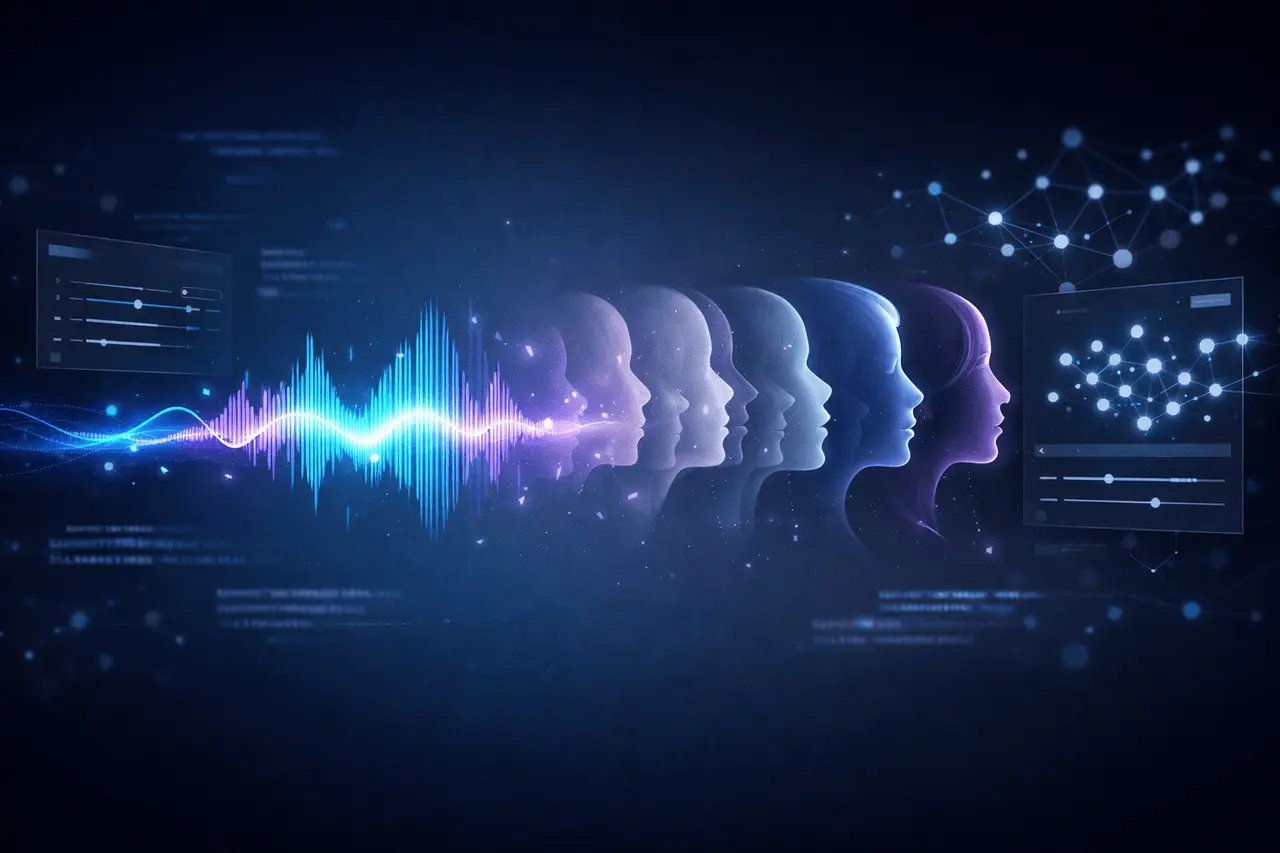
Qwen3-TTS is an upcoming open-source family of text-to-speech (TTS) models designed to offer high-quality, versatile, flexible, and production-ready speech synthesisers. Intended for researchers, developers, and businesses that combine advanced voice design, customised voice cloning, and strong multilingual support into one open framework.
By open-sourcing the complete model family, including VoiceDesign CustomVoice, CustomVoice, and Base variations, Qwen3 TTS lowers barriers to experimentation and delivers modern-day performance comparable to the best custom-built systems.
What Is Qwen3-TTS?
Qwen3-TTS is a new neural system that converts the written word into native-sounding, natural speech. It’s released as a complete range of models instead of just a single checkpoint. This allows users to select between free-form voice creation and personalised voice replication.
The model line-up includes five variations across two scales, 0.6B and 1.8B, balancing audio quality and efficiency for different deployment needs.
Why Qwen3-TTS Matters?
Quality TTS is now essential for accessibility tools for educational platforms, conversational AI and multimedia production. Many advanced systems are closed or limit fine-tuning, thereby reducing transparency and flexibility.
Qwen3 is significant because it can provide:
- Open-source and fully accessible for commercial and research use
- Multilingual support is strong out of the box
- Customised voice features with no use of proprietary lock-in
- Competitive, state-of-the-art synthesis quality
This makes it particularly relevant to teams looking for long-term control over their speech technology.
Qwen3-TTS Model Family Overview
The Qwen3 TTS release has three fundamental model categories, each with its own specific purpose.
Base Models
Base models concentrate on high-quality, general-purpose speech synthesisers. They can be used for tasks like audio narration, assistance, and automated announcements.
VoiceDesign Models
VoiceDesign models enable free-form voice creation. Instead of copying a previous microphone, people can create new voices by altering vocal characteristics, such h tone and pitch, as well as style.
CustomVoice Models
CustomVoice models can support voice cloning. This allows systems to reproduce a particular speaker’s voice if trained using the correct information. This can be useful for personalising branding, ensuring consistency across different products, and providing a consistent experiential feature.
Model Sizes and Architecture
Qwen3-TTS is available in five different versions that span two scales of parameters:
- 0.6B parameters to facilitate efficient inference
- 1.8B parameters to provide higher quality and more expressiveness
This flexibility is compatible with both server-grade and edge-friendly deployments.
Multilingual Support
The model is natively compatible with 10 languages, ensuring consistent voice quality across them. This means there is no requirement for separate, specific-language TTS systems.
Advanced Tokenization
Qwen3-TTS is a cutting-edge tokeniser that operates at 12Hz and is designed for high compression. This permits efficient representation of speech while maintaining its natural sound and clarity, increasing both the efficiency of training and inference.
Full Fine-Tuning Support
Unlike many closed systems, Qwen3 supports fine-tuning of the entire system. Users can modify models to:
- Domain-specific vocabulary
- Unique speaking styles
- Target hardware constraints
This allows the system to be used for research experiments as well as the commercialisation of optimisation.
Feature Comparison Table
| Feature | Base | VoiceDesign | CustomVoice |
|---|---|---|---|
| General TTS | Yes | Yes | Yes |
| Free-form voice creation | No | Yes | Limited |
| Voice cloning | No | No | Yes |
| Fine-tuning support | Yes | Yes | Yes |
| Multilingual output | Yes | Yes | Yes |
How Qwen3-TTS Works?
On a broader degree, Qwen3 TTS follows an underlying neural TTS pipeline
- Text is encoded and tokenised with language and contextual characteristics
- The model anticipates audio representations with its 12Hz tokeniser
- A Vocoder converts these representations to audible speech
Combining powerful tokenisation and a large-scale neural model can enable natural prosody and a scalable deployment.
Real-World Applications
Qwen3 can be used in a variety of industries:
- Accessibility: Screenreaders and voice aids
- Artificial Intelligence: Conversational Chatbots as well as virtual assistants
- Education: Learn in multiple languages, narration and content
- Media Production Audiobooks: Dubbing, voiceovers and voice-overs
- Enterprise Systems: Automated customer communication
Its openness also makes it ideal for academic research or benchmarking.
Benefits of Qwen3-TTS
- Transparency and extensibility from Open Source.
- High-quality, state-of-the-art speech synthesis
- Voice design in free-form and cloning all in one framework
- Ten languages are supported, without separate models
- Flexible deployment across different compute budgets
Limitations and Practical Considerations
While Qwen3-TTS is a robust protocol, users should think about:
- Fine-tuning needs high-quality speech data to achieve the best results.
- The larger models require more memory and computation.
- Voice cloning should be used with care and in accordance with the applicable laws.
A proper curation of datasets and safeguards for ethical use are essential.
Advantages vs. Challenges
| Aspect | Advantage | Challenge |
|---|---|---|
| Open-source access | Full control and transparency | Requires in-house expertise |
| Voice customization | Highly flexible voices | Data preparation effort |
| Model scale options | Efficient or high-fidelity | Trade-off decisions needed |
My Final Thoughts
Qwen3 is a significant leap forward for open-source text-to-speech technology. It combines support for multilingual languages, free-form voice design and voice cloning, advanced tokenisation, and tuning, and it offers the most advanced functionality without compromising on flexibility.
As demand for transparent, customizable speech systems increases, Qwen3 provides the foundation for further innovations in AI-driven speech technologies.
FAQs
1. What are the uses of Qwen3 TTS?
Qwen3 is utilised to transform text into natural-sounding speech for applications such as assistive devices and accessibility devices, as well as for multimedia content.
2. What are the languages Qwen3-TTS can support?
Qwen3-TTS supports more than 10 native languages, enabling multilingual speech synthesis with the same Model Family.
3. Does Qwen3-TTS support voice cloning?
Yes, the CustomVoice models were specifically developed to clone voices during training with relevant speaker information.
4. Can Qwen3’s TTS be tuned?
Yes, all models in the Qwen3 TTS family can be configured to support full fine-tuning for domain adaptation and voice-specific customisation.
5. What sizes of models are available?
Qwen3-TTS is offered in five variations spanning 0.6B to 1.8B in parameter scale.
Also Read –
Qwen-Image-2512: Strongest Open-Source AI Image Model