
Industrial automation is entering a new era as robots with humanoid features are moving from controlled labs into real factory environments. Recent proof-of-concept (POC) work carried out by Humanoid in partnership with Siemens demonstrates that general-purpose robots can operate in real-time, autonomous logistics in a safe, reliable, and secure manner, at a rapid rate of production.
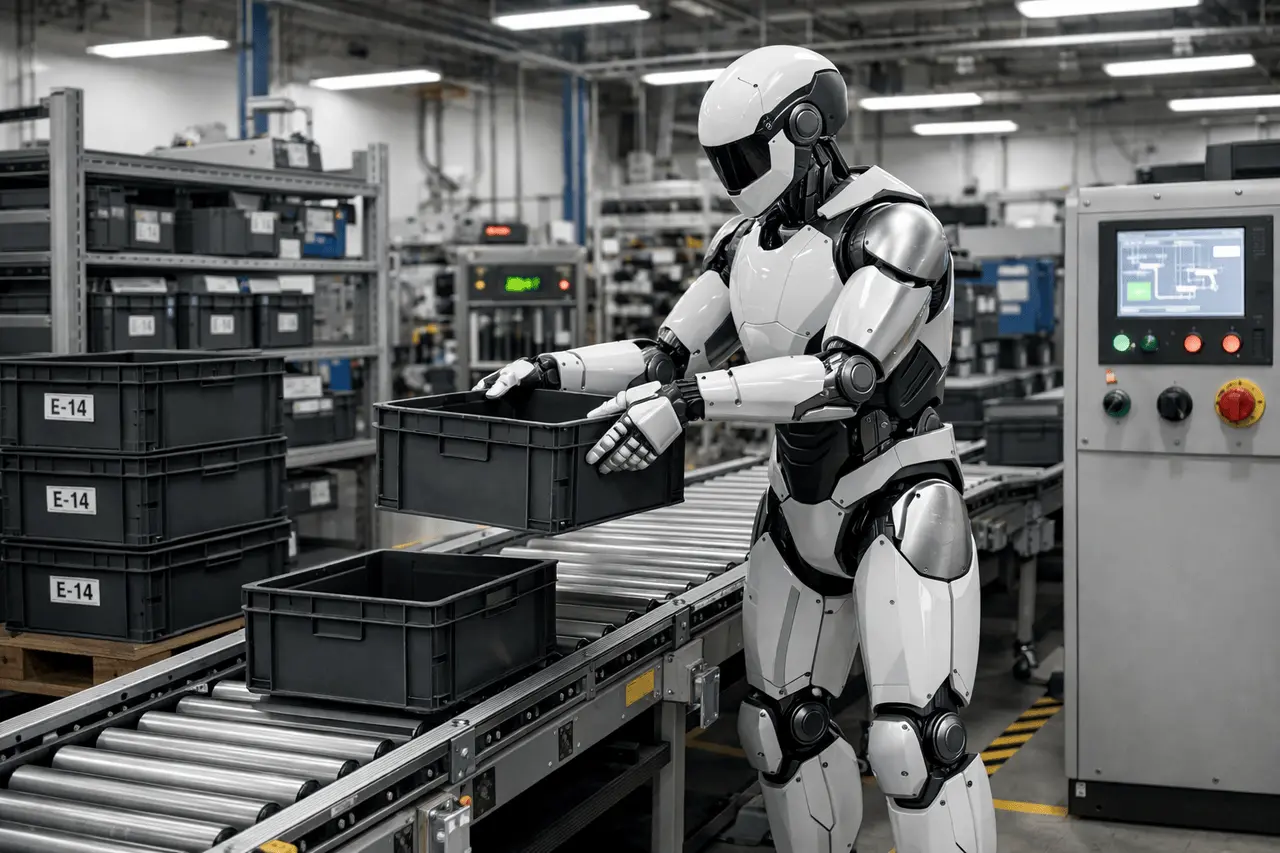
In the second week of an installation at the Siemens Electronics Factory in Erlangen, the HMND 01 robotic humanoid completed a task of transferring the contents of a container from a truck without human intervention. Although the task appears simple at first glance, the achievement is a solution to one of the most enduring challenges: flexibility in material handling in highly dynamic environments.
In this article, we will explore humanoid robots in industrial logistics, examining how real-world factory trials, autonomous material handling, and industry partnerships are accelerating their transition from experimental technology to practical deployment.
Why Industrial Logistics Needs Humanoid Robots?
The logistics tasks of sorting, picking, destacking, and transporting materials are crucial to the factory’s processes. In the past, these tasks depended on the human workforce or highly specialized automation. Every option has its own pros and cons:
- Human employees are flexible but also face stress due to ergonomic issues, labor shortages, and rising costs.
- Systems for fixed automation provide speed and accuracy, but they lack flexibility and require costly reconfiguration when layouts or products are modified.
Humanoid robots seek to bridge the gap. They are designed with human-like forms and capabilities; they can navigate environments designed for people, use existing equipment, and adapt to change without significant infrastructure changes. This makes them particularly appealing for logistics workflows that change from day to day.
Inside the Siemens-Humanoid Proof of Concept
The POC focused on an operational requirement: a self-contained process for removing totes before loading them onto the conveyor system. This is a standard but crucial step in the manufacturing of electronics, in which components must move smoothly between manufacturing stages.
Over two weeks, the HMND 01 robot operated directly in the Siemens manufacturing environment rather than in a simulator. Some of the key elements of the trial included:
- Fully Autonomous: Robots did the job without any human intervention.
- Operational Reality: It worked in conjunction with existing equipment and workflows.
- Consistency Over Time: Performance was verified across multiple days, not just a single test run.
By meeting these criteria, the POC demonstrated that humanoid robots can handle repetitive logistics tasks under real-world constraints, lighting changes, space limitations, and interactions with industrial systems.
The Significance of Tote-to-Conveyor Destacking
Destacking totes might sound easy, but in practice, it requires precise perception, skilled manipulation, and secure motion planning. Totes may change in weight, direction, and location, and the robot must adjust in real time.
Achieving this goal is a sign of progress in a variety of critical areas:
- Vision and computer vision for determining the exact positions of conveyors and totes
- A robot that is capable of safely handling industrial containers
- Autonomous decision-making, which adapts to minor changes without manual resets
This capability can be applied to other logistics functions. Destacking is a strong foundation for overall deployment capability.
From POC to Scalable Deployment
According to both parties, this trial is the first step towards a larger collaboration. The goal isn’t eliminating workers in a matter of hours; instead, it is about improving operational efficiency by automating labor-intensive tasks or removing bottlenecks.
For manufacturers, the implications are enormous:
- Rapid Deployment Processes: Humanoid robots can be deployed without redesigning entire infrastructures.
- Increased Durability: Robots can help maintain efficiency during labor shortages or spikes in demand.
- Automation that can be Future-Proofed: Software updates can expand capabilities without requiring new hardware investment.
This strategy aligns with the growing demand for a flexible, automated system that scales with production requirements.
Safety and Human-Robot Collaboration
Being in a live production facility requires a strict adherence to safety regulations. Humanoid robots must be able to detect humans, avoid collisions, and behave with a sense of security around sensitive equipment. The success of the on-site deployment suggests that safety systems, including stop-and-force control, perception-based stops, and compliant motion, are advancing toward a state suitable for use.
This is crucial in the field of electronics manufacturing, where precision and quality control are essential. Promoting the safety of collaboration in this environment can help convince for broader acceptance.
What does this mean for the Robotics Industry?
It is believed that the Siemens factory trial marks an evolution in how humanoids are viewed. Instead of being focused on displays that are flashy robots, manufacturers are now focusing on
- Task-specific validation in real facilities
- Performance is measured over a long period
- Integration into the current industrial workflow processes
In the future, as more POCs evolve into pilot programmes, humanoid robotics will likely become a common sight in assembly, logistics, and inspection tasks.
Humanoid robots in industrial logistics: Looking Ahead
While there are challenges to overcome, costs, scalability, and long-term reliability are among them. The accomplishment of this POC shows that humanoid robotics is now closer than ever before to significant industrial applications. Partnerships between robotics pioneers and established companies are essential for defining use cases and accelerating adoption.
Humanoid systems continue to evolve; logistical systems could be the key application that can bring them into the mainstream of industrial production.
My Final Thoughts
The successful completion of an industrial logistics test shows that humanoid robots are getting closer to real-world applications. In autonomously performing an essential, repetitive job over a prolonged period, the robot demonstrated not only its technical capabilities but also its ability to operate in real manufacturing conditions. While the widespread acceptance of robots depends on ongoing testing, cost efficiency, and long-term reliability, this accomplishment indicates greater confidence from major industry players. As alliances between robotics researchers and manufacturers expand, the humanoid robot is likely to play an increasingly important role in creating more flexible, efficient, productive, and future-proof manufacturing environments.
Frequently Asked Questions
1. What is the tote-to-conveyor-destacking job?
It is the process of removing stacked containers (totes) and placing them on a conveyor for further processing. It is an essential step in logistics factories.
2. Why is this important for robots with humanoids?
It is a test of perception manipulation, perception, and self-assuring decision-making in an actual industrial setting, making it an excellent indicator of the readiness to deploy.
3. Did the robot run in complete autonomy?
Yes, the HMND 01 robot completed the job without human supervision during deployment.
4. The location of the test is where?
The POC was conducted at the Siemens Electronics Factory in Erlangen, in an active production environment.
5. Does this mean humanoid robots are ready for mass deployment?
The trial has shown significant advancement; more widespread rollout will be contingent on the results of additional trials, cost optimization, and long-term performance validation.
6. How will this affect the factory workers?
Humanoid robots are designed to aid workers in completing physical, repetitive tasks, allowing them to focus on more lucrative work.
Also Read –