
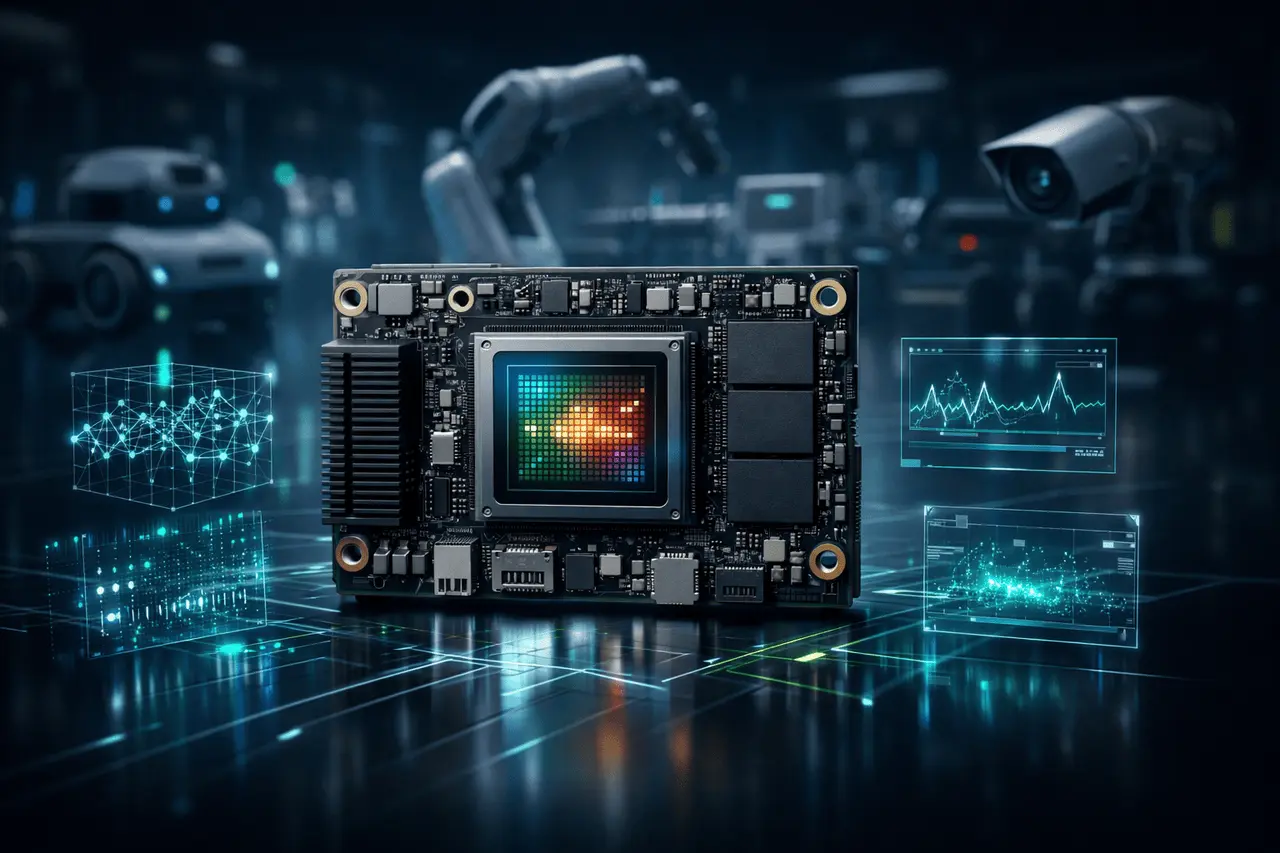
In the early part of January 2026, NVIDIA unveiled the Jetson T4000, an extremely fast AI module that is designed to provide high-end real-time computation to a variety of edge computing and robotics applications. Based on NVIDIA’s newest Blackwell technology and a new Blackwell architecture, the Jetson T4000 combines cutting-edge AI computation with a sleek layout, powerful memory, and a redesigned software stack with JetPack 7.1.
This article explains NVIDIA Jetson T4000, the most critical specifications, software enhancements, applications, and considerations regarding deployment for both organisations and developers who want to create intelligent systems that are at the cutting edge.
What is the Jetson T4000 built for?
The Jetson family has been recognised as a top integrated AI platform for industrial automation, robotics and smart devices. Its Jetson T4000 expands this legacy by providing significantly more AI compute power than the previous modules, which also maintain energy efficiency within the tight power envelopes. This is an essential element for autonomous robots’ smart infrastructure, as well as other edge applications where thermal and power limitations are crucial.
The Jetson T4000 is aimed at real-time AI analysis in environments where reliability, latency, and efficiency are crucial. It allows complex neural networks that include huge model languages (LLMs), vision transformers, as well as multimodal AI, to operate locally on your device, instead of using remote cloud servers. This feature not only increases performance but also increases the security and privacy of data.
Blackwell Architecture: High Performance Meets Efficiency
The Jetson T4000 leverages NVIDIA’s Blackwell GPU architecture, which has been specifically designed for AI applications across FP4 as well as other formats for precision. With the possibility of up to 1,200 FP4 sparse TFLOPS AI performance, the T4000 achieves the right balance between high computation capacity and high energy efficacy. This is essential for battery-powered robots and edge devices.
Highlights of the hardware include:
- 1,536-core Blackwell GPU featuring fifth-generation Tensor Cores, enabling dense parallel AI compute.
- 12-core Arm Neoverse V3AE 64-bit CPU providing fast general-purpose processing.
- 64GB of LPDDR5x memory, with 273 GB/s of bandwidth, offering large data paths for sensors and models with large data streams.
- Flexible power envelope (40 W 70 W) allows for installation in environments with limited energy.
These specifications enable Jetson T4000 to Jetson T4000 to handle demanding computer vision, sensor fusion and inference of neural networks, as well as support live-time processing for video. It has an encoder for video that is dedicated (NVENC) and encode (NVDEC) engines that can handle efficient workflows for 4K multimedia in the 4K format.
JetPack 7.1: Software That Unlocks the Hardware
Hardware performance is just one part of the puzzle. It is equally important to have software that lets developers make the most of that performance. NVIDIA’s JetPack 7.1, which is the latest version of the JetPack SDK, includes tools, libraries, and runtime enhancements specifically designed to support the latest developments in AI.
JetPack 7.1 builds upon the previous versions, with improvements that help to speed up AI efficiency and multimedia processing. Some of the notable features include:
- TensorRT Edge: Optimised inference engine to handle large languages at the edge, decreasing the amount of latency and memory footprint.
- Unified Video Codec SDK: A video acceleration technology that facilitates hardware-accelerated decoding and encoding across a variety of video formats.
- Better support for LLM speech, LLM, and vision Models: Designers can create complicated AI work with more efficient workflows.
- Ecosystem Integration: Integrity with NVIDIA’s wider AI stack, including CUDA, cuDNN, and other libraries, ensures software compatibility across all devices.
These capabilities in software decrease the development costs to develop AI applications and make it simpler to incorporate advanced features such as multimodal reasoning and on-device reasoning for production applications.
Compatibility and Development Benefits
The most important aspect of design to consider when designing the Jetson T4000 is its form dimension, along with pin connectivity to higher-end Jetson T5000 modules. This allows designers to create the same carrier board, and the performance can be scaled up or down according to the needs of the project.
This interoperability can benefit both prototyping and product development through:
- Reduced costs for hardware redesign by upgrading to better performance modules.
- Simplifying the management of inventory and supply chain for product lines that range from entry-level devices to top-of-the-line edge technology.
Furthermore, the Jetson developer ecosystem, which includes forums, SDKs and community resources, also speeds up timelines for projects as well as the sharing of knowledge.
Real-World Use Cases for the T4000
Combining powerful computing, a streamlined design, and a rich application, the Jetson T4000 is well-suited for various applications:
Robotics and Autonomous Machines
Developers of robotics can make use of the T4000 to run the autonomy stack, such as perception pipelines and multi-sensor fusion projects, with low latency. Its hardware is suitable for use in mobile robots, drones and service robots, in which energy efficiency and real-time decision making are crucial.
Industrial Automation
In warehouses and factories, the T4000 can be used to enable the use of intelligent Inspection and quality Control, in addition to automated hand-off systems. Its AI inference capabilities support sophisticated visual inspection models as well as workflows for anomaly detection without having to transfer the data onto central servers.
Smart Cameras and Vision Systems
The built-in video acceleration features make the T4000 the ideal option for advanced vision systems that include intelligent surveillance, traffic monitoring, and interactive settings. Local processing helps reduce the need for bandwidth and enhances the speed of response.
Edge AI in Infrastructure
Smart cities, smart homes and IoT gateways. The Jetson T4000 provides the local AI computation required to support applications such as prescriptive maintenance, monitoring of the environment, and contextual analytics.
Deployment Considerations
Although Jetson T4000 is a great option, while Jetson T4000 offers significant advantages; however, a successful deployment calls for focus on a variety of practical aspects:
- Thermal Management: While made to be efficient, the T4000 still requires sufficient cooling, particularly at higher power configurations.
- Software Optimisation: Taking advantage of JetPack 7.1 features, such as TensorRT Edge-LLM, requires precise tuning to ensure the best possible inference performance.
- Model Selection: For specific generative AI models or for massive model deployments, designers may have to balance the size of their models with performance requirements.
My Final Thoughts
The Jetson T4000 represents a meaningful advancement in cutting-edge AI platforms, and not only because of its performance, but also due to the way it is packaged for deployment in real-world settings. The blend of remarkable FP4 AI throughput and energy-efficient design, a modern CPU architecture, and a well-established software stack makes it an excellent choice for industrial automation and intelligent vision systems. JetPack 7.1 increases the value of this feature by reducing the friction when installing complicated AI models, such as enhanced support for video pipelines, as well as large-scale model inference of language models on the edge.
To companies that are developing future-proof autonomous machines or intelligent infrastructure, the Jetson T4000 offers a scalable and future-proof foundation. It lets teams develop systems that can respond more quickly and more autonomously and process sensitive information locally. This is one of the main advantages in a time when advanced AI is expanding across all industries.
Frequently Asked Questions
1. What is the NVIDIA Jetson T4000?
The Jetson T4000 is an AI inference module based on NVIDIA’s Blackwell architecture that can provide 1200 to 1.200 F4 sparse, TFLOPS. It’s developed for effective edge AI and robotics-related tasks.
2. How can JetPack 7.1 help to improve the T4000?
JetPack 7.1 incorporates optimised inference engines, such as TensorRT Edge-LLM, as well as a unifying video codec SDK, enhancing the performance of AI and multimedia with Jetson modules.
3. What are the typical uses for which this program can be used?
Most common uses include robotics with autonomous capabilities, industrial automation, intelligent vision systems, and other latency-sensitive solutions that need the local AI compute.
4. What can I do to upgrade my T4000 to higher-performance modules?
Yes, the T4000 shares the same form factor and pin compatibility with Jetson T5000, allowing upgrades without redesigning the carrier boards.
5. Is the T4000 ideal for large-language models?
In conjunction with JetPack 7.1’s optimisations like TensorRT Edge LLM, T4000 can run compression LLMs as well as other models with advanced features. Still, performance can vary depending on the model’s size and the power configuration.
Also Read –
NVIDIA Cosmos Reason 2: Physical AI Reasoning Model Explained
NVIDIA Nemotron 3 Nano: Efficient MoE Model with 1M Context