
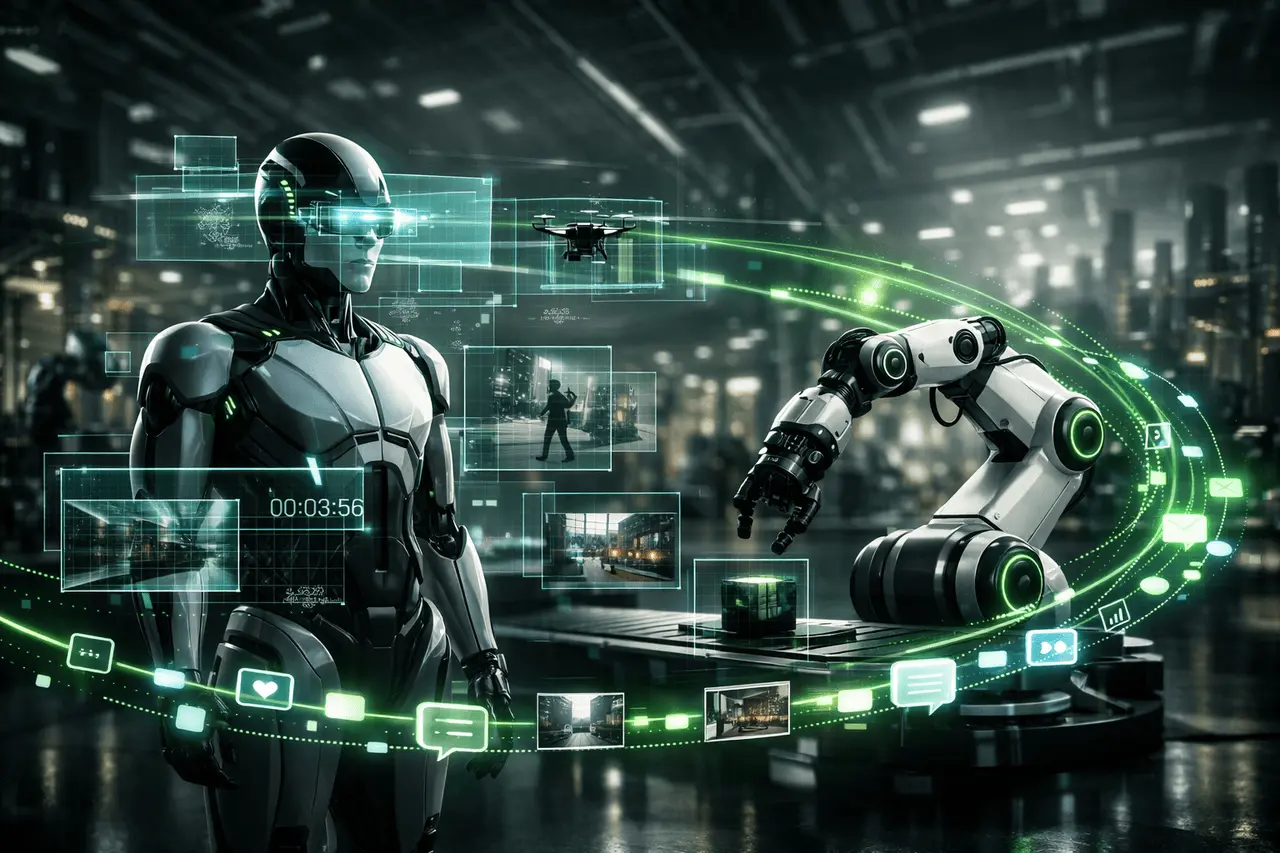
NVIDIA has launched Cosmos Reason 2, a cutting-edge reasoning model (VLM) created to enhance the capabilities of robotics and physical AI. This new release, which is part of a broader campaign at CES 2026, highlights new tools and models created to make machines sensitive, aware of context, and in a position to plan and communicate with real-world situations. With Reason 2, NVIDIA rolled out the latest versions of Cosmos Predict 2.5, Cosmos Transfer 2.5 and Isaac GR00T N1.6, the Isaac GR00T N1.6 robotic foundation models, each of which is aimed at speeding up robotics development and deployment.
What Is Cosmos Reason 2?
Cosmos Reason 2 is an open, high-accuracy reasoning language model that was designed specifically for physical AI, which is the area in which AI systems operate and interpret in real-world situations rather than only in digital ones. Its strength is in the way it combines reasoning and visual perception that allows robots and Artificial Intelligence agents to “see,” understand, and make decisions as humans do.
As opposed to previous models, which focused primarily on finding objects or analysing text, The Reason 2 incorporates common sense reasoning as well as spatial-temporal consciousness, which allows it to understand how things are moving through space and time, and decide on actions in line with. This makes it ideal for applications like robotic navigation that is autonomous, manufacturing automation, and real-world robotics.
Cosmos Reason 2: Key Features and Capabilities
Enhanced Spatio-Temporal Understanding and Precision
Cosmos Reason 2 significantly improves the capacity of models to perceive spatio-temporal dynamics, as well as how objects shift in position and status as they move through time. This improved perception is enhanced by the precision of timestamps, which is crucial for interpreting video data or synchronising inputs from multiple sensors in robots.
Flexible Deployment Options
The model is available in 2 billion or 8 billion parameter sizes. This gives developers the option of balancing the computational cost, performance, and deployment. This flexibility allows deployments that range from devices on the edge to cloud-based systems, which helps small-sized robotic applications as well as massive physical AI workflows.
Long-Context Reasoning Up to 256K Tokens
A single one of Cosmos Reason 2’s most significant innovations is its support of long-context reasoning. It handles up to 256,000 tokens, which is far beyond the usual limits for earlier vision-language models. This expanded context window enables the model to take into account long video sequences and complex multimodal inputs, which allows for greater understanding and deeper reasoning.
Expanded Visual Perception Across Complex Environments
Reason 2 improves visual perception capabilities by providing 2D/3D point location and bounding boxes, as well as trajectory data, and optical character recognition (OCR). These enhancements allow robots to comprehend physical environments better when it comes to determining the position of objects inside 3D spatial space, or reading text embedded in their surroundings.
The Broader Cosmos Model Family
Cosmos Reason 2 sits within NVIDIA’s wider Cosmos global model system that includes tools designed to aid in various areas involved in physical AI development. Two of the most critical components for Reason 2 are:
Cosmos Predict 2.5
The model is focused on creating synthetic video data that can be used in a variety of situations and conditions. By analysing millions of videos, Predict 2.5 will simulate how scenes and objects change over time, providing quality data that can be used for training purposes as well as validating robot perception and planning systems.
Cosmos Transfer 2.5
Transfer 2.5 provides efficient world-to-world translation, allowing the transformation of synthetic or simulation scenarios into more realistic versions. It provides stable, high-quality video creation with a more substantial physical alignment and fewer mistakes that can bridge the gap between simulations used for training and the actual environment of application.
Together, these models form a robust suite of synthetic data generation, environmental simulation, and embodied thinking — crucial components to advance physical AI.
Isaac GR00T N1.6: A Robot Foundation Model
Alongside Cosmos Reason 2, NVIDIA revealed Isaac GR00T N1.6, a foundation for robot models specifically designed to provide power to general-purpose robots. The model is built on its VLM features of Cosmos Reason by combining the perception of language and planning of actions into one base for controlling robotics.
Robot foundation models like GR00T are part of the growing class of Vision-Language-Action (VLA) systems, which interpret inputs from cameras and language commands and translate them into executable robot actions. These models help in the development of robots by replacing custom hand-coded control logic, learned representations, and guidelines.
With GR00T N1.6, Humanoid robots and other machines that are autonomous can attain full body coordination by grasping objects, moving through dynamic environments, and completing tasks that require a mix of reasoning, vision, and motion control.
Why This Matters for Robotics and Physical AI?
NVIDIA’s expanded ecosystem reflects a broader shift in the AI landscape toward embodied intelligence–systems that understand and interact with the physical world, not just process text or static images. The technology reduces dependence on manual rules and models created entirely by humans; robotic systems can learn from massive data sets, artificial environments, and actual experiences.
Through open-sourcing these models as well as tools, NVIDIA aims to democratize access to robotics technology that is advanced and encourage innovation across various industries like manufacturing, logistics, autonomous vehicles, and service robots. Developers can utilise these models to develop, train, and deploy physical AI systems faster than ever before.
My Final Thoughts
Cosmos Reason 2, along with the most recent Cosmos and GR00T update, reflects a significant shift in AI development, from understanding images or text isolated to reasoning in real-world, dynamic environments. With enhanced spatio-temporal understanding as well as long-context reasoning with up to 256K tokens and more detailed perceptual capabilities, these AI models tackle the long-standing issues in robotics and physical AI.
Through the combination of algorithms for reasoning with artificial world generation as well as foundation models for robots, NVIDIA is lowering the amount of work required to build capable robots. This reduces the need for mechanically engineered, rigid systems and allows AI to be scalable so that it can adapt to different tasks and environments. Cosmos Reason 2 is more than just an incremental update; it creates an excellent foundation for the next generation of physical intelligence and robotics.
Frequently Asked Questions
1. What sets Cosmos Reason 2 apart from earlier AI vision models?
Cosmos Reason 2 combines high-precision spatial-temporal understanding, along with lengthy-context logic (up to 256K tokens) and broad visual perception, which allows greater comprehension of the scene and practical analysis to perform physical AI tasks.
2. Can Cosmos Reason 2 run on edge devices?
Yes. With both 8B and 2B parameter choices, Cosmos Reason 2 offers an incredibly flexible deployment, which can scale from robotics that is based on edge platforms to a robust cloud infrastructure.
3. How do Cosmos Predict and Transfer 2.5 models help robotics development?
They create video-based simulations and translate them into scenarios with high fidelity, delivering high-quality training data as well as simulation environments that can improve the robotic perception and the control system.
4. What’s the purpose of Isaac Gr00T N1.6?
Isaac Gr00T N1.6 is a foundational robot model that makes use of Cosmos Reason’s reasoning capabilities. It can let robots, specifically humanoids, design and carry out specific physical tasks.
5. Are these models accessible and accessible to developers?
Yes. NVIDIA have made Cosmos Reason 2 Predict 2.5 Transfer 2.5 and GR00T N1.6 accessible through open platforms, such as Hugging Face and Hugging Face, which encourages community adoption and contributions.
6. How do these technologies impact the future of robotics?
With an established standard for reasoning actions, perceptions, and models, the NVIDIA ecosystem can make it easier to build advanced robots and allow them to operate efficiently in complex, real-world settings.
Also Read –
Runway Gen-4.5 Video Generation on NVIDIA Vera Rubin
NVIDIA Nemotron 3 Nano: Efficient MoE Model with 1M Context